
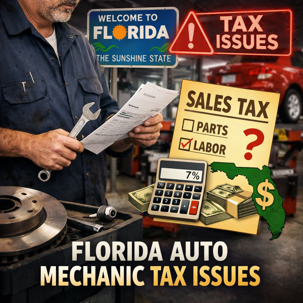
Auto mechanics in Florida are skilled professionals. They can diagnose a misfiring engine, replace a blown head gasket, and rebuild a transmission with a level of expertise that the average person cannot begin to replicate. But when it comes to Florida sales and use tax, even the most technically sophisticated repair shop owner can find themselves completely blindsided — and the Florida Department of Revenue (DOR) is counting on it. The most common issue – only charging tax on materials and not labor….
The Florida Department of Revenue has been targeting auto repair shops and independent mechanics with aggressive sales tax audits for years. These are not gentle inquiries. They are methodical, data-driven examinations of your business records — often going back three full years — with the goal of generating a tax assessment large enough to threaten the future of your business. Many shop owners have received assessments well into the six figures. Some have been forced to close. Others have faced personal liability on top of the business liability.
This article is designed to walk Florida auto mechanics and auto repair shop owners through the most common and most dangerous Florida sales tax traps in the industry. If you are reading this before a DOR auditor has knocked on your door, you are in the best possible position to fix problems before they become catastrophic. If an audit has already started, do not wait — seek experienced Florida sales tax counsel immediately.
The "One Drop of Oil" Rule: Florida's Most Dangerous Tax Trap for Mechanics
No concept causes more damage to Florida auto repair shops than what practitioners commonly call the "one drop of oil" rule. Understanding this rule is not optional — it is essential to every invoice your shop produces.
Under Florida law, when a repair shop performs a service and that service involves the transfer of any tangible personal property to the customer — no matter how small — the entire transaction becomes subject to Florida sales tax. Not just the parts. Not just the materials. The entire charge, including every dollar of labor, is taxable.
The name comes from a straightforward example. Suppose a customer brings in a truck for a diagnostic inspection. The mechanic looks things over, identifies an electrical problem, and charges $300 for labor. No parts were installed, and no materials went onto the vehicle. In that scenario, the transaction is a pure labor service and is not subject to Florida sales tax.
But now suppose the mechanic adds a single drop of oil to the engine during the inspection — perhaps topping off a reservoir as a courtesy. The moment that oil goes into the vehicle and transfers to the customer, the entire $300 transaction — labor and all — becomes taxable under Florida law. One drop of oil just created a sales tax liability on the entire invoice.
This is not a theoretical risk. The Florida Department of Revenue uses this principle aggressively on audit. Auditors will review your invoices and look for any evidence that tangible personal property was transferred to the customer. If your invoices do not clearly and explicitly state that the transaction was labor only and that no tangible personal property was provided to the customer, the DOR will presume taxability and assess accordingly. This is very much a “guilty until you prove yourself innocent” type of law…
The takeaway: every invoice your shop produces must be reviewed through this lens. If any parts, fluids, shop supplies, or materials went onto the customer's vehicle, the full transaction — parts and labor — is taxable. If truly no tangible property transferred, your invoice must explicitly document that fact.
Labor-Only Transactions: Documentation Is Everything
One of the most commonly misunderstood areas in the auto repair industry is the treatment of labor-only transactions. Many mechanics believe that labor is never taxable in Florida. That misconception can cost a shop hundreds of thousands of dollars over a three-year audit period.
Here is the correct rule: labor is exempt from Florida sales tax only when the transaction truly involves no transfer of tangible personal property whatsoever to the customer. This typically arises in two scenarios — when the customer supplies their own parts, or when the repair genuinely consists of nothing more than the mechanic's time and skill (diagnostic work, electrical checks, etc.).
When these situations arise, the shop is not required to charge sales tax on the labor. However, the burden of proof falls entirely on the repair shop. The Florida Department of Revenue will presume that any repair invoice is taxable unless the invoice unequivocally demonstrates otherwise. If an auditor reviews your records and cannot determine from the face of the invoice whether parts were included, the DOR will assess sales tax on the full amount.
Best practice: when a transaction is genuinely labor only, your invoice should contain explicit language — something to the effect of "No tangible personal property was transferred to the customer in connection with this transaction. Labor only." Without that clarity, you are leaving money on the table during a DOR audit, because the auditor will not give you the benefit of the doubt.
Critically, you cannot split a transaction that includes both parts and labor onto separate invoices to reduce the taxable base. Florida law specifically prohibits this technique. If parts and labor are part of the same repair job, they must be treated as a single taxable transaction.
Shop Supplies: A Hidden Audit Landmine
Walk into virtually any auto repair shop and you will find a line item on customer invoices called "shop supplies" or "miscellaneous supplies." This catch-all charge is one of the most contested and most frequently assessed areas in Florida DOR audits against mechanics.
The tax treatment of shop supplies depends entirely on what those supplies actually are. Florida law draws a critical distinction between two categories:
Category 1 — Supplies incorporated into the repair. If the shop supplies charge covers items that actually go onto the customer's vehicle and become part of it — such as lubricants, solvents, thread-locking compounds, or other materials that transfer to the customer — those supplies are taxable to the customer. The good news is that the repair shop can purchase these materials tax-free using a resale certificate, because the tax will be collected when the shop charges the customer.
Category 2 — Supplies consumed by the shop. If the shop supplies charge covers items used by the shop in performing the repair but that do not transfer to the customer — shop rags, paper towels, protective floor mats, cleaning solvents used on the shop floor — those items are not taxable to the customer. However, the shop must pay sales or use tax when purchasing these items, because they are being consumed by the shop rather than resold.
The problem that generates audit assessments is when a shop uses a single "shop supplies" line item on its invoices without distinguishing between these two categories. Auditors will characterize the entire amount as taxable if it cannot be clearly shown what the charge covers. Document your shop supplies charges. Know what goes into that line item and be prepared to explain and defend it to a DOR auditor.
Insurance and Warranty Repairs: A Taxable Trap
Auto repair shops frequently perform repairs that are paid for not by the vehicle's owner but by an insurance company or a third-party extended warranty company. Many shop owners assume these arrangements create a special exemption from Florida sales tax. They do not.
Insurance-paid repairs: When an insurance company pays for a vehicle repair to settle a claim under the owner's liability, collision, or comprehensive coverage, the Florida Department of Revenue's position is that the full repair — parts and labor — is taxable. The insurance company does not receive a resale exemption simply because it is the payor rather than the vehicle owner. Unless the insurance company provides a valid Florida Resale Certificate — which most will not — the repair shop should be collecting sales tax on these transactions.
Extended warranty and service contract repairs: Service warranties and extended service contracts add another layer of complexity. Generally speaking, when a vehicle owner has a service contract and brings a vehicle in for a covered repair, the repair shop can purchase the necessary parts tax-free by providing its resale certificate to the parts supplier, because the sales tax obligation will ultimately flow through the warranty company's sale of the service contract to the consumer. However, the mechanics of this process involve multiple parties, and mistakes in documentation or the resale certificate process can result in the shop being assessed for use tax on those parts. If your shop handles a significant volume of warranty work, the documentation requirements deserve careful attention.
Subcontracted Repairs: Don't Forget the Resale Certificate
Some repair shops subcontract specialized work to other shops — transmission rebuilds, body work, alignment, or other services outside the primary shop's expertise. This common business practice has a straightforward but frequently overlooked sales tax consequence.
When a subcontracted repair shop performs work on a vehicle, it will typically charge sales tax on that work. But if the primary shop is paying the subcontractor and then billing the vehicle owner for the full repair (including the subcontracted portion), the primary shop is effectively purchasing a service for resale. In that case, the primary shop should provide the subcontractor with a valid Florida Annual Resale Certificate (Form DR-13) so that the subcontractor does not charge sales tax on the invoice. The primary shop then collects and remits the tax when it charges the customer.
If the primary shop fails to provide its resale certificate to the subcontractor, it may end up paying sales tax twice — once to the subcontractor and once when it collects from the customer. Worse, if the subcontractor charged tax but the primary shop cannot document that it provided a resale certificate, the DOR may still assess tax on the full amount billed to the customer. Keep your resale certificates current and provide them to subcontractors before the work is performed.
How the Florida DOR Finds Your Shop
Many mechanics believe that if they fly under the radar — a small shop, mostly cash — the Florida Department of Revenue will never find them. That belief is increasingly dangerous. The DOR has expanded the tools it uses to identify businesses for audit, and they are highly effective.
One of the most powerful is the Form 1099-K, which payment processors are required to file when a business processes a certain volume of credit and debit card transactions. The DOR receives these forms and can compare the revenue reported on a business's sales tax returns against the total credit card volume reported on the 1099-K. A large discrepancy — for example, a shop reporting $300,000 in taxable sales while its 1099-K shows $700,000 in card transactions — is an obvious red flag that can trigger an audit.
The DOR also receives information from other government agencies, reviews publicly available business data, and operates tip lines. The notion that a repair shop is too small to be noticed is simply not accurate.
Personal Liability: When the Business Tax Becomes Your Tax
One aspect of Florida sales tax law that catches many repair shop owners completely off guard is the concept of personal liability. Florida law allows the DOR to pursue not just the business entity for unpaid sales tax but also the individuals who were responsible for collecting, trusting, and remitting that tax. This means that in a sales tax audit, the shop owner, a working partner, or even a bookkeeper who had control over tax compliance could potentially be held personally liable for the business's sales tax obligations up to 200% of the tax obligation owed by the business.
This liability does not go away in bankruptcy. Sales tax is simply not dischargeable under bankruptcy law. So, the Florida Department of Revenue actively fights in bankruptcy proceedings and collect from responsible individuals even after a business has closed. If your repair shop is facing a significant DOR assessment, understanding your personal exposure is as important as understanding the business assessment.
What To Do Right Now
If you operate an auto repair shop in Florida and you have not had your sales tax compliance reviewed by an experienced Florida sales tax professional, now is the time to act. A pre-audit review can identify problems you may not know exist and give you the opportunity to address them — either through voluntary disclosure to the DOR (which can significantly reduce penalties and limit the audit lookback period) or through proactive changes to your invoicing and record-keeping practices.
If you have already received a DR-840 Notice of Intent to Audit from the Florida Department of Revenue, do not speak to the auditor without representation. The statements you make during an audit can be used against you, and auditors are trained to develop the largest assessment possible. An experienced Florida sales tax attorney who understands the auto repair industry can make an enormous difference in the outcome. There may even be ways to minimize or eliminate the penalties and interest. We can also help get you into a payment plan with the state.
The good news is that these are winnable situations with the right representation. But only if you act quickly.
 About the Author: James Sutton is a Florida licensed CPA and attorney as well as a shareholder in Moffa, Sutton, & Donnini, PA. Mr. Sutton is charge of the Tampa office of the firm and practices almost exclusively in the area of Florida Sales & Use Tax Controversy. Mr. Sutton handles audits, protest, litigation, criminal cases, revocations, collections, and consulting engagements all in the area of sales tax. Mr. Sutton is an active member in the FICPA and Florida Bar Tax Section. Mr. Sutton is also the State and Local Tax Chairman for the AAA-CPA and past president of the Florida AAA-CPA. For 2022 to 2024, Mr Sutton was the Chairman for the State Tax Committee for the FICPA. Otherwise, you can learn more about Mr. Sutton in his firm bio HERE and you call him directly at 813-775-2131.
About the Firm: At the Law Office of Moffa, Sutton, & Donnini, PA, our primary practice area is Florida taxes, with a very heavy emphasis in Florida sales and use tax. We have defended Florida businesses against the Florida Department of Revenue since 1991 and have over 100 years of cumulative sales tax experience within our firm. Our partners are both CPAs/Accountants and Attorneys, so we understand both the accounting side of the situation as well as the legal side. We even have former sales tax auditors on staff. We represent taxpayers and business owners from the entire state of Florida. Contact us for a FREE INITIAL CONSULTATION to confidentially discuss how we can help put this nightmare behind you.
ADDITIONAL RESOURCES
FLORIDA SALES TAX AUDITS PROCESS AND TRAPS, published March 4, 2023, by David Brennan, Esq.
FL SALES TAX PLAYBOOK: CAR REPAIR SHOPS, published August 2, 2024, by David Brennan, Esq.
FLORIDA SALES TAX AUDIT: CONSTRUCTION CONTRACTORS, published November 8, 2025, by James Sutton, CPA, Esq.
FLORIDA SALES TAX INFORMAL WRITTEN PROTEST, published November 17, 2018, by James Sutton, CPA, Esq.
FLORIDA SALES TAX PROTEST LAWYER, published January 14, 2026, by James Sutton, CPA, Esq.
FL Sales tax audit – From Audit Notice (DR-840) to NOPA, published September 17, 2023, by Matthew Parker, Esq.
DON’T HIRE AN IRS ATTORNEY FOR SALES TAX PROBLEMS!, published July 17, 2024, by James Sutton, CPA, Esq.
FL SALES TAX AUDITS – AUDITING YOURSELF BEFORE A STATE DOES, published October 23, 2023, by Matthew Parker, Esq.
FL TAX ALERT – 200% PENALTY STINGS BUSINESS OWNER, published March 24, 2013, by James Sutton, CPA, Esq, and Gerald Donnini, Esq.
©Copyright 2026 to James H Sutton Jr. All rights reserved.