
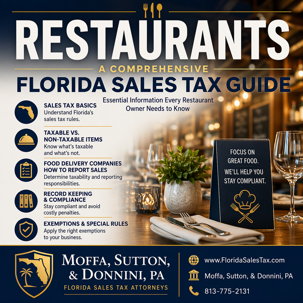
Running a restaurant in Florida is one of the most demanding businesses a person can choose. The margins are razor thin, the labor challenges never seem to end, and the cost of food and supplies can shift without warning. Restaurant owners are already managing more challenges than most business owners ever face — and then the Florida Department of Revenue adds another one. This article is designed as the official comprehensive guide for Florida sales tax for the restaurant industry.
Florida sales and use tax for restaurants is one of the most complicated areas of Florida tax law. The rules are layered, the exemptions are narrow, the traps are numerous, and the Florida Department of Revenue (DOR) knows this industry well. Auditors who specialize in restaurants understand the business model, know how to read point-of-sale reports, and know exactly where to look for underpaid taxes. The assessments that come out of restaurant audits can be staggering — easily reaching six figures over a three-year audit period — and in some cases they have put otherwise viable restaurants permanently out of business.
This article is a practical guide to the Florida sales and use tax issues that most commonly arise in restaurant audits. Some of these may surprise you. Others may confirm issues you already suspect. Either way, understanding these problems before a DOR auditor walks through your door is the difference between a manageable situation and a catastrophic one.
The General Rule: Almost Everything Is Taxable
Many business owners are surprised to learn that the grocery food exemption they enjoy every day at the grocery stores does not apply to restaurants. It is true that food products not for immediate human consumption are generally exempt from Florida sales tax — but that exemption is designed for grocery stores, supermarkets, and similar retailers selling uncooked, unprepared food products for home consumption.
The moment food is prepared and sold for immediate consumption — which is exactly what every restaurant does, every single day — the exemption disappears. It does not matter whether the customer eats inside the restaurant or takes the food to go. It does not matter whether the meal is a $7 lunch special or a $75 tasting menu. Prepared food sold by a restaurant is taxable in Florida, period.
This is the starting point that every restaurant owner must internalize: assume everything you sell is taxable unless you can identify a specific, documented exemption. The exceptions exist, but they are narrow, and if you rely on assumptions rather than documentation, then that will be how restaurants end up writing large checks to the Florida Department of Revenue.
The Gratuity Trap: Mandatory vs. Optional Tips
One of the most frequently mishandled areas in restaurant sales tax compliance is the treatment of gratuities. Many restaurant owners — and even some accountants — get this wrong, and the DOR has become quite skilled at spotting it on audit.
The rule is simpler than it appears once you understand the logic: an optional gratuity is not subject to Florida sales tax, but a mandatory gratuity is.
When a customer voluntarily chooses to leave a tip — whether in cash, on a credit card, or by writing an amount on a receipt — that gratuity is not a charge mandated by the restaurant. It is the customer's own decision. Because it is not part of the "sales price" charged by the dealer, it is not subject to sales tax.
But when a restaurant automatically adds a service charge to the bill — a common practice for large parties, private events, or certain business models — that mandatory charge becomes part of the total sales price and is fully subject to Florida sales tax. The DOR does not care that the money ultimately goes to servers. What matters is that the restaurant imposed the charge. If the restaurant controls it, it is taxable. However, as any restaurant owner knows, mandatory large party tips are something unhappy customers can request be waived. If the restaurant owner can show at least one large party group whether the mandatory tip was waived, then we have a good argument that all large party tips are optional.
There are additional nuances. If a mandatory gratuity is collected and any portion of it is retained by the restaurant — even to cover credit card processing fees — the analysis becomes more complicated. And if the restaurant reports gratuities as gross income on its federal income tax return, a DOR auditor will compare that federal figure against the sales tax returns and assess tax on the difference unless the restaurant can prove those amounts are non-taxable tips. Keeping meticulous, separately-documented records of voluntary tips is essential.
Other charges that operate similarly to mandatory gratuities — and are therefore taxable — include service charges, minimum charges, corkage fees, setup fees, and cover charges. If a customer must pay it to do business with you, it is part of the taxable sales price.
The Complimentary Item Trap: Use Tax on Free Food
Almost every restaurant gives something away for free. Free chips and salsa while customers wait. A complimentary birthday dessert. A promotional appetizer. Bread service. These practices seem completely tax-neutral — after all, no money is changing hands — but Florida's use tax rules create a significant and widely overlooked exposure.
Here is the issue. When a restaurant purchases food inventory, it typically does so using a resale certificate, buying those items tax-free because they will eventually be resold to customers. When a restaurant then takes an item out of that inventory and gives it away for free — rather than selling it — the item is no longer being "resold." The restaurant used it for a purpose other than resale. Under Florida law, that triggers a use tax obligation on the restaurant based on the cost of the item.
The practical result is that every time a restaurant pulls inventory for giveaways, the restaurant owes use tax on what those items cost.
There is, however, an important distinction. If a "free" item is included as part of a meal purchase — for example, free chips and salsa are advertised on the menu as coming with every entrée order — Florida treats that item as sold with the meal, not as a separate giveaway. No use tax is due in that situation because the item is considered part of the taxable sale. The key is that the free item must be genuinely bundled with and contingent upon a purchase. A standalone giveaway, however, triggers use tax regardless of the customer experience rationale behind it.
Restaurant owners who have been giving away items without tracking the use tax implications should conduct an honest internal review. Undisclosed use tax exposure can accumulate significantly over a three-year audit period.
A highly common example of use tax being due on free food is employee meals. If the employee has to pay anything, even a penny, for the meal, then use tax is not due. But a completely free meal to the employee triggers use tax on the restaurant’s cost of the times given away, not the retail price. This can be a real challenge for restaurant owners to calculate the cost of a free meal.
Tax-Exempt Customers: The Certificate Trap
Restaurants that cater to churches, schools, nonprofits, or government agencies sometimes receive requests to waive sales tax on purchases. This is entirely legitimate — but only if done exactly right.
Florida law requires restaurants to collect sales tax on all sales unless the customer presents a current, valid Florida Department of Revenue-issued exemption certificate. A customer's word that they are a nonprofit is not sufficient. A church bulletin is not sufficient. A school ID is not sufficient. A university purchase order does not automatically qualify. The restaurant must have the actual DOR-issued Consumer's Certificate of Exemption (Form DR-14) in hand at the time of the sale, and that certificate must be current for the year in question.
Additionally, the form of payment matters. The payment must come directly from the tax-exempt organization — not from an employee's personal credit card or cash from an individual's wallet who claims to be purchasing on behalf of the organization. If a church deacon pays out of pocket and is later reimbursed by the church, that is not a qualifying exempt purchase from the restaurant's perspective. The restaurant should have collected tax.
Finally, the restaurant must retain the exemption certificate AND proof that payment came from the tax exempt organization for at least three years and be able to produce it on audit. If the DOR asks for documentation supporting an exempt sale and the certificate cannot be produced, the restaurant will owe the tax, the penalty, and the interest — even if the customer was genuinely a tax-exempt entity.
The one exception: sales directly to the U.S. federal government do not require a certificate. However, the restaurant must document that the purchaser is a branch of the federal government, and again, payment should reflect the government agency as the purchaser.
Catering and Delivery: More Taxable Than You Think
Many restaurants expand into catering and delivery services, and the sales tax treatment of these transactions trips up a surprising number of owners.
For catering, the safest approach is to treat every element of a catered event as taxable — the food, the beverages, the delivery fee, the setup charge, the equipment rental, and the staffing charge — unless a specific exemption applies. Bottled water sold in its sealed original container is the most common exempt item in a catering context. Everything else is almost certainly taxable.
For delivery, the analysis turns on who is doing the delivering and whether the delivery fee is optional. When a restaurant uses its own employees to deliver food, and the customer could have picked up the order without paying the delivery fee (i.e., the fee is optional), the delivery fee is not taxable. But if the restaurant delivers exclusively — meaning delivery is not optional — the delivery charge is taxable if the customer cannot avoid it.
When a third-party delivery service (such as DoorDash, Uber Eats, or Grubhub) is involved, the analysis shifts again depending on how the transaction is structured. If the third-party service purchases the food from the restaurant and resells it to the customer, the restaurant needs only to collect a resale certificate from the delivery company to avoid collecting sales tax — the delivery company handles the tax obligations to the end customer. If, however, the restaurant is the seller and the third-party platform is acting merely as an agent, the restaurant remains responsible for collecting and remitting tax on the full price paid by the customer. The contracts and operational facts matter greatly here, and many restaurants have not thought carefully about which model they operate under. This seems simple enough, but it’s really not that simple and it depends on what period of time we are talking about. In a three year audit starting today, a restaurant owner will likely face two different answers depending on when the delivery occurred.
At this point, mid-2026, most major food delivery companies have started collecting and remitted sales tax themselves in Florida, but it was not always that way. UberEats started October 2023. DoorDash started May 1, 2024. GrubHub also started sometime in 2024. Prior to those dates, the delivery companies were collecting Florida sales tax, but giving the sales tax back to the restaurant. Unfortunately, most restaurant owners I’ve talked too had no idea that they were getting the sales tax on their food delivery company sales and were excluding those sales from their sales tax returns. The problem is, this is a collected but not remitted tax issue, which can turn criminal. We’ve represented a couple hundred restaurants that ran into this problem and it is never pretty. During the audit and even on administrative protest, the DOR will not budge on this issue. Sometimes on litigation, the DOR will settle for something less than the total tax due. If you have an restaurant under sales tax audit in Florida and you used delivery companies, then this is probably your biggest exposure issue.
Alcohol: A High-Visibility Audit Area
Alcohol sales represent one of the highest-margin revenue sources in a restaurant, and the DOR knows it. Alcohol is generally subject to Florida sales tax, and the DOR will scrutinize alcohol revenue closely during an audit.
One common practice — building the sales tax into the listed price of a drink — is permissible, but only if done correctly. A restaurant or bar that wants to include tax in its stated drink prices must post conspicuous public notice that tax is included in the price. Without that posted notice, the DOR will treat the stated price as the pre-tax price and assess tax on top of it — a significant problem for a bar that has been selling drinks at the same advertised price for years without proper disclosure. This means that the restaurant will be paying sales tax on the portion of the sales price the restaurant considered to be sales tax from the customer. The amount is not large per transaction, but it can add up over a 3 year audit.
Bars and restaurants that rely heavily on cash alcohol sales should be aware that the DOR uses credit card data and other third-party information to estimate total alcohol revenue. If cash sales appear low relative to card sales or industry benchmarks, auditors may project total alcohol revenue using statistical methods and assess tax on amounts the restaurant never reported.
How the DOR Finds Restaurants to Audit
Restaurant owners sometimes assume they are too small or too local to attract DOR attention. That assumption is wrong, and it is becoming more wrong every year as the DOR's data-matching capabilities expand.
The DOR receives 1099-K data from credit card processors and payment platforms, which allows it to compare the gross sales a restaurant reports on its sales tax returns against the credit and debit card volume actually processed through its terminals. Even more alarming, the 1099-K provides sales by month that can easily be compared to a restaurant owner’s sales tax returns. A significant gap between those two numbers is a red flag that virtually guarantees audit scrutiny. Restaurants that handle a significant cash volume need to understand that the DOR uses banking deposits, credit card data, and federal income tax returns to reconstruct total sales — and inconsistencies will be pursued.
Competitor tips, licensing data from the Division of Hotels and Restaurants, and referrals from other agencies also feed the DOR's audit selection process. Staying off the DOR's radar requires consistent, accurate reporting — not just low visibility.
Personal Liability and Criminal Exposure
Unlike many business obligations, Florida sales tax liabilities can follow a restaurant owner personally, past the life of the business and even through bankruptcy. The Florida Department of Revenue has the authority to pursue owners, officers, and anyone who had responsibility for collecting and remitting sales tax when those taxes are not paid over to the state.
In the most serious cases — where the DOR concludes that sales tax was collected from customers but deliberately not remitted to the state — the exposure becomes criminal. Florida treats the willful failure to remit collected sales tax as a form of theft, and prosecutions of restaurant owners for sales tax fraud do occur. The DOR refers cases to the Florida Department of Law Enforcement when the evidence supports it. It only takes $301 to become a 3rd degree felony with up to 5 years in jail. Collect and not remit over $20,000 and you are looking at up to 15 years in jail.
What To Do Now
If you own or operate a restaurant in Florida and have any doubt about your sales tax compliance, a voluntary review now is far less expensive than a DOR audit later. Areas to examine immediately include your gratuity practices, your complimentary item policies, your handling of exempt customer sales, and your documentation for all delivery and catering transactions.
If you have already received a Form DR-840 Notice of Intent to Audit from the Florida Department of Revenue, stop — do not meet with the auditor alone. Contact an experienced Florida sales tax attorney before making any disclosures or producing any records. The way an audit begins often determines how it ends, and the decisions made in the first days of an audit can have consequences that are difficult or impossible to reverse.
The good news is that with the right guidance and representation, restaurant sales tax audits can be managed and often successfully resolved. But only if you act while you still have the right to challenge the assessment.
 About the Author: James Sutton is a Florida licensed CPA and attorney as well as a shareholder in Moffa, Sutton, & Donnini, PA. Mr. Sutton is charge of the Tampa office of the firm and practices almost exclusively in the area of Florida Sales & Use Tax Controversy. Mr. Sutton handles audits, protest, litigation, criminal cases, revocations, collections, and consulting engagements all in the area of sales tax. Mr. Sutton is an active member in the FICPA and Florida Bar Tax Section. Mr. Sutton was also the State and Local Tax Chairman for the AAA-CPA and past president of the Florida AAA-CPA. For 2022 to 2024, Mr Sutton was the Chairman for the State Tax Committee for the FICPA. Otherwise, you can learn more about Mr. Sutton in his firm bio HERE and you call him directly at 813-775-2131.
About the Firm: At the Law Office of Moffa, Sutton, & Donnini, PA, our primary practice area is Florida taxes, with a very heavy emphasis in Florida sales and use tax. We have defended Florida businesses against the Florida Department of Revenue since 1991 and have over 150 years of cumulative sales tax experience within our firm. Our partners are both CPAs/Accountants and Attorneys, so we understand both the accounting side of the situation as well as the legal side. We even have former sales tax auditors on staff. We represent taxpayers and business owners from the entire state of Florida. Contact us for a FREE INITIAL CONSULTATION to confidentially discuss how we can help put this nightmare behind you.
ADDITIONAL RESOURCES
FL SALES TAX: PRE-PREPARED MEALS & CATERING, published April 2, 2026, by Michele Larrinaga, Esq.
FLORIDA SALES TAX ARREST – PALM BEACH PIZZERIA OWNER, published March 4, 2026, by James Sutton, CPA, Esq.
FLORIDA – RESTUARANTS SALES AND USE TAX AUDITS, published November 6, 2020, by James Sutton, CPA, Esq.
FLORIDA SALES TAX RESTAURANT HANDBOOK, published January 4, 2018, by James Sutton, CPA, Esq and David Brennan, Esq.
© 2026 James H Sutton, Jr. All Rights Reserved