
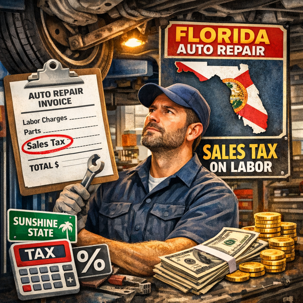
If you own an auto repair shop in Florida — or you are the CPA advising one — you may have encountered the question before: Do we really have to charge sales tax on labor? The short answer is: almost always, yes. And if you have not been doing it correctly, the consequences can be far more serious than simply paying a bit of catch-up tax. The Florida Department of Revenue (FL DOR) has made the automotive repair industry one of its most frequently audited sectors, and the agency is not known for its mercy when it discovers years of underreported sales tax.
This article is the official comprehensive guide for Auto Mechanics to understand Flordia sales tax. I will walk you through exactly what Florida law requires of auto repair shops regarding sales tax, what happens when a shop gets it wrong — intentionally or not — and what both business owners and their CPAs should be doing right now to protect the business.
THE BASIC RULE: PARTS AND LABOR ARE BOTH TAXABLE
Let's start with the law, because many shop owners are still operating under a fundamental misconception. Under Florida Statute Section 212.05 and Rule 12A-1.006, Florida Administrative Code, when a repair shop performs repairs on tangible personal property (including motor vehicles, RVs, Boats, etc), the entire charge to the customer — both parts and labor — is subject to Florida sales tax, provided any tangible personal property is transferred to the customer as part of the transaction. By any…. We really do mean anything. Even one drop of oil is enough to make the entire transaction taxable.
Many shop owners believe they only need to collect sales tax on parts and that labor is a separate, non-taxable service. That belief is wrong, and it is costing auto repair shops tens of thousands — sometimes hundreds of thousands — of dollars when the FL DOR comes knocking. What is really heart breaking is that you could have simply been charging the tax to your customers. But when you don’t charge tax, you end up eating the tax when the Florida Department of Revenue audits you – plus 25% to 50% penalties and interest.
Here is how the FL DOR frames the issue: if your technician installs a new alternator for $150 in parts and $150 in labor, the total $300 charge is subject to sales tax. The reason is simple — because tangible personal property (the alternator) was transferred to the customer, the entire transaction is treated as the sale of tangible personal property, not merely a service. Labor charges associated with the sale of tangible personal property are taxable too.
This is not a technicality. It is the explicit statutory scheme, and the FL DOR enforces it aggressively. Here is why – there is no fair market value requirement to set you prices under Florida sales tax law. If you only had to charge sales tax on parts, then on a $5,000 job, you could charge $1 for parts and $4,999 on labor to avoid most of the tax. The sales tax would almost completely be avoided every time and the customer would still have a $5,000 installed part. By the law forcing sales tax to be paid on price for the full installed part (labor too), the tax is always fairly applied without the ability to manipulate the taxed amount.
Oh… and putting parts on one invoice and labor on another invoice will not work!
THE "ONE DROP OF OIL" RULE
The situation gets even more unforgiving when you understand what the FL DOR calls the "one drop of oil" rule. If a customer brings in their vehicle and supplies all of the parts themselves, and your technician performs $50,000 in skilled labor — but in the course of that work, adds even a single drop of oil — the entire $50,000 in labor is now subject to sales tax.
The theory is straightforward: if any tangible personal property whatsoever was transferred to the customer during the repair, the transaction is classified as the sale of tangible personal property, and the labor loses its otherwise-non-taxable character. There is no de minimis threshold. One quart of oil, one can of brake cleaner, one washer — any of these can transform a labor-only job into a fully taxable transaction.
This rule catches shop owners by surprise more often than virtually any other sales tax issue. The shop may have a policy of not charging tax on "pure labor" jobs, but if the technician routinely uses shop supplies that become part of the vehicle (even incidentally), the FL DOR will take the position that every job is taxable. Unfortunately, there seems to be a bad rumor going around in the automative repair industry that labor is never taxable. Well – the FL Department of Revenue has gotten wind of this misconception and has been targeting the entire industry for sales tax audits.
For CPAs reviewing a client's books, this is a critical point to investigate. Look at the shop's invoices carefully. Are shop supplies being charged to customers? Are those charges broken out separately? How is the shop determining which jobs are "labor only"? The answers to these questions will determine how exposed your client is. Even if you are not handling their sales tax, your clients will expect you to give them advice about all their taxes.
SHOP SUPPLIES: A GRAY AREA THAT OFTEN BECOMES A BLACK MARK
Shop supplies deserve special attention because they are one of the most common and costly audit triggers in the auto repair industry. Many shops include a line item on their invoices for "shop supplies" — a catch-all charge covering miscellaneous items used during the repair. The problem is that this category can include both:
- Items incorporated into the vehicle (such as lubricants, fluids, adhesives, or fasteners), which are taxable when passed to the customer; and
- Items consumed by the shop in performing the repair (such as shop towels, solvent used for cleaning the technician's tools, or protective floor coverings), which are generally not taxable when charged to the customer — but on which the shop should have paid sales tax at the time of purchase.
If a shop charges customers a flat shop supplies fee without distinguishing between these two categories, the FL DOR will almost certainly treat the entire amount as taxable. Worse, if the shop is purchasing those consumed supplies tax-free using a resale certificate and then not charging the customer tax on them, the shop has created an additional use tax liability.
For both shop owners and CPAs, the takeaway is this: shop supply charges need to be carefully documented and categorized. A blanket "shop supplies" line item is an audit red flag, and it can result in taxes being assessed on amounts the shop never intended to collect in the first place.
HOW THE FL DOR FINDS SHOPS THAT AREN'T CHARGING TAX CORRECTLY
You might wonder how the FL DOR identifies which shops to target. The answer, increasingly, is through data matching — and the agency has become quite good at it.
One of the primary methods is comparing a business's IRS Form 1099-K (which reports credit and debit card transaction totals from payment processors) against the shop's Florida sales tax returns. Worse yet – the DOR has software that can do this for the whole auto repair industry at one time, creating a state wide hit list of auto repair companies with perceived problems. If there is a significant gap between total receipts reported to the IRS and the taxable sales reported to the FL DOR, the agency's computer systems flag the business for potential audit. For a shop that has been routinely treating labor as non-taxable, this discrepancy can stand out like dramatic fireworks over your repair shop saying “audit me.”
The FL DOR also receives referrals, tips, and information from other state agencies, former employees, and competitors. Industry-wide audits are common when the department identifies a pattern of non-compliance in a particular sector. The automotive repair industry has been one of those sectors in recent years, and shops across Florida have received Form DR-840 (Notice of Intent to Audit Books and Records) seemingly out of nowhere.
For a CPA whose client operates a repair shop, it is worth reviewing the client's 1099-K alongside their sales tax returns annually. If the numbers do not reconcile — and there is not a clear, documented reason for the difference — the client is at risk. I know because we’ve represented more than 200 auto repair shops just in the last couple of years.
WHAT HAPPENS WHEN AN AUDIT OCCURS?
When the FL DOR selects an auto repair shop for audit, the auditor's job is straightforward: reconstruct taxable sales for the audit period (typically the last three years, though it can go back as far as seven years if fraud is alleged) and determine the gap between taxable revenue reported and remitted versus what should have been taxable. And, to the horror of most business owners, the presumption starts with “every dollar of revenue is taxable” unless you can prove it’s not.
In practice, the FL DOR auditor will often:
- Look at total revenue reported by the 1099-k, the federal tax returns, bank deposits, and/or your accounting software.
- Then they take the highest revenue amount and presume every penny is taxable.
- Calculate the difference in gross revenue to what you have as revenue subject to sales tax on your monthly returns and calculate sales tax on the difference.
- Apply interest from the date the tax was originally due (currently accruing at 11% per year)
- Add a minimum 10% penalty for failure to pay the correct amount of tax, which can increase to 25% or even higher in cases involving fraud or gross negligence
- Then – tell you to prove them wrong. The burden falls 100% on you to prove some of your revenue was not taxable. And…. invoices that show parts and untaxable labor are of no help.
Florida sales tax audits always cover a period of three years. For a shop that has been in business for three years and consistently not charging tax on labor, the resulting assessment can easily reach six figures. Add in 11% to 12% interest that has been accruing for years, and the number grows further.
What makes this particularly painful is that the business owner typically cannot go back and collect that sales tax from customers after the fact. The tax becomes a liability that the business must absorb out of its own pocket — often from cash that was never set aside for this purpose.
THE RESPONSIBLE PARTY PROBLEM
Here is something that surprises many business owners and their CPAs alike: the liability for unpaid Florida sales tax does not necessarily stop at the business entity level.
Under Florida law, the FL DOR has the authority to pursue what it calls "responsible party" assessments. If the business itself is unable to pay the audit assessment — whether because it has closed, gone bankrupt, or simply lacks sufficient assets — the FL DOR can turn its attention to the individuals who were responsible for collecting and remitting the tax on behalf of the business. This can include owners, officers, partners, managers, and in some cases, CPAs or bookkeepers who had control over the business's finances.
The threshold for responsible party liability is not limited to intentional wrongdoing. The FL DOR takes the position that anyone who had the authority to ensure taxes were paid and failed to do so can be held personally liable for up to 200% if the tax due for the business. For a business owner who thought the shop's accountant was handling the sales tax, and for an accountant who assumed the shop's invoicing system was set up correctly, this can come as a devastating surprise. Bankruptcy is no relief because sales tax is specifically excluded under federal bankruptcy law.
For CPAs advising repair shops, this creates both a professional responsibility and a personal exposure concern. If you are preparing your client's books or sales tax returns without verifying that the underlying invoicing and collection practices are correct, you could find yourself in a difficult position when an audit reveals years of non-compliance.
WHAT ABOUT SUBCONTRACTED REPAIRS?
Some auto repair shops subcontract portions of their work — sending vehicles to a specialty transmission shop, for example, or using an independent mechanic for overflow work. These arrangements create additional sales tax complexity. The general rule is that the primary shop is supposed to give the subcontract a resale certificate for the work, then charge sales tax on the whole cost to the ultimate customer. From a sales tax perspective, subcontracted work is taxed exactly the same to the ultimate customer as work done by your own employees.
If your shop is the one doing the subcontractor work, a current years Florida resale certificate is the only thing that protects your shop from owing sales tax when you get audited. Having the correct exemption documentation is key. In practice, many small repair shops handle these subcontracting arrangements informally, without written agreements or proper tax documentation. An audit that exposes this type of arrangement can result in tax being assessed twice — once at the subcontractor level and once at the primary shop level — unless the shop can clearly document that taxes were properly paid somewhere in the chain.
WHAT CAN BE TAX EXEMPT?
If you are still reading this article, then the biggest question you are probably asking is what actually is exempt from Florida sales tax for my auto repair business and how do I prove it when I get audited. Exempt sales for an auto mechanic fall into two categories. One – based on what you are doing for a customer. Two – the customer has it’s own exemption.
One – labor only transactions and warranty repairs are the only two types of transactions that are not taxable in your industry. If, for example, you are only doing diagnostic work and add no tangible personal property to the vehicle, then an invoice that properly documents that the transaction is labor only with no parts is what is required to defend yourself on audit. Anything short of this and you’ll be paying tax on a non-taxable transaction. For warranty repairs, sales tax was imposed when the warranty was sold and, therefore, no tax is due when the repair is actually done. But, as with anything sales tax, your invoicing must document that it was a warranty repair to survive an audit.
Two – repairing a car that is someone else’s inventory held for sale, such as a car dealer or rental car company, it tax exempt as long as you get the customer’s current year resale certificate. The customer may be in agriculture and have an agricultural exempt certificate. If the customer is a federally tax exempt 501(c)(3), such as a church, then the repair can be tax free if you get BOTH a current year FL exemption certificate AND keep proof the payment came directly from the tax exempt entity (not the employee’s credit card).
WHAT SHOULD A SHOP OWNER OR CPA DO NOW?
If you have read this far and you are not entirely confident that your shop — or your client's shop — is handling sales tax correctly, the good news is that there are options short of waiting for an audit notice to arrive.
Conduct an internal review. Pull a sample of recent invoices and verify that sales tax is being charged on the full amount — parts and labor — for jobs where any tangible personal property was transferred to the customer. Identify categories of invoices where labor was billed without tax, and determine whether those jobs truly qualify as pure labor services or whether tax should have been charged.
Review shop supply practices. Are shop supply charges on invoices taxable or non-taxable? Is the shop paying tax when it purchases consumed supplies? The answers need to be documented and consistent. Warning – auditors often will presume shop supplies are taxable, which is not always the case.
Consider a voluntary disclosure. Florida's Voluntary Disclosure Program allows businesses that have unreported or underreported sales tax to come forward proactively and resolve the liability, often with a reduced look-back period and the possibility of having penalties waived. This is not an option available once an audit has already begun, but for a shop owner who knows the numbers are not right and wants to get right with the state before the DOR comes calling, it can be a significantly less painful path than a full audit.
Seek professional help before an audit starts. If there is any reason to believe a shop is non-compliant — perhaps a former employee has already made a complaint, or the owner has received a DR-840 — do not attempt to handle it alone. An experienced Florida sales tax attorney can often limit the scope and damage of an audit far more effectively when involved from the outset than when brought in after the auditor has already completed their work.
THE BOTTOM LINE
Florida auto repair shops operate in one of the most heavily scrutinized industries from a sales tax compliance standpoint. The rules are not ambiguous — labor charges are taxable when tangible personal property is part of the transaction, and the FL DOR will find the shops that are not complying. The resulting assessments, interest, and penalties can threaten the financial viability of even a well-run business.
Whether you are a shop owner who has been charging tax on parts only, or a CPA who has been preparing your client's returns without digging into the underlying invoicing practices, now is the time to take a hard look and make corrections before the Florida Department of Revenue does it for you.
 About the Author: James Sutton is a Florida licensed CPA and attorney as well as a shareholder in Moffa, Sutton, & Donnini, PA. Mr. Sutton is in charge of the Tampa office of the firm and practices almost exclusively in the area of Florida Sales & Use Tax Controversy. Mr. Sutton handles audits, protests, litigation, criminal cases, revocations, collections, and consulting engagements all in the area of sales tax. Mr. Sutton is an active member in the FICPA and Florida Bar Tax Section. Mr. Sutton is also the State and Local Tax Chairman for the AAA-CPA and past president of the Florida AAA-CPA. For 2022 to 2024, Mr. Sutton was the Chairman for the State Tax Committee for the FICPA. You can learn more about Mr. Sutton in his firm bio and reach him directly at 813-775-2131.
About the Firm: At the Law Office of Moffa, Sutton, & Donnini, PA, our primary practice area is Florida taxes, with a very heavy emphasis in Florida sales and use tax. We have defended Florida businesses against the Florida Department of Revenue since 1991 and have over 100 years of cumulative sales tax experience within our firm. Our partners are both CPAs/Accountants and Attorneys, so we understand both the accounting side of the situation as well as the legal side. We even have former sales tax auditors on staff. We represent taxpayers and business owners from the entire state of Florida. Contact us for a FREE INITIAL CONSULTATION to confidentially discuss how we can help put this nightmare behind you.
ADDITIONAL RESOURCES
The following articles from FloridaSalesTax.com provide additional guidance on Florida sales tax issues for auto repair shops, dealers, and related businesses:
- FL SALES TAX PLAYBOOK: CAR REPAIR SHOPS — Published August 2024, by David J. Brennan, Jr., Esq. A comprehensive industry guide covering the most common audit areas for car repair shops, including how the FL DOR targets the industry and what invoicing practices create the most risk.
- FL SALES TAX - AUTO MECHANICS: WHAT YOU DON'T KNOW WILL HURT YOU — Published April 21, 2026, by James H Sutton, Jr, CPA, Esq. - A recent article examining the most frequently misunderstood sales tax obligations facing independent auto mechanics in Florida.
- FLORIDA SALES TAX AUDIT - AUTO REPAIR SHOPS — Published January 27, 2022, by David J. Brennan, Jr., Esq. An in-depth look at how the FL DOR selects auto repair shops for audit, including the use of IRS Form 1099-K data matching, and the most common areas of assessment.
- FL SALES TAX CAR DEALERS PLAYBOOK — Published April 22, 2023, by David J. Brennan, Jr., Esq. While focused on car dealers, this article covers service department sales tax obligations, service warranties, and parts taxation that applies equally to independent repair shops.
- FLORIDA SALES TAX - IS LABOR TAXABLE? — Published October 2025. Explains the governing rule on labor taxability in Florida, including the "one drop of oil" rule and practical examples relevant to the auto repair industry.
- FLORIDA SALES AND USE TAX FOR TAXABLE SERVICES — Published December 1, 2023. Covers the full landscape of taxable services in Florida, with specific guidance on repair services and why the auto repair industry consistently underestimates its tax exposure.
- FLORIDA SALES TAX INFORMAL WRITTEN PROTEST — Published November 17, 2018, by James Sutton, C.P.A., Esq. Once an audit assessment has been issued, this article explains the protest process and how businesses can challenge an assessment they believe is incorrect.
- ARE SERVICES TAXABLE IN FLORIDA? — Published September 2020. Provides a foundational overview of which services are and are not taxable under Florida law, with discussion of repair services and the tangible personal property transfer rule.
If you own an auto repair shop in Florida — or you are the CPA advising one — you may have encountered the question before: Do we really have to charge sales tax on labor? The short answer is: almost always, yes. And if you have not been doing it correctly, the consequences can be far more serious than simply paying a bit of catch-up tax. The Florida Department of Revenue (FL DOR) has made the automotive repair industry one of its most frequently audited sectors, and the agency is not known for its mercy when it discovers years of underreported sales tax.
This article will walk you through exactly what Florida law requires of auto repair shops regarding sales tax, what happens when a shop gets it wrong — intentionally or not — and what both business owners and their CPAs should be doing right now to protect the business.
THE BASIC RULE: PARTS AND LABOR ARE BOTH TAXABLE
Let's start with the law, because many shop owners are still operating under a fundamental misconception. Under Florida Statute Section 212.05 and Rule 12A-1.006, Florida Administrative Code, when a repair shop performs repairs on tangible personal property (including motor vehicles, RVs, Boats, etc), the entire charge to the customer — both parts and labor — is subject to Florida sales tax, provided any tangible personal property is transferred to the customer as part of the transaction. By any…. We really do mean anything. Even one drop of oil is enough to make the entire transaction taxable.
Many shop owners believe they only need to collect sales tax on parts and that labor is a separate, non-taxable service. That belief is wrong, and it is costing auto repair shops tens of thousands — sometimes hundreds of thousands — of dollars when the FL DOR comes knocking. What is really heart breaking is that you could have simply been charging the tax to your customers. But when you don’t charge tax, you end up eating the tax when the Florida Department of Revenue audits you – plus 25% to 50% penalties and interest.
Here is how the FL DOR frames the issue: if your technician installs a new alternator for $150 in parts and $150 in labor, the total $300 charge is subject to sales tax. The reason is simple — because tangible personal property (the alternator) was transferred to the customer, the entire transaction is treated as the sale of tangible personal property, not merely a service. Labor charges associated with the sale of tangible personal property are taxable too.
This is not a technicality. It is the explicit statutory scheme, and the FL DOR enforces it aggressively. Here is why – there is no fair market value requirement to set you prices under Florida sales tax law. If you only had to charge sales tax on parts, then on a $5,000 job, you could charge $1 for parts and $4,999 on labor to avoid most of the tax. The sales tax would almost completely be avoided every time and the customer would still have a $5,000 installed part. By the law forcing sales tax to be paid on price for the full installed part (labor too), the tax is always fairly applied without the ability to manipulate the taxed amount.
Oh… and putting parts on one invoice and labor on another invoice will not work!
THE "ONE DROP OF OIL" RULE
The situation gets even more unforgiving when you understand what the FL DOR calls the "one drop of oil" rule. If a customer brings in their vehicle and supplies all of the parts themselves, and your technician performs $50,000 in skilled labor — but in the course of that work, adds even a single drop of oil — the entire $50,000 in labor is now subject to sales tax.
The theory is straightforward: if any tangible personal property whatsoever was transferred to the customer during the repair, the transaction is classified as the sale of tangible personal property, and the labor loses its otherwise-non-taxable character. There is no de minimis threshold. One quart of oil, one can of brake cleaner, one washer — any of these can transform a labor-only job into a fully taxable transaction.
This rule catches shop owners by surprise more often than virtually any other sales tax issue. The shop may have a policy of not charging tax on "pure labor" jobs, but if the technician routinely uses shop supplies that become part of the vehicle (even incidentally), the FL DOR will take the position that every job is taxable. Unfortunately, there seems to be a bad rumor going around in the automative repair industry that labor is never taxable. Well – the FL Department of Revenue has gotten wind of this misconception and has been targeting the entire industry for sales tax audits.
For CPAs reviewing a client's books, this is a critical point to investigate. Look at the shop's invoices carefully. Are shop supplies being charged to customers? Are those charges broken out separately? How is the shop determining which jobs are "labor only"? The answers to these questions will determine how exposed your client is. Even if you are not handling their sales tax, your clients will expect you to give them advice about all their taxes.
SHOP SUPPLIES: A GRAY AREA THAT OFTEN BECOMES A BLACK MARK
Shop supplies deserve special attention because they are one of the most common and costly audit triggers in the auto repair industry. Many shops include a line item on their invoices for "shop supplies" — a catch-all charge covering miscellaneous items used during the repair. The problem is that this category can include both:
- Items incorporated into the vehicle (such as lubricants, fluids, adhesives, or fasteners), which are taxable when passed to the customer; and
- Items consumed by the shop in performing the repair (such as shop towels, solvent used for cleaning the technician's tools, or protective floor coverings), which are generally not taxable when charged to the customer — but on which the shop should have paid sales tax at the time of purchase.
If a shop charges customers a flat shop supplies fee without distinguishing between these two categories, the FL DOR will almost certainly treat the entire amount as taxable. Worse, if the shop is purchasing those consumed supplies tax-free using a resale certificate and then not charging the customer tax on them, the shop has created an additional use tax liability.
For both shop owners and CPAs, the takeaway is this: shop supply charges need to be carefully documented and categorized. A blanket "shop supplies" line item is an audit red flag, and it can result in taxes being assessed on amounts the shop never intended to collect in the first place.
HOW THE FL DOR FINDS SHOPS THAT AREN'T CHARGING TAX CORRECTLY
You might wonder how the FL DOR identifies which shops to target. The answer, increasingly, is through data matching — and the agency has become quite good at it.
One of the primary methods is comparing a business's IRS Form 1099-K (which reports credit and debit card transaction totals from payment processors) against the shop's Florida sales tax returns. Worse yet – the DOR has software that can do this for the whole auto repair industry at one time, creating a state wide hit list of auto repair companies with perceived problems. If there is a significant gap between total receipts reported to the IRS and the taxable sales reported to the FL DOR, the agency's computer systems flag the business for potential audit. For a shop that has been routinely treating labor as non-taxable, this discrepancy can stand out like dramatic fireworks over your repair shop saying “audit me.”
The FL DOR also receives referrals, tips, and information from other state agencies, former employees, and competitors. Industry-wide audits are common when the department identifies a pattern of non-compliance in a particular sector. The automotive repair industry has been one of those sectors in recent years, and shops across Florida have received Form DR-840 (Notice of Intent to Audit Books and Records) seemingly out of nowhere.
For a CPA whose client operates a repair shop, it is worth reviewing the client's 1099-K alongside their sales tax returns annually. If the numbers do not reconcile — and there is not a clear, documented reason for the difference — the client is at risk. I know because we’ve represented more than 200 auto repair shops just in the last couple of years.
WHAT HAPPENS WHEN AN AUDIT OCCURS?
When the FL DOR selects an auto repair shop for audit, the auditor's job is straightforward: reconstruct taxable sales for the audit period (typically the last three years, though it can go back as far as seven years if fraud is alleged) and determine the gap between taxable revenue reported and remitted versus what should have been taxable. And, to the horror of most business owners, the presumption starts with “every dollar of revenue is taxable” unless you can prove it’s not.
In practice, the FL DOR auditor will often:
- Look at total revenue reported by the 1099-k, the federal tax returns, bank deposits, and/or your accounting software.
- Then they take the highest revenue amount and presume every penny is taxable.
- Calculate the difference in gross revenue to what you have as revenue subject to sales tax on your monthly returns and calculate sales tax on the difference.
- Apply interest from the date the tax was originally due (currently accruing at 11% per year)
- Add a minimum 10% penalty for failure to pay the correct amount of tax, which can increase to 25% or even higher in cases involving fraud or gross negligence
- Then – tell you to prove them wrong. The burden falls 100% on you to prove some of your revenue was not taxable. And…. invoices that show parts and untaxable labor are of no help.
Florida sales tax audits always cover a period of three years. For a shop that has been in business for three years and consistently not charging tax on labor, the resulting assessment can easily reach six figures. Add in 11% to 12% interest that has been accruing for years, and the number grows further.
What makes this particularly painful is that the business owner typically cannot go back and collect that sales tax from customers after the fact. The tax becomes a liability that the business must absorb out of its own pocket — often from cash that was never set aside for this purpose.
THE RESPONSIBLE PARTY PROBLEM
Here is something that surprises many business owners and their CPAs alike: the liability for unpaid Florida sales tax does not necessarily stop at the business entity level.
Under Florida law, the FL DOR has the authority to pursue what it calls "responsible party" assessments. If the business itself is unable to pay the audit assessment — whether because it has closed, gone bankrupt, or simply lacks sufficient assets — the FL DOR can turn its attention to the individuals who were responsible for collecting and remitting the tax on behalf of the business. This can include owners, officers, partners, managers, and in some cases, CPAs or bookkeepers who had control over the business's finances.
The threshold for responsible party liability is not limited to intentional wrongdoing. The FL DOR takes the position that anyone who had the authority to ensure taxes were paid and failed to do so can be held personally liable for up to 200% if the tax due for the business. For a business owner who thought the shop's accountant was handling the sales tax, and for an accountant who assumed the shop's invoicing system was set up correctly, this can come as a devastating surprise. Bankruptcy is no relief because sales tax is specifically excluded under federal bankruptcy law.
For CPAs advising repair shops, this creates both a professional responsibility and a personal exposure concern. If you are preparing your client's books or sales tax returns without verifying that the underlying invoicing and collection practices are correct, you could find yourself in a difficult position when an audit reveals years of non-compliance.
WHAT ABOUT SUBCONTRACTED REPAIRS?
Some auto repair shops subcontract portions of their work — sending vehicles to a specialty transmission shop, for example, or using an independent mechanic for overflow work. These arrangements create additional sales tax complexity. The general rule is that the primary shop is supposed to give the subcontract a resale certificate for the work, then charge sales tax on the whole cost to the ultimate customer. From a sales tax perspective, subcontracted work is taxed exactly the same to the ultimate customer as work done by your own employees.
If your shop is the one doing the subcontractor work, a current years Florida resale certificate is the only thing that protects your shop from owing sales tax when you get audited. Having the correct exemption documentation is key. In practice, many small repair shops handle these subcontracting arrangements informally, without written agreements or proper tax documentation. An audit that exposes this type of arrangement can result in tax being assessed twice — once at the subcontractor level and once at the primary shop level — unless the shop can clearly document that taxes were properly paid somewhere in the chain.
WHAT CAN BE TAX EXEMPT?
If you are still reading this article, then the biggest question you are probably asking is what actually is exempt from Florida sales tax for my auto repair business and how do I prove it when I get audited. Exempt sales for an auto mechanic fall into two categories. One – based on what you are doing for a customer. Two – the customer has it’s own exemption.
One – labor only transactions and warranty repairs are the only two types of transactions that are not taxable in your industry. If, for example, you are only doing diagnostic work and add no tangible personal property to the vehicle, then an invoice that properly documents that the transaction is labor only with no parts is what is required to defend yourself on audit. Anything short of this and you’ll be paying tax on a non-taxable transaction. For warranty repairs, sales tax was imposed when the warranty was sold and, therefore, no tax is due when the repair is actually done. But, as with anything sales tax, your invoicing must document that it was a warranty repair to survive an audit.
Two – repairing a car that is someone else’s inventory held for sale, such as a car dealer or rental car company, it tax exempt as long as you get the customer’s current year resale certificate. The customer may be in agriculture and have an agricultural exempt certificate. If the customer is a federally tax exempt 501(c)(3), such as a church, then the repair can be tax free if you get BOTH a current year FL exemption certificate AND keep proof the payment came directly from the tax exempt entity (not the employee’s credit card).
WHAT SHOULD A SHOP OWNER OR CPA DO NOW?
If you have read this far and you are not entirely confident that your shop — or your client's shop — is handling sales tax correctly, the good news is that there are options short of waiting for an audit notice to arrive.
Conduct an internal review. Pull a sample of recent invoices and verify that sales tax is being charged on the full amount — parts and labor — for jobs where any tangible personal property was transferred to the customer. Identify categories of invoices where labor was billed without tax, and determine whether those jobs truly qualify as pure labor services or whether tax should have been charged.
Review shop supply practices. Are shop supply charges on invoices taxable or non-taxable? Is the shop paying tax when it purchases consumed supplies? The answers need to be documented and consistent. Warning – auditors often will presume shop supplies are taxable, which is not always the case.
Consider a voluntary disclosure. Florida's Voluntary Disclosure Program allows businesses that have unreported or underreported sales tax to come forward proactively and resolve the liability, often with a reduced look-back period and the possibility of having penalties waived. This is not an option available once an audit has already begun, but for a shop owner who knows the numbers are not right and wants to get right with the state before the DOR comes calling, it can be a significantly less painful path than a full audit.
Seek professional help before an audit starts. If there is any reason to believe a shop is non-compliant — perhaps a former employee has already made a complaint, or the owner has received a DR-840 — do not attempt to handle it alone. An experienced Florida sales tax attorney can often limit the scope and damage of an audit far more effectively when involved from the outset than when brought in after the auditor has already completed their work.
THE BOTTOM LINE
Florida auto repair shops operate in one of the most heavily scrutinized industries from a sales tax compliance standpoint. The rules are not ambiguous — labor charges are taxable when tangible personal property is part of the transaction, and the FL DOR will find the shops that are not complying. The resulting assessments, interest, and penalties can threaten the financial viability of even a well-run business.
Whether you are a shop owner who has been charging tax on parts only, or a CPA who has been preparing your client's returns without digging into the underlying invoicing practices, now is the time to take a hard look and make corrections before the Florida Department of Revenue does it for you.
About the Author: James Sutton is a Florida licensed CPA and attorney as well as a shareholder in Moffa, Sutton, & Donnini, PA. Mr. Sutton is in charge of the Tampa office of the firm and practices almost exclusively in the area of Florida Sales & Use Tax Controversy. Mr. Sutton handles audits, protests, litigation, criminal cases, revocations, collections, and consulting engagements all in the area of sales tax. Mr. Sutton is an active member in the FICPA and Florida Bar Tax Section. Mr. Sutton is also the State and Local Tax Chairman for the AAA-CPA and past president of the Florida AAA-CPA. For 2022 to 2024, Mr. Sutton was the Chairman for the State Tax Committee for the FICPA. You can learn more about Mr. Sutton in his firm bio and reach him directly at 813-775-2131.
About the Firm: At the Law Office of Moffa, Sutton, & Donnini, PA, our primary practice area is Florida taxes, with a very heavy emphasis in Florida sales and use tax. We have defended Florida businesses against the Florida Department of Revenue since 1991 and have over 100 years of cumulative sales tax experience within our firm. Our partners are both CPAs/Accountants and Attorneys, so we understand both the accounting side of the situation as well as the legal side. We even have former sales tax auditors on staff. We represent taxpayers and business owners from the entire state of Florida. Contact us for a FREE INITIAL CONSULTATION to confidentially discuss how we can help put this nightmare behind you.
ADDITIONAL RESOURCES
The following articles from FloridaSalesTax.com provide additional guidance on Florida sales tax issues for auto repair shops, dealers, and related businesses:
- FL SALES TAX PLAYBOOK: CAR REPAIR SHOPS — Published August 2024, by David J. Brennan, Jr., Esq. A comprehensive industry guide covering the most common audit areas for car repair shops, including how the FL DOR targets the industry and what invoicing practices create the most risk.
- FL SALES TAX - AUTO MECHANICS: WHAT YOU DON'T KNOW WILL HURT YOU — Published April 21, 2026, by James H Sutton, Jr, CPA, Esq. - A recent article examining the most frequently misunderstood sales tax obligations facing independent auto mechanics in Florida.
- FLORIDA SALES TAX AUDIT - AUTO REPAIR SHOPS — Published January 27, 2022, by David J. Brennan, Jr., Esq. An in-depth look at how the FL DOR selects auto repair shops for audit, including the use of IRS Form 1099-K data matching, and the most common areas of assessment.
- FL SALES TAX CAR DEALERS PLAYBOOK — Published April 22, 2023, by David J. Brennan, Jr., Esq. While focused on car dealers, this article covers service department sales tax obligations, service warranties, and parts taxation that applies equally to independent repair shops.
- FLORIDA SALES TAX - IS LABOR TAXABLE? — Published October 2025. Explains the governing rule on labor taxability in Florida, including the "one drop of oil" rule and practical examples relevant to the auto repair industry.
- FLORIDA SALES AND USE TAX FOR TAXABLE SERVICES — Published December 1, 2023. Covers the full landscape of taxable services in Florida, with specific guidance on repair services and why the auto repair industry consistently underestimates its tax exposure.
- FLORIDA SALES TAX INFORMAL WRITTEN PROTEST — Published November 17, 2018, by James Sutton, C.P.A., Esq. Once an audit assessment has been issued, this article explains the protest process and how businesses can challenge an assessment they believe is incorrect.
- ARE SERVICES TAXABLE IN FLORIDA? — Published September 2020. Provides a foundational overview of which services are and are not taxable under Florida law, with discussion of repair services and the tangible personal property transfer rule.
If you own an auto repair shop in Florida — or you are the CPA advising one — you may have encountered the question before: Do we really have to charge sales tax on labor? The short answer is: almost always, yes. And if you have not been doing it correctly, the consequences can be far more serious than simply paying a bit of catch-up tax. The Florida Department of Revenue (FL DOR) has made the automotive repair industry one of its most frequently audited sectors, and the agency is not known for its mercy when it discovers years of underreported sales tax.
This article will walk you through exactly what Florida law requires of auto repair shops regarding sales tax, what happens when a shop gets it wrong — intentionally or not — and what both business owners and their CPAs should be doing right now to protect the business.
THE BASIC RULE: PARTS AND LABOR ARE BOTH TAXABLE
Let's start with the law, because many shop owners are still operating under a fundamental misconception. Under Florida Statute Section 212.05 and Rule 12A-1.006, Florida Administrative Code, when a repair shop performs repairs on tangible personal property (including motor vehicles, RVs, Boats, etc), the entire charge to the customer — both parts and labor — is subject to Florida sales tax, provided any tangible personal property is transferred to the customer as part of the transaction. By any…. We really do mean anything. Even one drop of oil is enough to make the entire transaction taxable.
Many shop owners believe they only need to collect sales tax on parts and that labor is a separate, non-taxable service. That belief is wrong, and it is costing auto repair shops tens of thousands — sometimes hundreds of thousands — of dollars when the FL DOR comes knocking. What is really heart breaking is that you could have simply been charging the tax to your customers. But when you don’t charge tax, you end up eating the tax when the Florida Department of Revenue audits you – plus 25% to 50% penalties and interest.
Here is how the FL DOR frames the issue: if your technician installs a new alternator for $150 in parts and $150 in labor, the total $300 charge is subject to sales tax. The reason is simple — because tangible personal property (the alternator) was transferred to the customer, the entire transaction is treated as the sale of tangible personal property, not merely a service. Labor charges associated with the sale of tangible personal property are taxable too.
This is not a technicality. It is the explicit statutory scheme, and the FL DOR enforces it aggressively. Here is why – there is no fair market value requirement to set you prices under Florida sales tax law. If you only had to charge sales tax on parts, then on a $5,000 job, you could charge $1 for parts and $4,999 on labor to avoid most of the tax. The sales tax would almost completely be avoided every time and the customer would still have a $5,000 installed part. By the law forcing sales tax to be paid on price for the full installed part (labor too), the tax is always fairly applied without the ability to manipulate the taxed amount.
Oh… and putting parts on one invoice and labor on another invoice will not work!
THE "ONE DROP OF OIL" RULE
The situation gets even more unforgiving when you understand what the FL DOR calls the "one drop of oil" rule. If a customer brings in their vehicle and supplies all of the parts themselves, and your technician performs $50,000 in skilled labor — but in the course of that work, adds even a single drop of oil — the entire $50,000 in labor is now subject to sales tax.
The theory is straightforward: if any tangible personal property whatsoever was transferred to the customer during the repair, the transaction is classified as the sale of tangible personal property, and the labor loses its otherwise-non-taxable character. There is no de minimis threshold. One quart of oil, one can of brake cleaner, one washer — any of these can transform a labor-only job into a fully taxable transaction.
This rule catches shop owners by surprise more often than virtually any other sales tax issue. The shop may have a policy of not charging tax on "pure labor" jobs, but if the technician routinely uses shop supplies that become part of the vehicle (even incidentally), the FL DOR will take the position that every job is taxable. Unfortunately, there seems to be a bad rumor going around in the automative repair industry that labor is never taxable. Well – the FL Department of Revenue has gotten wind of this misconception and has been targeting the entire industry for sales tax audits.
For CPAs reviewing a client's books, this is a critical point to investigate. Look at the shop's invoices carefully. Are shop supplies being charged to customers? Are those charges broken out separately? How is the shop determining which jobs are "labor only"? The answers to these questions will determine how exposed your client is. Even if you are not handling their sales tax, your clients will expect you to give them advice about all their taxes.
SHOP SUPPLIES: A GRAY AREA THAT OFTEN BECOMES A BLACK MARK
Shop supplies deserve special attention because they are one of the most common and costly audit triggers in the auto repair industry. Many shops include a line item on their invoices for "shop supplies" — a catch-all charge covering miscellaneous items used during the repair. The problem is that this category can include both:
- Items incorporated into the vehicle (such as lubricants, fluids, adhesives, or fasteners), which are taxable when passed to the customer; and
- Items consumed by the shop in performing the repair (such as shop towels, solvent used for cleaning the technician's tools, or protective floor coverings), which are generally not taxable when charged to the customer — but on which the shop should have paid sales tax at the time of purchase.
If a shop charges customers a flat shop supplies fee without distinguishing between these two categories, the FL DOR will almost certainly treat the entire amount as taxable. Worse, if the shop is purchasing those consumed supplies tax-free using a resale certificate and then not charging the customer tax on them, the shop has created an additional use tax liability.
For both shop owners and CPAs, the takeaway is this: shop supply charges need to be carefully documented and categorized. A blanket "shop supplies" line item is an audit red flag, and it can result in taxes being assessed on amounts the shop never intended to collect in the first place.
HOW THE FL DOR FINDS SHOPS THAT AREN'T CHARGING TAX CORRECTLY
You might wonder how the FL DOR identifies which shops to target. The answer, increasingly, is through data matching — and the agency has become quite good at it.
One of the primary methods is comparing a business's IRS Form 1099-K (which reports credit and debit card transaction totals from payment processors) against the shop's Florida sales tax returns. Worse yet – the DOR has software that can do this for the whole auto repair industry at one time, creating a state wide hit list of auto repair companies with perceived problems. If there is a significant gap between total receipts reported to the IRS and the taxable sales reported to the FL DOR, the agency's computer systems flag the business for potential audit. For a shop that has been routinely treating labor as non-taxable, this discrepancy can stand out like dramatic fireworks over your repair shop saying “audit me.”
The FL DOR also receives referrals, tips, and information from other state agencies, former employees, and competitors. Industry-wide audits are common when the department identifies a pattern of non-compliance in a particular sector. The automotive repair industry has been one of those sectors in recent years, and shops across Florida have received Form DR-840 (Notice of Intent to Audit Books and Records) seemingly out of nowhere.
For a CPA whose client operates a repair shop, it is worth reviewing the client's 1099-K alongside their sales tax returns annually. If the numbers do not reconcile — and there is not a clear, documented reason for the difference — the client is at risk. I know because we’ve represented more than 200 auto repair shops just in the last couple of years.
WHAT HAPPENS WHEN AN AUDIT OCCURS?
When the FL DOR selects an auto repair shop for audit, the auditor's job is straightforward: reconstruct taxable sales for the audit period (typically the last three years, though it can go back as far as seven years if fraud is alleged) and determine the gap between taxable revenue reported and remitted versus what should have been taxable. And, to the horror of most business owners, the presumption starts with “every dollar of revenue is taxable” unless you can prove it’s not.
In practice, the FL DOR auditor will often:
- Look at total revenue reported by the 1099-k, the federal tax returns, bank deposits, and/or your accounting software.
- Then they take the highest revenue amount and presume every penny is taxable.
- Calculate the difference in gross revenue to what you have as revenue subject to sales tax on your monthly returns and calculate sales tax on the difference.
- Apply interest from the date the tax was originally due (currently accruing at 11% per year)
- Add a minimum 10% penalty for failure to pay the correct amount of tax, which can increase to 25% or even higher in cases involving fraud or gross negligence
- Then – tell you to prove them wrong. The burden falls 100% on you to prove some of your revenue was not taxable. And…. invoices that show parts and untaxable labor are of no help.
Florida sales tax audits always cover a period of three years. For a shop that has been in business for three years and consistently not charging tax on labor, the resulting assessment can easily reach six figures. Add in 11% to 12% interest that has been accruing for years, and the number grows further.
What makes this particularly painful is that the business owner typically cannot go back and collect that sales tax from customers after the fact. The tax becomes a liability that the business must absorb out of its own pocket — often from cash that was never set aside for this purpose.
THE RESPONSIBLE PARTY PROBLEM
Here is something that surprises many business owners and their CPAs alike: the liability for unpaid Florida sales tax does not necessarily stop at the business entity level.
Under Florida law, the FL DOR has the authority to pursue what it calls "responsible party" assessments. If the business itself is unable to pay the audit assessment — whether because it has closed, gone bankrupt, or simply lacks sufficient assets — the FL DOR can turn its attention to the individuals who were responsible for collecting and remitting the tax on behalf of the business. This can include owners, officers, partners, managers, and in some cases, CPAs or bookkeepers who had control over the business's finances.
The threshold for responsible party liability is not limited to intentional wrongdoing. The FL DOR takes the position that anyone who had the authority to ensure taxes were paid and failed to do so can be held personally liable for up to 200% if the tax due for the business. For a business owner who thought the shop's accountant was handling the sales tax, and for an accountant who assumed the shop's invoicing system was set up correctly, this can come as a devastating surprise. Bankruptcy is no relief because sales tax is specifically excluded under federal bankruptcy law.
For CPAs advising repair shops, this creates both a professional responsibility and a personal exposure concern. If you are preparing your client's books or sales tax returns without verifying that the underlying invoicing and collection practices are correct, you could find yourself in a difficult position when an audit reveals years of non-compliance.
WHAT ABOUT SUBCONTRACTED REPAIRS?
Some auto repair shops subcontract portions of their work — sending vehicles to a specialty transmission shop, for example, or using an independent mechanic for overflow work. These arrangements create additional sales tax complexity. The general rule is that the primary shop is supposed to give the subcontract a resale certificate for the work, then charge sales tax on the whole cost to the ultimate customer. From a sales tax perspective, subcontracted work is taxed exactly the same to the ultimate customer as work done by your own employees.
If your shop is the one doing the subcontractor work, a current years Florida resale certificate is the only thing that protects your shop from owing sales tax when you get audited. Having the correct exemption documentation is key. In practice, many small repair shops handle these subcontracting arrangements informally, without written agreements or proper tax documentation. An audit that exposes this type of arrangement can result in tax being assessed twice — once at the subcontractor level and once at the primary shop level — unless the shop can clearly document that taxes were properly paid somewhere in the chain.
WHAT CAN BE TAX EXEMPT?
If you are still reading this article, then the biggest question you are probably asking is what actually is exempt from Florida sales tax for my auto repair business and how do I prove it when I get audited. Exempt sales for an auto mechanic fall into two categories. One – based on what you are doing for a customer. Two – the customer has it’s own exemption.
One – labor only transactions and warranty repairs are the only two types of transactions that are not taxable in your industry. If, for example, you are only doing diagnostic work and add no tangible personal property to the vehicle, then an invoice that properly documents that the transaction is labor only with no parts is what is required to defend yourself on audit. Anything short of this and you’ll be paying tax on a non-taxable transaction. For warranty repairs, sales tax was imposed when the warranty was sold and, therefore, no tax is due when the repair is actually done. But, as with anything sales tax, your invoicing must document that it was a warranty repair to survive an audit.
Two – repairing a car that is someone else’s inventory held for sale, such as a car dealer or rental car company, it tax exempt as long as you get the customer’s current year resale certificate. The customer may be in agriculture and have an agricultural exempt certificate. If the customer is a federally tax exempt 501(c)(3), such as a church, then the repair can be tax free if you get BOTH a current year FL exemption certificate AND keep proof the payment came directly from the tax exempt entity (not the employee’s credit card).
WHAT SHOULD A SHOP OWNER OR CPA DO NOW?
If you have read this far and you are not entirely confident that your shop — or your client's shop — is handling sales tax correctly, the good news is that there are options short of waiting for an audit notice to arrive.
Conduct an internal review. Pull a sample of recent invoices and verify that sales tax is being charged on the full amount — parts and labor — for jobs where any tangible personal property was transferred to the customer. Identify categories of invoices where labor was billed without tax, and determine whether those jobs truly qualify as pure labor services or whether tax should have been charged.
Review shop supply practices. Are shop supply charges on invoices taxable or non-taxable? Is the shop paying tax when it purchases consumed supplies? The answers need to be documented and consistent. Warning – auditors often will presume shop supplies are taxable, which is not always the case.
Consider a voluntary disclosure. Florida's Voluntary Disclosure Program allows businesses that have unreported or underreported sales tax to come forward proactively and resolve the liability, often with a reduced look-back period and the possibility of having penalties waived. This is not an option available once an audit has already begun, but for a shop owner who knows the numbers are not right and wants to get right with the state before the DOR comes calling, it can be a significantly less painful path than a full audit.
Seek professional help before an audit starts. If there is any reason to believe a shop is non-compliant — perhaps a former employee has already made a complaint, or the owner has received a DR-840 — do not attempt to handle it alone. An experienced Florida sales tax attorney can often limit the scope and damage of an audit far more effectively when involved from the outset than when brought in after the auditor has already completed their work.
THE BOTTOM LINE
Florida auto repair shops operate in one of the most heavily scrutinized industries from a sales tax compliance standpoint. The rules are not ambiguous — labor charges are taxable when tangible personal property is part of the transaction, and the FL DOR will find the shops that are not complying. The resulting assessments, interest, and penalties can threaten the financial viability of even a well-run business.
Whether you are a shop owner who has been charging tax on parts only, or a CPA who has been preparing your client's returns without digging into the underlying invoicing practices, now is the time to take a hard look and make corrections before the Florida Department of Revenue does it for you.
About the Author: James Sutton is a Florida licensed CPA and attorney as well as a shareholder in Moffa, Sutton, & Donnini, PA. Mr. Sutton is in charge of the Tampa office of the firm and practices almost exclusively in the area of Florida Sales & Use Tax Controversy. Mr. Sutton handles audits, protests, litigation, criminal cases, revocations, collections, and consulting engagements all in the area of sales tax. Mr. Sutton is an active member in the FICPA and Florida Bar Tax Section. Mr. Sutton is also the State and Local Tax Chairman for the AAA-CPA and past president of the Florida AAA-CPA. For 2022 to 2024, Mr. Sutton was the Chairman for the State Tax Committee for the FICPA. You can learn more about Mr. Sutton in his firm bio and reach him directly at 813-775-2131.
About the Firm: At the Law Office of Moffa, Sutton, & Donnini, PA, our primary practice area is Florida taxes, with a very heavy emphasis in Florida sales and use tax. We have defended Florida businesses against the Florida Department of Revenue since 1991 and have over 100 years of cumulative sales tax experience within our firm. Our partners are both CPAs/Accountants and Attorneys, so we understand both the accounting side of the situation as well as the legal side. We even have former sales tax auditors on staff. We represent taxpayers and business owners from the entire state of Florida. Contact us for a FREE INITIAL CONSULTATION to confidentially discuss how we can help put this nightmare behind you.
ADDITIONAL RESOURCES
The following articles from FloridaSalesTax.com provide additional guidance on Florida sales tax issues for auto repair shops, dealers, and related businesses:
- FL SALES TAX PLAYBOOK: CAR REPAIR SHOPS — Published August 2024, by David J. Brennan, Jr., Esq. A comprehensive industry guide covering the most common audit areas for car repair shops, including how the FL DOR targets the industry and what invoicing practices create the most risk.
- FL SALES TAX - AUTO MECHANICS: WHAT YOU DON'T KNOW WILL HURT YOU — Published April 21, 2026, by James H Sutton, Jr, CPA, Esq. - A recent article examining the most frequently misunderstood sales tax obligations facing independent auto mechanics in Florida.
- FLORIDA SALES TAX AUDIT - AUTO REPAIR SHOPS — Published January 27, 2022, by David J. Brennan, Jr., Esq. An in-depth look at how the FL DOR selects auto repair shops for audit, including the use of IRS Form 1099-K data matching, and the most common areas of assessment.
- FL SALES TAX CAR DEALERS PLAYBOOK — Published April 22, 2023, by David J. Brennan, Jr., Esq. While focused on car dealers, this article covers service department sales tax obligations, service warranties, and parts taxation that applies equally to independent repair shops.
- FLORIDA SALES TAX - IS LABOR TAXABLE? — Published October 2025. Explains the governing rule on labor taxability in Florida, including the "one drop of oil" rule and practical examples relevant to the auto repair industry.
- FLORIDA SALES AND USE TAX FOR TAXABLE SERVICES — Published December 1, 2023. Covers the full landscape of taxable services in Florida, with specific guidance on repair services and why the auto repair industry consistently underestimates its tax exposure.
- FLORIDA SALES TAX INFORMAL WRITTEN PROTEST — Published November 17, 2018, by James Sutton, C.P.A., Esq. Once an audit assessment has been issued, this article explains the protest process and how businesses can challenge an assessment they believe is incorrect.
- ARE SERVICES TAXABLE IN FLORIDA? — Published September 2020. Provides a foundational overview of which services are and are not taxable under Florida law, with discussion of repair services and the tangible personal property transfer rule.
© Copyright 2026 – James H Sutton Jr – All Rights Reserved