
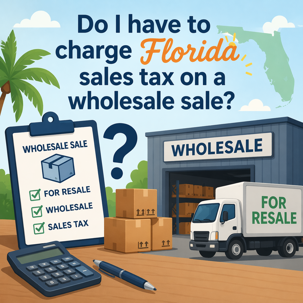
A common questions I hear from Florida business owners and their CPAs: "We only sell wholesale — we don't sell to end consumers — so we don't have to worry about sales tax, right?" It is an understandable assumption. Wholesale sounds like it should be tax-free by definition. After all, if you are selling to another business that is going to resell your goods, shouldn't sales tax be that other business's problem?
The answer is: theoretically, No, but practically, maybe — and the distinction matters. While sales tax in the US, in theory, attempts to only subject the final consumer of the good or service to sales tax. However, the law doesn’t gently follow that theory. As a relevant example, Florida law does not make wholesale sales automatically exempt. The exemption that applies to sales between dealers is real, but it is conditional, it requires specific documentation, and it places burden of proof squarely on the seller. If the seller can’t prove the exemption applies, then the seller is going to eat the sales tax. It can also expose the purchasing dealer to tax as well, if they are not registered for sales tax at the time of the purchase regardless of the intent to resell. This article explains exactly how the wholesale sales tax exemption works in Florida, what a seller must do to claim it, and what happens when the rules are not followed.
THE STARTING POINT: EVERY SALE IS TAXABLE UNLESS AN EXEMPTION APPLIES
Florida's sales tax framework begins with a broad rule: under Section 212.05, Florida Statutes, every sale of tangible personal property in Florida is subject to sales tax unless a specific statutory exemption applies and that exemption is strictly complied with. There is no general carve-out for wholesale transactions. The word "wholesale" does not appear in Chapter 212 as a self-executing exemption.
What Florida law does provide is the sale for resale exemption — a specific exemption that applies when a registered Florida dealer buys tangible personal property in Florida for resell to another dealer or the end customer. That exemption, when properly documented, is what makes genuine wholesale transactions tax-free. But "properly documented" is doing a lot of work in that sentence, and the documentation requirements are where most wholesale sellers run into trouble.
THE SALE FOR RESALE EXEMPTION: WHAT IT REQUIRES
The legal authority for the sale for resale exemption is found primarily in Section 212.07(1)(b), Florida Statutes, and Rule 12A-1.039, Florida Administrative Code. Together, these provisions establish the conditions that must be satisfied for a wholesale transaction to be exempt from Florida sales tax.
The Buyer Must Be A Florida Registered Dealer. The exemption only applies when the buyer is a registered Florida sales tax dealer — meaning the buyer holds a current Florida Certificate of Registration (Form DR-11) issued by the Florida Department of Revenue (FL DOR). A buyer who is not registered as a Florida dealer cannot make a valid exempt purchase for resale, regardless of whether they actually intend to resell the goods. (But I know a trick to possibly get around this – See link to “Inadvertent Registration” article at the bottom of this article)
The buyer must provide valid documentation. Under Rule 12A-1.039, the seller must obtain and retain one of three forms of documentation proving the transaction qualifies as an exempt sale for resale:
- A copy of the buyer's current Florida Annual Resale Certificate (Form DR-13);
- A transaction authorization number obtained from the FL DOR using the buyer's resale certificate number; or
- A vendor authorization number obtained annually from the FL DOR for regular wholesale customers.
The seller's obligation is active, not passive. "He told me he was a dealer" is not sufficient. "I assumed they were registered" is not sufficient. The actual certificate, transaction number, or vendor authorization number must be in the seller's hands before the exempt sale is made, and it must be retained for at least three years.
The goods must actually be purchased for resale. The exemption covers goods that the buyer intends to resell as tangible personal property, re-rent, incorporate into tangible personal property being repaired, or use as a component in goods manufactured for sale. If the buyer ultimately uses the goods for their own consumption rather than resale — and the seller knew or should have known — the transaction does not qualify.
WHAT HAPPENS WHEN DOCUMENTATION IS MISSING OR INVALID
This is the part of the wholesale sales tax equation that catches Florida businesses most off guard: if the seller does not have the required documentation at the time of sale, the seller — not the buyer — is responsible for collecting and remitting the sales tax on the transaction.
Under Section 212.07(1)(b), a seller who makes a tax-exempt sale for resale without proper documentation in hand cannot later claim the exemption if audited. The FL DOR will assess tax on the full sales price as though it were a retail transaction, plus interest and applicable penalties. The fact that the buyer was in fact a registered dealer, or that the goods were in fact resold, does not cure the documentation failure after the fact.
This is a critical point for wholesale businesses to understand. The exposure in an audit is not just for transactions where the buyer was not actually a dealer — it is for every transaction where the seller cannot produce the required documentation. For a wholesale operation doing millions of dollars in annual sales, missing or expired resale certificates in the audit period can result in a tax assessment on the full transaction volume, even for transactions that were genuinely intended as resales.
The practical takeaway: collect resale certificates before the first sale to any customer, verify that certificates are current at the start of each calendar year, and maintain organized records for at least three years.
MUST HOLD GOODS IN INVENTORY TO KEEP THE EXEMPTION
This is one of those quirks in Florida sales tax law that can catch even a tax savvy business owner off guard. Florida sales tax law requires the purchaser to strictly keep the items purchased in “inventory” for the sale for resale exemption to apply. Take the item out of inventory to use, even for a little while, at the sale for resale exemption collapses – exposing the company to use tax on the full purchase price of the good regardless of whether the good is eventually sold and taxed to a customer. There is one odd, let very commonly used exception to this rule. Car dealers are allowed to drive their car inventory with a dealer’s license plate without the car failing the “keep in inventory” test. The dealer can even take the car home overnight. The theoretical argument here is that the car dealer is technically still trying to sell the car, one could guess. But this is an exception that both sales tax auditors and highway patrolmen seem to forget.
THE SITUATION THAT SURPRISES MOST WHOLESALE SELLERS: SALES TO NON-REGISTERED BUYERS
Many Florida wholesale businesses occasionally — or regularly — sell to buyers who are not registered Florida dealers. This might include out-of-state buyers, small businesses that are not registered, or unregistered individuals purchasing in commercial quantities. In these situations, the sale for resale exemption is not available, and the seller is required to collect and remit Florida sales tax on the transaction or they will be liable for the tax. What I see all too often are wholesalers that get lax with the required paperwork and processes keeping up with sales tax, especially ones that have never been through a sales tax audit.
EXAMPLE – Individual Name Instead of Company Name: Big problem child example that I often see is that the sales department gets lax about what name to put on the invoice. The buying company is Buyer’s Beware Inc, but the company agent that has been ordering the goods for the last decade is Norm (not so) Lucky. The invoices for hundreds of thousands of dollars’ worth of goods are made out to Norm Lucky instead of the Buyer’s Beware Inc. It doesn’t matter that the selling company has a resale certificate from Buyer’s Beware Inc because the invoices prove the sales was legally to the individual Norm Lucky. Arguing that the company is the one that actually paid for the goods is not a valid defense. The sales office just knows and loves Johny (picture the whole sales office going “NORM!” every time he walks in) and put the sales invoices in his individual name. Costly mistake.
EXAMPLE - Buyer Changes Names: If you have been in business more than a few years, then you have already seen the frequency at which companies change ownership, change names, or even start doing business under a subsidiary’s name. The business world is ever changing. The problem for sales tax is that exemption certificates and invoice names MUST match. When your sales department is not trained to make sure that is true for every sale, then expensive tax problems start accruing liabilities.
EXAMPLE – Purchaser Out of Business by the Time You Ask For Resale Certificate: If the sales team is not highly trained to make sure resale certificate rules are followed, then I’ve seen many companies sell to companies knowing that the buyer is a reseller without ever getting a valid resale exemption certificate. By the time the seller gets a sales tax audit notice, the purchase is out of business. Without that resale certificate, the sale is taxable. What can be a little more frustrating is when your sales team does a bang up job getting the resale certificate in the first year you make sales to a company, but your team doesn’t have the processes in place to make sure to get new resale certificate every January. So, you get a 2026 sales tax audit notice for a company that accounted for 20% of your sales up until they closed doors in late 2025. But you only have a 2017 resale certificate on file for that buyer. Technically, without a current resale certificate, sales in that year are taxable. In a practical since, for this particular example, we can sometimes talk the auditor into accepting that the buyer was still buying for resale. Sometimes we can’t.
The moral of these examples are: train your staff well to be vigilant about sales tax, exemption certificates, and invoicing. It all must work in concert and be checked every year. Do this and just maybe you can avoid having to hire me to fight back!
A FEW WORDS ON OUT-OF-STATE BUYERS
If your Florida wholesale business sells to buyers located outside of Florida who will resell the goods outside of Florida, the transaction may be exempt from Florida sales tax as an out-of-state sale — but, like the sale for resale exemption, strict documentation requirements must be followed and the burden falls 100% of the seller to prove the exemption. Rule 12A-1.0015, Florida Administrative Code, discusses several ways for sales tax out of state buyers to be exempt.
- The most common method is to ship the goods by common carrier to an out of state address for the buyer (aka “committing the property to the exportation process”), but with the shipping records as proof of the exemption. No resale exemption certificate needed.
- Delivering out of state with your own employees can be exempt but the delivering employee must have an affidavit signed by the employee and customer stating the goods, time and location of delivery.
- Out of state dealers may also pick up the goods at a Florida location, but the purchasing dealer must execute a statement proving out of state dealer statute and attesting the goods will be transported outside Florida (see Rule 12A-1.0015(3)(d) for suggested format of the affidavit)
For anyone other than a non-resident dealer, picking up the goods anywhere in Florida makes the transaction subject to Florida sales tax. Without some other applicable exemption (such as the DR-123 Form for a car dealer), the selling dealer is required to collect sales tax on those “in state” sales and will still be liable for the sales tax even if not collected.
Simply selling to an out-of-state company does not automatically exempt the transaction if the goods are picked up in Florida or delivered to a Florida address. The specific rules must be followed and documented to avoid tax.
THE BOTTOM LINE
Wholesale sales in Florida are not automatically exempt from sales tax. The sale for resale exemption is real and valuable, but it requires the seller to collect and retain proper documentation on every exempt transaction at the time the sale is made. Sellers who skip this step are exposing themselves to audit assessments on the full tax on the value of undocumented transactions — regardless of the buyer's actual intent or dealer status. And, regardless of the fact you didn’t collect the tax. Remember, sales tax is actually an excise tax on the seller for the privilege of selling based on the sales price of the good sold. The seller is allowed by law to pass that tax on to the customer. But if the tax is not collected (or proof of an exemption is not available), then the seller is going to be liable for the sales tax.
If your business sells at wholesale and you have questions about whether your documentation practices are audit-ready, or if you have received a Notice of Intent to Audit and are concerned about your resale certificate records, the attorneys at the Law Offices of Moffa, Sutton & Donnini, P.A. can help. As Florida’s premier sales and use tax controversy law firm, we have 16 attorneys and 3 former sales tax auditors on staff that do nothing but sales tax every day. Florida sales tax is what we do! Call 888-444-9568 or visit www.FloridaSalesTax.com.
ABOUT THE AUTHOR
 James H. Sutton, Jr., CPA, Esq. is a shareholder and named partner at the Law Offices of Moffa, Sutton & Donnini, P.A., a Florida state and local tax law firm with offices in Fort Lauderdale, Tampa, and Tallahassee. Mr. Sutton holds dual credentials as a Certified Public Accountant and a Florida-licensed attorney, and his practice is devoted exclusively to Florida sales and use tax controversy. He has represented wholesale distributors, manufacturers, and retailers in Florida sales tax audits, protests, and voluntary disclosure proceedings, and has taught Florida sales and use tax to CPAs, attorneys, and law school students for 20 years as an adjunct professor of law. He can be reached at 813-775-2131, JamesSutton@FloridaSalesTax.com or through the contact form at www.FloridaSalesTax.com.
The information in this article is for general informational purposes only and does not constitute legal advice. No attorney-client relationship is formed by reading this article.
ADDITIONAL RESOURCES
- FLORIDA SALES TAX SALES FOR RESALE EXEMPTION — Published December 1, 2023 by David Brennan, Esq. The most comprehensive treatment on the site of the sale for resale exemption, including how to document exempt transactions and what happens when the documentation is deficient.
- FL SALES TAX – USED CAR DEALERS: WHAT YOU DON'T KNOW WILL COST YOU — Published April 24, 2026, by James H Sutton, Jr, CPA, Esq. Covers wholesale dealer-to-dealer vehicle transactions and the resale certificate obligations that apply — a close parallel to the documentation requirements facing any wholesale seller.
- FLORIDA SALES TAX – INADVERTENT REGISTRATION — Published June 5, 2026, by James H Sutton, Jr., CPA, Esq. If your wholesale business made purchases for resale before it was registered as a Florida dealer, this article explains the relief available under Section 212.07(9) and the inadvertent registration process.
- FLORIDA SALES TAX VOLUNTARY DISCLOSURE: THE BEST WAY TO CLEAN UP A FLORIDA SALES TAX PROBLEM — Published May 26, 2026, by James H Sutton, Jr., CPA, Esq. For wholesale businesses that have discovered documentation gaps or unreported tax exposure, voluntary disclosure is almost always the best path before the FL DOR identifies the issue first.
- HOW TO FIGHT A FLORIDA SALES TAX AUDIT — Published September 8, 2024, by James Sutton, CPA, Esq. and Jackie Mustian, Esq. If your wholesale business has received Form DR-840, this article explains the audit process, the records the auditor will request, and the strategies available to limit the assessment.
- FL SALES TAX OCCASIONAL ISOLATED SALES EXEMPTION — Published July 12, 2019, by Amanda Levine, Esq. Covers the narrow occasional sales exemption that wholesalers sometimes mistakenly believe applies to their transactions — and why it almost never does for businesses that purchase goods for resale.
© Copyright 2026 James H Sutton Jr All rights reserved.