
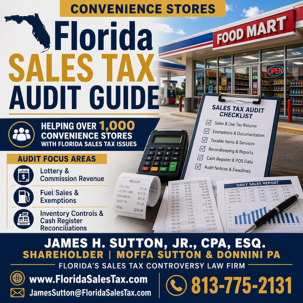
Florida Sales Tax Audits of Convenience Stores: A Guide for Owners and Their CPAs
The Department of Revenue has spent over a decade building a purchase-data machine specifically aimed at your industry. Here’s how the audit actually works, why the math is often wrong, and why collecting sales tax you don’t remit can put you in handcuffs instead of just owing a bill.
James H. Sutton, Jr., CPA, Esq.
Law Offices of Moffa, Sutton & Donnini, P.A.
Direct: 813-775-2131 | Email: JamesSutton@FloridaSalesTax.com | FloridaSalesTax.com
Synopsis: Convenience stores are among the most heavily targeted industries in Florida sales tax enforcement. I should know because our law firm has represented over 1,000 of them. From this experience, I have written this guide for the store owner and their CPA. It explains how the Florida Department of Revenue identifies audit targets using purchase data collected from alcohol and tobacco distributors, walks through the markup-based estimating formula the Department applies to that data, and explains where that formula tends to overstate liability. It also addresses a risk that too many owners underestimate until it is too late: sales tax collected from customers but not remitted to the state is not just a civil liability — it is, under Florida law, theft of state funds, a crime that can carry felony charges and prison time. Owners and their CPAs need to understand both the numbers and the exposure before the audit letter arrives.
I. Why Convenience Stores Are a Standing Audit Target
Florida has audited the convenience store and gas station industry aggressively for well over a decade, and the reasons are structural, not incidental. These businesses run high transaction volume in cash and near-cash categories — fuel, tobacco, alcohol, lottery, and prepared food — where the gap between what a store actually collects and what a store reports can be wide and, from the Department’s perspective, hard to verify through ordinary bank-deposit analysis. More importantly, the Department has built a dedicated data pipeline specifically for this industry, discussed in the next section, that does not exist for most other types of retail businesses. Once that pipeline flags a store, an audit tends to follow.
For the owner, this means the audit often arrives before any internal red flag would have. For the CPA, it means client convenience stores deserve a standing recommendation: get ahead of the numbers before the Department does.
II. How the Trigger Works: Distributor Reporting Under Section 212.133
The mechanism starts well before any auditor calls. Under Section 212.133, Florida Statutes, every manufacturer, wholesaler, or distributor of alcoholic beverages or tobacco products must file an annual information report with the Department identifying, for each Florida retailer it sold to, the general category of product (cigarettes, cigars, other tobacco, beer, wine, spirits) and the net dollar total sold to that retailer by month. The reporting period runs July 1 through June 30, the report is due July 1, and it becomes delinquent if not filed by September 30. A distributor that misses the deadline faces a penalty of $1,000 per month up to $10,000.
That reporting requirement exists for exactly one purpose stated in the statute: enforcing collection of Florida’s retail sales tax. The Department takes the purchase totals reported by every distributor selling to a given store and compares them against what that store reported on the monthly sales tax return. When the purchase-based estimate of sales runs meaningfully higher than reported sales, the store becomes an audit lead.
This is worth explaining to an owner plainly: the audit usually does not start because a bank account looked suspicious or a competitor complained. It starts because a spreadsheet flagged a mismatch between what distributors say they sold into the store and what the store’s own sales tax returns say it sold out the door.
III. Inside the Department’s Estimating Formula
Once a store is selected, the Department typically does not begin by reconstructing actual register data. It starts with the same distributor purchase data that triggered the audit and runs it through a markup-based estimating model. The mechanics generally work like this:
- Start with purchases. The auditor totals the store’s reported purchases of cigarettes, other tobacco products, beer, wine, and spirits for the audit period, drawn from distributor reports and any invoices obtained during the audit.
- Apply a markup. The auditor applies a standard markup percentage to each product category — a percentage the Department has derived from prior audits and internal averages, not from this particular store’s actual pricing, discounting, or promotional practices. These mark-up estimates are much higher than the average store’s mark-ups.
- Gross up for non-alcohol, non-tobacco sales. Because alcohol and tobacco typically represent only a portion of a convenience store’s total sales, the Department applies an assumed ratio — commonly treating alcohol and tobacco as roughly three-quarters of total store sales — to gross the marked-up figure up into an estimate of total store sales, including fuel, snacks, drinks, and other merchandise.
- Compare to reported sales. The resulting estimated total sales figure is compared to the taxable sales the store actually reported for the same period.
- Extrapolate a ratio across the audit period. Where the estimate exceeds reported sales, the Department calculates the ratio between the two and applies that same ratio to every month in the audit period — meaning one skewed month can distort the entire assessment.
The output of this process is a proposed assessment that can run into six figures even for a modestly sized store, built almost entirely from a formula rather than from the store’s actual point-of-sale records.
IV. Where the Formula Breaks Down
Owners and CPAs should understand that this model is a starting point for the Department, not a finding of fact — and it has well-documented weak points that a knowledgeable practitioner can and should challenge.
The underlying purchase data is frequently wrong. Distributor information reports are compiled by the distributor, not by the store, and errors are common. Purchases belonging to a different retailer sometimes appear on a store’s report. Return credits, damaged-product write-offs, and promotional giveaways are not always backed out. A store that participates in a buying group or that shares a corporate parent with other locations can see purchases misattributed across locations entirely.
The markup percentages are generic, not store-specific. The Department’s markup assumptions are typically drawn from a small sample of prior audits and tend to reflect higher-margin operations. They rarely account for a store operating in a highly competitive corridor with several other gas stations within a mile, a store running frequent multi-pack promotions, or a store absorbing significant shrinkage from theft — all of which push real-world markup well below the assumed figure.
The gross-up ratio ignores the store’s actual sales mix. Treating alcohol and tobacco as a fixed percentage of total sales assumes every convenience store looks the same. A store with a strong food-service or fuel component, for example, will have a very different alcohol-and-tobacco share of total revenue than a pure package store, and the formula does not adjust for that on its own.
The extrapolation compounds every one of these errors. Because the Department applies a single ratio across the full audit period — typically three years — even a modest overstatement in the base calculation gets multiplied across 36 months of assessed tax, penalty, and interest.
None of this means the estimate is automatically wrong for every store. It means the estimate is not self-proving, and the burden of unwinding it falls on the taxpayer once the Department has made its case using this method.
V. Two Different Legal Standards the Department Sometimes Confuses
This is a technical point every CPA representing a convenience store owner should understand, because it comes up constantly in this industry. Section 212.12, Florida Statutes, actually authorizes two different approaches to estimating a liability, and they are not interchangeable.
Under Section 212.12(5)(b), the Department may make an assessment based on the best information then available to it — which is where a purchase-data markup estimate fits most naturally — but only where the dealer fails or refuses to make records available, fails to register, fails to file returns, or files a grossly incorrect or fraudulent report. In other words, this standard is meant for taxpayers with no usable records at all.
Where a store does have records — POS reports, register tapes, purchase invoices — but the auditor simply considers them incomplete or inconvenient, the correct standard is different. Section 212.12(6)(b) requires the Department to base its assessment on a statistical sample of the available records with an appropriate proration, not to discard the store’s actual records wholesale in favor of a purchase-based estimate. Auditors do not always draw this distinction correctly, and a store that has real records — even imperfect ones — has a strong argument that the Department was required to sample those records rather than defaulting straight to the markup model. This distinction has been litigated successfully in other industries facing similar estimation disputes, and the same argument applies with full force to convenience stores.
VI. The Records That Actually Protect the Store
The best defense to an inflated purchase-based estimate is not an argument made after the fact — it is a documentation habit built before the audit letter ever arrives. Under Section 212.13, Florida Statutes, every dealer is required to keep a complete record of tangible personal property sold, distributed, or stored, along with invoices, gross receipts, and related records, for as long as required by Section 213.35. For a convenience store, that should mean, at minimum:
- Daily point-of-sale (Z-tape) reports broken out by department (fuel, tobacco, alcohol, lottery, prepared food, general merchandise)
- All distributor and vendor purchase invoices, matched against the store’s own receiving records
- Bank statements and merchant processing statements
- Documentation of inventory shrinkage, theft, spoilage, and damaged-goods write-offs
- Federal income tax returns and any internal profit-and-loss statements
- Copies of any resale or exemption certificates accepted from other retailers
Owners frequently underestimate how much a documented shrinkage and theft history can do to counter an inflated markup assumption, and CPAs are well positioned to build that record contemporaneously rather than reconstructing it under audit pressure. Retaining these records for a full five years, rather than the statutory minimum, gives both the owner and counsel more room to work if an audit reaches back further than expected.
VII. When the Civil Audit Turns Criminal: Theft of State Funds
This is the point in the process that too many convenience store owners do not take seriously enough, and it deserves direct, unambiguous language: sales tax collected from a customer belongs to the State of Florida from the moment it is collected, not to the business. Under Section 212.15(1), Florida Statutes, those funds become state funds at the moment of collection. Under Section 212.15(2), any person who, with intent to unlawfully deprive or defraud the state of those funds, fails to remit sales tax that has been collected commits theft of state funds — a criminal offense entirely separate from the civil audit assessment.
The grading of that offense is tied directly to the dollar amount involved:
- Under $1,000 — second-degree misdemeanor; a second conviction escalates to a first-degree misdemeanor, and a third or subsequent conviction becomes a third-degree felony.
- $1,000 to under $20,000 — third-degree felony.
- $20,000 to under $100,000 — second-degree felony.
- $100,000 or more — first-degree felony.
The statute expressly allows the Department to aggregate stolen revenue across multiple periods when determining the grade of the offense, which means a series of smaller shortfalls can add up to felony-level exposure even where no single month looks alarming on its own. Prosecution must generally commence within two years for a misdemeanor and five years for a felony.
Never assume that a small dollar figure keeps this in misdemeanor territory or off the prosecutor’s desk entirely. The Department has, over many years, pursued criminal charges against convenience store and small business owners for collected-but-unremitted amounts far smaller than most owners would expect to trigger an arrest. In one representative case out of Fort Myers, a convenience store owner was arrested and charged with a felony over roughly $8,000 in sales tax that had been collected from customers but not remitted to the state during a period in which the store was open and operating. The dollar amount was modest; the charge was still a felony.
The critical legal element separating a criminal theft-of-state-funds charge from an ordinary civil collection matter literally nothing but whether the Department decides to turn your case into a criminal investigation. Collecting and not remitting sales tax timely is sales tax fraud. It really does not matter that you work 15 hour days and are barely making enough money to live on. If your business collects sales tax and does not remit it timely, that is the crime. So, there is a fine line to walk when your convenience store goes through a sales tax civil audit and you have collected but not remitted sales tax. When the auditor accuses you of $150,000 of sales tax liabilities, and your records show that number is only $30,000, then do your records prove that you stole $30,000 of sales tax? I have seen cases like this turn criminal. I’ve seen business owners end up being arrested under this exact scenario. You really need someone who knows how to walk this line to defend a high audit estimate without giving the state everything they need to prosecute you. This experience is exactly why we have defended so many convenience stores.
VIII. Other Criminal Exposure Convenience Store Owners Should Know
Theft of state funds is not the only criminal statute that can surface once a convenience store audit is underway. Section 212.13(2), Florida Statutes, makes it a first-degree misdemeanor for a dealer to fail to maintain the sales, purchase, and inventory records the statute requires. If a subsequent violation involves the intentional destruction of those records with intent to evade payment of tax or deprive the state of tax revenue, that subsequent offense becomes a third-degree felony. In practice, this means an owner who — out of panic rather than malice — discards or “cleans up” purchase invoices or register tapes after learning an audit is coming can convert a documentation problem into a separate felony exposure layered on top of any theft-of-state-funds issue.
Combined with unfiled returns, each of which can carry its own exposure, these ancillary charges are often what a prosecutor uses to build a stronger overall case and a higher sentencing score, even where the theft-of-state-funds count is the headline charge. The lesson for owners and CPAs alike: once an audit notice arrives, the records freeze exactly as they are. Do not “fix” or discard anything.
IX. What Owners and CPAs Should Do From Day One
A Florida sales tax audit of a convenience store typically begins with a phone call confirming the business is still operating, followed by a formal Notice of Intent to Audit Books and Records (Form DR-840). Under Section 212.13(5)(a), the Department must generally provide at least 60 days’ written notice before the auditor actually begins work, unless the taxpayer requests an emergency audit or the situation involves a distress or jeopardy assessment. That 60-day window is not dead time — it is the single best opportunity the owner and the CPA have to organize records, identify weak points, and correct course before the auditor’s numbers become the starting point for negotiation.
From day one, the owner and CPA working together should:
- Pull and organize all POS, purchase, and bank records for the full audit period before the auditor’s first site visit
- Reconcile distributor purchase totals against the store’s own receiving records to identify errors early, rather than after the Department has already built its estimate
- Document shrinkage, theft, and promotional activity that a generic markup assumption will not otherwise capture
- Confirm all sales tax returns for the period were actually filed and that no gaps exist
- Involve a sales tax attorney early if there is any indication that collected tax was not fully remitted — not after an investigator’s file is already built
FAQ
Q: How does the Department decide which convenience stores to audit?
Primarily through distributor purchase data reported under Section 212.133. When purchase-based estimates of sales run higher than a store’s reported taxable sales, the store becomes an audit lead.
Q: Is the Department’s markup estimate final, or can it be challenged?
It can and should be challenged. The estimate relies on generic markup percentages and a fixed sales-mix ratio that rarely match any particular store’s actual operations, and the underlying distributor data itself is often inaccurate.
Q: We have most of our records but not everything. Does that mean the Department can just use the purchase-data estimate?
Not necessarily. If competent records exist, the Department is generally required to sample and prorate from those records under Section 212.12(6)(b) rather than defaulting to a purchase-based estimate meant for taxpayers with no records at all.
Q: Can a business owner really be arrested for a few thousand dollars of unremitted sales tax?
Yes. Florida’s theft-of-state-funds statute makes as little as $1,000 of collected but not remitted sales tax a felony, and I’ve seen real convenience store owners have faced felony charges over amounts as low as $1,500.
Q: What is the single most damaging mistake an owner can make once an audit notice arrives?
Altering or discarding records after learning of the audit. That conduct can create a separate felony under Section 212.13 even where the original tax issue would have been resolved civilly.
Q: Should the CPA or the owner handle communication with the auditor?
Both should be involved, but any indication of collected-but-unremitted tax warrants bringing in a sales tax attorney immediately, given the criminal exposure discussed above.
About the Author
 James H. Sutton, Jr., CPA, Esq. is a Shareholder at the Law Offices of Moffa, Sutton & Donnini, P.A., a Florida law firm concentrating almost exclusively in the area of Florida state and local tax (SALT) controversy, with offices in Tampa, Fort Lauderdale, and Tallahassee. Mr. Sutton is a State and Local Tax (SALT) attorney, CPA, and has been a licensed CPA since 1994 and a member of The Florida Bar since 1998. Since 2002, he has served as an Adjunct Professor of Law at Stetson University College of Law, teaching State and Local Tax, and also teaches Sales and Use Tax at Boston University School of Law’s LLM in Taxation program. Mr. Sutton can be reached at 813-775-2131 or JamesSutton@FloridaSalesTax.com, and his full bio is available here. If you have any questions, then Mr. Sutton has a FREE INITIAL CONSULTATION policy.
About the Firm
The Law Offices of Moffa, Sutton & Donnini, P.A. is a Florida law firm practicing almost exclusively in the area of Florida state and local tax (SALT) controversy, with over 200 years of combined experience among its attorneys. The firm represents businesses and individuals in Florida sales and use tax audits, protests, criminal investigations, and litigation before the Florida Department of Revenue, and has offices in Tampa, Fort Lauderdale, and Tallahassee.
Additional Resources
- “Florida Sales Tax Criminal Investigations: When Sales Tax Experience Matters,” published June 24, 2026, by James H Sutton, Jr, CPA, Esq.
- “Florida Sales Tax: Public Works Contracts Guide: What Construction Companies and Their CPAs Need to Know Including the New University Refund Law,” July 2026, by James H Sutton, Jr., CPA, Esq.
- “FLORIDA SALES TAX CONVENIENCE STORE AUDITOR TACTICS,” July 17, 2024, David Brennan, Esq.
- “FT. MYERS BUSINESS OWNER ARRESTED FOR FAILING TO REMIT ONLY $8,000 IN SALES TAX COLLECTED,” August 11, 2012
Statutes cited in this article:
- Section 212.12, F.S. — Dealer’s credit for collecting tax; powers of Department in dealing with delinquents
- Section 212.13, F.S. — Records required to be kept; power to inspect; audit procedure
- Section 212.133, F.S. — Information reports required for sales of alcoholic beverages and tobacco products
- Section 212.15, F.S. — Taxes declared state funds; penalties for failure to remit taxes
© Copyright 2026. James H. Sutton, Jr. All rights reserved.