
Florida Sales Tax on Construction: Why Most Contracts Never Qualify as (3)(d) Retail Sale Plus Installation Contracts
Contractors love the idea of collecting tax only on materials and passing installation labor through tax-free. Florida law allows it — but only for a narrow scenario that almost nobody qualifies for.
James H. Sutton, Jr., CPA, Esq.
Law Offices of Moffa, Sutton & Donnini, P.A.
Direct: 813-775-2131 | Email: JamesSutton@FloridaSalesTax.com | www.FloridaSalesTax.com
Synopsis: Florida taxes real property contractors as the “ultimate consumer” of the materials they install — meaning the contractor pays tax on materials and charges the customer nothing. There is one exception: the “retail sale plus installation” contract described in Rule 12A-1.051(3)(d), F.A.C., which flips the tax collection point onto the contractor’s customer instead. Every construction company wants to believe its contracts qualify, because it sounds like a better deal. Almost none of them do. This article walks through exactly what a (3)(d) contract requires, why the itemization rule trips up nearly every contractor who tries it, and what happens in audit when a contractor charged tax as if it had a (3)(d) contract but didn’t.
I. Every Construction Contract in Florida Falls Into One of Five Buckets
Rule 12A-1.051(3), F.A.C., sorts every real property contract into one of five pricing categories: lump sum, cost plus or fixed fee, upset or guaranteed price, retail sale plus installation, and time and materials. This classification is not cosmetic. It determines who pays the sales tax and on what amount.
For four of those five categories — lump sum, cost plus, upset price, and time and materials — the rule is unambiguous: the contractor is the ultimate consumer of the materials and pays tax on the cost of those materials to its own supplier. The contractor marks up their prices to account for the extra sales tax expense, but sales tax is never mentioned on the invoice to customers. A contractor cannot separately state “materials” and “labor” on an invoice under one of these four contract types and use that formatting to avoid tax — the tax was already due when the contractor bought the materials, and no invoice language changes that.
The fifth category, the retail sale plus installation contract described in paragraph (3)(d) of Rule 12A-1.051, F.A.C., works the other way. Under a genuine (3)(d) contract, the contractor is treated as a dealer selling tangible personal property. The contractor buys materials tax-exempt using its resale certificate, then charges the customer sales tax on the price of the materials — but not on the installation labor.
That distinction is worth real money on a large job, which is exactly why so many contractors want to claim it applies to their contracts. The problem is that the rule sets a strict, narrow test for getting there, and I see very few contracts in this practice that actually meet the requirements.
II. What the Rule Actually Requires for (3)(d) Treatment
Rule 12A-1.051(3)(d) defines a retail sale plus installation contract as one in which the contractor agrees to sell specifically described and itemized materials and supplies at an agreed price or at the regular retail price and to complete the work either for an additional agreed price or on the basis of time consumed. Two conditions have to be satisfied together, in the contract itself, before work ever starts:
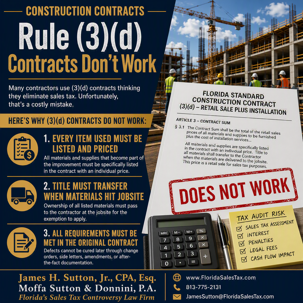
First, every material item that will be incorporated into the job must be itemized and priced. Not most of them. Not the expensive ones. All of them. The rule states this without qualification: “all the materials that will be incorporated into the work must be itemized and priced in the contract before work begins.” And the rule closes the obvious workaround immediately: “If a contract itemizes some materials but does not itemize other materials that will be incorporated into the work, the contract is not included in this category.” There is no partial credit. One un-itemized bag of screws or an unspecified number of shins not listed and priced, and the whole contract falls out of (3)(d) and defaults back to lump sum treatment.
Second, the sale of the materials has to be a genuinely separable transaction from the installation. The rule requires that the purchaser must assume title to and risk of loss of the materials and supplies as they are delivered, rather than accepting title only to the completed work. That is a real, substantive shift in the legal relationship between the parties — not a labeling exercise. If your customer’s actual expectation and your actual practice is that they are buying a finished building, a finished roof, or a finished pool, and not individually purchasing lumber and shingles and pumps as they land on the job site, you do not have a (3)(d) contract no matter what the invoice says.
Compare that to a time and materials contract, which the rule distinguishes explicitly: time and materials contracts differ from (3)(d) contracts because “the materials are not completely identified, itemized, and priced in the contract in advance and because the property owner is contracting for a finished job rather than the purchase of materials.” That is the line. If your customer wants a finished project and your contract does not itemize and price every stick of material in advance, you are on the time-and-materials or lump-sum side of that line — not the (3)(d) side.
III. Why Nearly Every Construction Contract Fails This Test
Never assume a construction contract qualifies as (3)(d) just because it separately states charges for “materials” and “labor.” That is the single most common misconception I see in this practice, and Rule 12A-1.051 anticipates it directly. Subsection (2)(h)4 makes clear that a proposal listing materials with unit pricing, followed by an invoice breaking the lump sum into a materials-and-labor split after the fact, is still a lump sum contract. The rule’s own example walks through exactly this scenario — a plumbing subcontractor bids a job with a materials breakdown, the developer accepts, and the invoice later shows materials and labor separately — and concludes that “neither the proposal nor the invoice is a contract under which the developer agrees to pay separately for materials and labor. They are documents prepared by the contractor to explain or justify the price.”
In real-world construction, three things almost always defeat (3)(d) qualification:
Change orders and field conditions. Construction jobs change. Materials get substituted, quantities get adjusted, unforeseen conditions require additional supplies that were never itemized in the original contract. Every one of those additions is, by definition, material that was not itemized and priced before work began. A single significant change order involving unitemized materials can knock an otherwise carefully drafted (3)(d) contract back into lump sum territory for the entire job.
Allowance items. Contracts that use allowances — a placeholder dollar figure for fixtures, flooring, or finishes the customer has not yet selected — cannot satisfy the itemization requirement for those items. An allowance is, by design, the opposite of a specifically described and itemized material at an agreed price.
The customer doesn’t actually want to buy materials. Most residential and commercial construction customers are buying a finished improvement, not shopping for lumber and concrete. Even where a contractor itemizes materials on paper, if the underlying business reality is that the customer is paying for a completed home, office buildout, or pool — and would never accept partial delivery of unassembled materials in lieu of the finished product — the “separable transaction” requirement in the rule is not met, regardless of the invoice format.
IV. What Happens When a Contractor Gets This Wrong
The consequences run in both directions, and both are expensive.
If a contractor mistakenly treats a lump sum, cost-plus, or time-and-materials contract as if it were (3)(d) — collecting sales tax from the customer on materials and not paying tax to its own suppliers — the Department of Revenue can assess the contractor for use tax on the full cost of every material item used in the job, because under the true contract classification the contractor, not the customer, was the taxable consumer. The sales tax improperly collected from the customer does not offset that liability; it simply creates a separate problem of tax collected but potentially not properly documented as such.
The reverse mistake is just as costly. A contractor that genuinely has a (3)(d) contract but fails to collect tax from the customer on the itemized materials — mistakenly believing itself to be the ultimate consumer — can be assessed for the sales tax it should have collected, plus penalty and interest, with no ability to go back to a completed job and collect from the customer after the fact.
Either way, the classification of the contract is not something you get to choose retroactively during an audit. Under subsection (5) of Rule 12A-1.051, F.A.C., contractors who perform genuine (3)(d) contracts must register as dealers and use their Annual Resale Certificate to buy materials tax-exempt for resale. An auditor examining a contractor’s purchase records will notice immediately if a contractor claims (3)(d) status on its sales invoices but paid tax to its own suppliers on the same materials — that inconsistency alone is often what triggers the audit inquiry in the first place.
V. If You Genuinely Want (3)(d) Treatment, Build It Into the Contract From Day One
For the rare construction business where (3)(d) treatment actually makes sense — typically specialty contractors selling and installing a discrete, fully specified package of materials, such as a defined equipment package or a fixed cabinetry order — qualifying requires discipline at the drafting stage, not after the fact:
- Itemize and price every single material item that will go into the job before signing, with no allowances and no “TBD” line items.
- Build change-order language that itemizes and prices any added materials as they arise, rather than absorbing them into a lump-sum adjustment.
- Structure delivery and risk-of-loss terms so that title to materials genuinely passes to the customer as delivered — not merely upon completion of the installed improvement.
- Register as a dealer, use your Annual Resale Certificate to purchase the itemized materials tax-exempt, and collect tax from the customer on the material price at the time of sale.
- Keep the (3)(d) contract separate from any bundled lump-sum work on the same job. A single contract can be predominantly real property work with some (3)(d)-eligible tangible personal property carved out — but that requires the mixed-contract analysis under subsection (8) of the rule, not a blanket (3)(d) label applied to the whole job.
For most contractors performing ordinary construction, renovation, or repair work, none of this is worth the trouble. The far more common — and far more defensible — approach is to accept lump-sum, cost-plus, or time-and-materials treatment, pay tax on materials to your suppliers as the ultimate consumer, and charge your customers nothing. That is not a consolation prize. It is simply how Florida taxes the vast majority of construction work, and trying to force a contract into (3)(d) status it does not meet is one of the more common — and more expensive — mistakes I see in sales tax audits of Florida contractors.
One last thing to consider is that a (3)(d) contract is usually more expensive to the customer, but provides no additional profit to the contractor. This is because when a contractor pays sales tax to its vendors, the tax is based on the lower cost to the contractor, not the marked up price to the customer. The sales tax on the marked up price results in higher overall cost to the customer. A contractor that understands sales tax will simply pay sales tax on material purchases then mark up prices charged to customers without any mention of sales tax in the customer’s contract or on invoices.
FAQ
Q: Can I make my contract qualify for (3)(d) treatment just by adding a line that separately states “materials” and “labor”?
No. The Department and the rule both look past invoice formatting to whether all materials were itemized and priced in advance and whether title and risk of loss actually passed to the customer as materials were delivered.
Q: What if I itemize 90% of my materials but leave a few items, like fasteners or sealants, as part of a general labor charge?
That defeats (3)(d) status for the entire contract. The rule requires that all materials incorporated into the work be itemized — partial itemization does not qualify.
Q: Does a change order ruin my (3)(d) contract?
It can. If the change order adds materials that are not itemized and priced before that portion of the work begins, those materials — and potentially the contract’s (3)(d) status as a whole — are at risk.
Q: If I mistakenly operated as if I had a (3)(d) contract, what should I do?
Correct the classification going forward immediately, and consider a voluntary disclosure to resolve any tax exposure on completed jobs before the Department finds it in an audit.
Q: Is a (3)(d) contract the same as a mixed contract?
No. A mixed contract, addressed in subsection (8) of Rule 12A-1.051, involves both real property work and separate tangible personal property that never becomes part of the realty. A (3)(d) contract is a real property contract in which all incorporated materials are itemized and sold separately from the installation labor.
About the Author
 James H. Sutton, Jr., CPA, Esq. is a State and Local Tax (SALT) attorney and CPA as well as a Shareholder at the Law Offices of Moffa, Sutton & Donnini, P.A. Mr. Sutton has been a licensed CPA since 1994 and a member of The Florida Bar since 1998 and has an almost exclusive focus on Florida sales and use tax controversy. From 2002 to 2022, he has served as an Adjunct Professor of Law at Stetson University College of Law, teaching State and Local Tax, and also taught Sales and Use Tax at Boston University School of Law’s LLM in Taxation program. Mr. Sutton can be reached at 813-775-2131 or JamesSutton@FloridaSalesTax.com, and his full bio is available here. If you have any questions, then Mr. Sutton has a FREE INITIAL CONSULTATION policy.
About the Firm
The Law Offices of Moffa, Sutton & Donnini, P.A. is a Florida law firm practicing almost exclusively in the area of Florida state and local tax (SALT) controversy, with over 200 years of combined experience among its attorneys. The firm represents businesses and individuals in Florida sales and use tax audits, protests, and litigation before the Florida Department of Revenue, and has offices in Tampa, Fort Lauderdale, and Tallahassee.
Additional Resources
- Florida Sales Tax: Public Works Contracts Guide: What Construction Companies and Their CPAs Need to Know Including the New University Refund Law, published July 11, 2026, by James H Sutton, Jr. CPA, Esq.
- Is Software as a Service (SaaS) Taxable in Florida?, published July y, 2026, by James H Sutton, Jr. CPA, Esq.
- Florida Sales Tax Exemptions for Manufacturers: The Machinery, Equipment, and Utility Breaks Every Florida Manufacturer Should Be Using, published July 2, 2026, by James H Sutton, Jr., CPA, Esq.
- Florida Sales Tax Criminal Investigations: When Sales Tax Experience Matters, June 24, 2026, by James H Sutton, Jr., CPA, Esq.
- Florida Sales Tax Data Center Exemption under Section 212.08(5)(r), published June 23, 2026, by James H Sutton, Jr., CPA, Esq.
Statutes and rules cited in this article:
- Rule 12A-1.051, F.A.C. — Sales to or by Contractors Who Repair, Alter, Improve and Construct Real Property
- Section 212.05, F.S. — Sales, storage, use tax
© Copyright 2026. James H. Sutton, Jr. All rights reserved.