
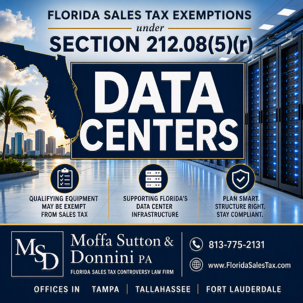
FLORIDA SALES TAX DATA CENTER EXEMPTION UNDER SECTION 212.08(5)(r), FLORIDA STATUTES
By James Sutton, CPA, Esq.
Shareholder, Law Offices of Moffa, Sutton & Donnini, P.A. | www.FloridaSalesTax.com
QUICK ANSWER: Florida exempts data center property from sales and use tax under Section 212.08(5)(r), Florida Statutes. As amended by HB 7031 (2025), effective August 1, 2025, the exemption now requires a cumulative capital investment of at least $150 million and a critical IT load of 100 megawatts or higher — raised from the original 15-megawatt threshold. The exemption covers equipment, infrastructure, electricity, and construction materials used exclusively at the data center. Businesses must apply for and receive certificates from the Florida Department of Revenue before claiming the exemption. New applications must be filed by June 30, 2037.
2025 LEGISLATIVE ALERT: Florida HB 7031, signed into law in 2025 and effective August 1, 2025, significantly amended Section 212.08(5)(r). The critical IT load threshold was raised from 15 MW to 100 MW, the application deadline was extended from June 30, 2027 to June 30, 2037, and the commercial rent carve-out was eliminated (consistent with the concurrent repeal of Florida’s commercial rent tax under § 212.031). Existing data centers with a critical IT load below 100 MW that hold permanent exemption certificates will lose their exemption upon their next five-year review if they cannot certify the 100 MW threshold. There is no grandfather provision.
Introduction
Florida has long positioned itself as a business-friendly state through its absence of a personal income tax and its relatively modest corporate income tax regime. When the legislature enacted the data center sales tax exemption in 2017, it added a powerful new tool to attract one of the most capital-intensive industries in the modern economy.
The data center industry has exploded in demand, driven by cloud computing, artificial intelligence, streaming services, and the massive data processing needs of the modern enterprise. States across the country have competed aggressively for data center investment with tax incentives, and Florida’s exemption under Section 212.08(5)(r), Florida Statutes is among the most comprehensive in the nation.
However, Florida’s data center exemption has not remained static. The 2025 legislature significantly tightened the qualification thresholds through HB 7031, raising the critical IT load requirement from 15 megawatts to 100 megawatts and effectively limiting the exemption to hyperscale facilities. Understanding both the original framework and the 2025 amendments is essential for data center owners, tenants, contractors, and their advisors.
This article provides a detailed legal analysis of Florida’s data center sales tax exemption as it currently stands: who qualifies under the amended statute, what property is covered, what the implementing rule requires, which Department of Revenue forms must be filed, what the 2025 amendments mean for existing certificate holders, and what traps for the unwary practitioners should anticipate.
Statutory Framework: Section 212.08(5)(r), Florida Statutes
The Florida Legislature created the data center sales tax exemption effective July 1, 2017. The exemption is codified at Section 212.08(5)(r), Florida Statutes, and is sometimes cited in Department of Revenue rules and publications as Section 212.08(5)(s) — a difference that reflects re-lettering of subsections at some point, not a substantive distinction. Rule 12A-1.108, F.A.C., the implementing rule, cites to the (5)(s) designation. Practitioners should be aware of both designations when researching the issue, but the current enrolled text uses (5)(r).
The statute exempts from the tax imposed by Chapter 212 the sale, rental, use, consumption, distribution, and storage of "data center property" used at a qualifying data center. Understanding the scope of that exemption requires unpacking the statute’s layered definitions.
Key Statutory Definitions
"Critical IT Load" (§ 212.08(5)(r)1.a.): That portion of electric power capacity, expressed in megawatts, reserved solely for owners or tenants to operate their computer server equipment. The term does not include ancillary load for cooling, lighting, common areas, or other support systems. This distinction is critical: the 100-megawatt qualifying threshold is measured against IT load specifically, not total facility power draw. A large data center with significant cooling and support infrastructure may have total power consumption well above 100 MW but a qualifying IT load below that threshold.
"Cumulative Capital Investment" (§ 212.08(5)(r)1.b.): The combined total of all expenses incurred by owners or tenants after July 1, 2017, in connection with acquiring, constructing, installing, equipping, or expanding the data center. The term excludes expenses incurred in acquiring improved real property that was already operating as a data center within 6 months prior to acquisition. This anti-churning rule prevents taxpayers from re-qualifying legacy facilities through mere ownership changes.
"Data Center" (§ 212.08(5)(r)1.c.): A facility that: (I) consists of one or more contiguous parcels in this state, along with the buildings, substations, and other infrastructure, fixtures, and personal property located on the parcels; (II) is used exclusively to house and operate equipment that receives, stores, aggregates, manages, processes, transforms, retrieves, researches, or transmits data, or that is necessary for the proper operation of such equipment; (III) has a critical IT load of 100 megawatts or higher, and a critical IT load of 1 megawatt or higher dedicated to each individual owner or tenant; and (IV) is constructed on or after July 1, 2017.
"Data Center Property" (§ 212.08(5)(r)1.d.): Property used exclusively at a data center to construct, outfit, operate, support, power, cool, dehumidify, secure, or protect a data center and any contiguous dedicated substations. The definition is expansive, encompassing:
- Construction materials, component parts, machinery, equipment, computers, and servers
- Installations, redundancies, and operating or enabling software (including replacements, updates, new versions, and upgrades), regardless of whether the property is a fixture or otherwise affixed to real property
- Cooling and dehumidification systems
- Backup power systems, including generators and UPS equipment
- Security and monitoring systems
- Infrastructure components including raised flooring, cabling, and racks
- Electricity used exclusively at the data center
The breadth of this definition is one of the exemption’s most valuable features. Florida’s exemption reaches not just the IT hardware itself, but the full physical ecosystem required to operate a modern data center — including the electricity bill, which for hyperscale facilities can represent tens of millions of dollars per year in otherwise-taxable purchases.
Current Qualification Requirements
Section 212.08(5)(r)2. sets out three threshold requirements, each of which must be satisfied no later than 5 years after the commencement of construction. These thresholds reflect the statute as amended by HB 7031 (2025), effective August 1, 2025:
1. Cumulative Capital Investment of $150 Million or More. The data center’s owners and tenants combined must invest at least $150 million in the facility after July 1, 2017. This threshold is unchanged from the original 2017 enactment.
2. Critical IT Load of 100 Megawatts or Higher (Facility-Wide). This is the threshold most significantly affected by HB 7031. The original 2017 exemption required only 15 megawatts of critical IT load at the facility level. Effective August 1, 2025, that threshold has been raised to 100 megawatts — a nearly seven-fold increase. For context, 100 megawatts of critical IT load represents an enormous facility. Most colocation data centers in Florida fall well short of this threshold. The exemption is now effectively limited to hyperscale facilities.
3. Critical IT Load of 1 Megawatt Per Owner or Tenant. Each individual owner or tenant within the data center must have a dedicated critical IT load of at least 1 megawatt. This per-tenant threshold is unchanged from the original statute and prevents a single large operator from qualifying a facility and then extending the exemption to minimal sub-tenants.
All three requirements must be met within the five-year window from commencement of construction.
The 2025 Amendments: HB 7031 and Its Impact
Florida HB 7031, passed June 30, 2025, and effective August 1, 2025, made three significant changes to Section 212.08(5)(r) that practitioners must understand:
Change 1: Critical IT Load Threshold Raised from 15 MW to 100 MW
This is the most consequential change. By raising the facility-wide critical IT load requirement from 15 megawatts to 100 megawatts, the legislature effectively eliminated the exemption for the vast majority of Florida data centers that had previously qualified or were in the process of qualifying.
The 100-megawatt threshold operates not only prospectively but also — through the five-year renewal mechanism — retroactively for existing certificate holders. When an existing permanent certificate holder comes up for its five-year Department review, it must certify that its critical IT load is 100 megawatts or higher. A data center that qualified under the old 15-megawatt threshold but operates below 100 megawatts cannot make that certification and will lose its permanent exemption certificate.
The statute contains no grandfather provision for existing sub-100 MW certificate holders. This means:
- Existing permanent certificate holders below 100 MW will lose their exemption upon their next five-year review
- All purchases of equipment, electricity, and construction materials made after the data center loses its certificate become fully taxable
- Purchases made after August 1, 2025 by data centers that can no longer qualify appear to be immediately at risk under audit
- Contractors who priced data center construction bids on the assumption of tax-free material purchases may face unexpected cost increases
- Lease agreements that guaranteed tenants tax-free treatment of electricity or equipment may be in breach if the exemption is lost
The Department of Revenue had not, as of the date of this writing, issued formal guidance addressing how it intends to enforce the 100-megawatt threshold against existing certificate holders mid-cycle between five-year reviews. Affected data center operators should seek a Technical Assistance Advisement from the Department and consult with qualified Florida sales tax counsel immediately.
Change 2: Application Deadline Extended from June 30, 2027 to June 30, 2037
On a more favorable note, HB 7031 extended the deadline for filing initial applications for a Data Center Property Temporary Tax Exemption Certificate from June 30, 2027 to June 30, 2037. This gives developers a much longer runway to enter the program, reflecting the legislature’s recognition that hyperscale data center development — the only scale that now qualifies — requires substantially longer planning and construction timelines.
The current statutory deadline is: after June 30, 2037, the Department may not issue a temporary tax exemption certificate pursuant to this paragraph. Developers planning new hyperscale data centers in Florida should file their DR-1214DCP application as early in the construction process as possible, but the ten-year application window provides meaningful flexibility.
Change 3: Elimination of the Commercial Rent Carve-Out
The original 2017 version of Section 212.08(5)(r)2. provided that data center property was exempt from the tax imposed by Chapter 212, except for the tax imposed by § 212.031. Section 212.031 imposed Florida’s commercial real property rental tax.
The current statute no longer contains that carve-out. The exemption now reads simply: “Data center property is exempt from the tax imposed by this chapter.” This change is consistent with HB 7031’s concurrent repeal of Florida’s commercial rent tax under Section 212.031, effective October 1, 2025. Because there is no longer a commercial rent tax to carve out, the carve-out language was unnecessary and was removed.
The practical implication is straightforward: data center tenants no longer owe Florida sales tax on their lease payments to data center landlords, because the commercial rent tax was repealed effective October 1, 2025. This is a significant benefit for colocation tenants and was itself one of the major provisions of HB 7031. For the purposes of the data center exemption analysis, the elimination of the carve-out means the analysis of whether a particular charge constitutes taxable commercial rent is now moot under Florida law.
Implementing Rule: Rule 12A-1.108, F.A.C.
The Department of Revenue promulgated Rule 12A-1.108, F.A.C. to implement the data center exemption. Adopted effective April 16, 2018, and amended June 14, 2022, the rule operationalizes the statutory requirements. Practitioners should note that the rule was promulgated under the pre-amendment version of the statute and cites the 15-megawatt threshold and the June 30, 2027 deadline. The Department has not yet amended the rule to conform to the HB 7031 changes as of the date of this article. The statute controls, but rule amendments should be anticipated.
The Two-Phase Certificate Process
The rule establishes a two-phase certificate process. Taxpayers cannot self-designate as a qualifying data center — they must apply to the Department and receive official certificates before purchasing data center property exempt from tax.
Phase 1 — Temporary Tax Exemption Certificate (DR-14TDCP): Before the data center has met all investment and power thresholds, the owner applies for a Data Center Property Temporary Tax Exemption Certificate. Upon a tentative determination that the exemption requirements will be met, the Department issues the temporary certificate, which allows tax-exempt purchases to begin during the construction and ramp-up period.
Phase 2 — Permanent Certificate of Exemption (DR-14DCP): Once all requirements have been satisfied, the owner applies for the permanent Data Center Property Certificate of Exemption, supported by independent certifications from a licensed professional engineer and a Florida-licensed CPA. The permanent certificate remains valid as long as the data center continues to qualify, subject to Department review every five years.
Ongoing Compliance: Five-Year Review
Rule 12A-1.108(5) requires the Department to conduct a review of registered data centers every five years. Within three months before the end of any five-year period, data center owners must submit a written declaration under penalty of perjury confirming that the critical IT load requirements continue to be met and that the data center continues to operate in compliance with Section 212.08(5)(r).
Under the current statute, that declaration must certify a critical IT load of 100 megawatts or higher — the amended threshold. This is the mechanism through which the 2025 amendment operates retroactively against existing sub-100 MW certificate holders: they simply cannot make the required declaration at their next review.
The written declaration should be sent to: Technical Assistance and Dispute Resolution, Florida Department of Revenue, P.O. Box 7443, Tallahassee, FL 32314-7443.
If the Department determines a data center is no longer in compliance, the permanent certificate is revoked. Any person who made tax-exempt purchases under that certificate becomes liable for all tax avoided since the date the data center fell out of compliance, plus penalty and interest. A six-year statute of limitations applies to assessments of tax avoided on data center property purchases under § 212.08(5)(r)3.c.
Required Forms
Form DR-1214DCP — Application for Data Center Property Temporary Tax Exemption Certificate. The initial application filed by the data center owner to receive the temporary exemption certificate. It must state that a qualifying data center designation is being sought and provide information indicating the requirements will be met within five years.
Form DR-14TDCP — Data Center Property Temporary Tax Exemption Certificate. Issued by the Department upon tentative determination that the exemption requirements will be met. The owner presents this to vendors when making tax-exempt purchases during the ramp-up period. Tenants and contractors must present a copy of this certificate together with a signed Certificate of Entitlement to each vendor.
Form DR-5DCP — Application for Data Center Property Certificate of Exemption. The second-stage application filed once all investment and power thresholds have been met. Must be accompanied by:
- Certification from a licensed professional engineer (Chapter 471, F.S.) confirming the data center meets the critical IT load requirement. The engineer must be independent — contracted solely to provide this certification, not otherwise professionally related to the data center’s owners, tenants, or contractors.
- Certification from a Florida-licensed certified public accountant (§ 473.302, F.S.) confirming that the required cumulative capital investment has been achieved. The CPA must likewise be independent.
Form DR-14DCP — Data Center Property Certificate of Exemption. The permanent certificate issued once the Department verifies the documentation. Presented to vendors for ongoing exempt purchases.
Certificate of Entitlement. Not a separately numbered DOR form but a prescribed document under Rule 12A-1.108(3)(c). Tenants and contractors — who are not themselves the certificate holder — must present both a copy of the owner’s DR-14TDCP or DR-14DCP and a signed Certificate of Entitlement to each vendor. The Certificate of Entitlement affirms that the purchaser is a tenant or contractor of the qualifying data center and that items purchased will be used exclusively at the data center. Vendors who receive valid certificates are relieved of responsibility for collecting tax; the Department looks solely to the purchaser if it later determines the purchaser was not entitled to the exemption.
Form DR-26S — Application for Refund (Sales and Use Tax). If a data center operator paid tax on qualifying purchases before the permanent certificate was issued, a refund can be sought using Form DR-26S, subject to the applicable statute of limitations under Section 215.26(2), Florida Statutes.
Electricity: A Special Case
The exemption’s inclusion of electricity remains one of its most valuable features. Rule 12A-1.108(4)(b) specifies three categories of electricity charges that qualify as exempt data center property:
- Charges billed by the utility provider directly to a data center tenant
- Charges billed by the utility provider directly to a data center owner
- Charges billed to a data center tenant by a data center owner that are separately stated on the owner’s invoice at the same or lower price as billed by the utility provider to the owner
The third category — utility pass-through charges — is particularly important in multi-tenant colocation arrangements. If the data center owner bills electricity to its tenants as a separately stated line item at cost or below, those charges are exempt. However, if the electricity charge is bundled into a single service fee without separate statement, the analysis becomes more complex.
Note: Rule 12A-1.108(4)(a) previously provided that the exemption did not include rental consideration subject to tax under § 212.031. With the repeal of the commercial rent tax effective October 1, 2025, this limitation is no longer operative under the current statutory framework.
What This Exemption Does Not Cover
Even under the current amended statute, several categories of property and transactions fall outside the exemption:
- Property not used exclusively at the data center — the "exclusively" requirement is strict and must be documented
- Data centers that fail to meet the $150 million investment threshold or the 100-megawatt IT load threshold within the five-year construction window
- Existing data centers with critical IT load below 100 MW, which will lose their exemption upon their next five-year review
- New data centers whose initial applications are filed after June 30, 2037
- Data centers constructed before July 1, 2017, which are expressly excluded from the definition of "data center" under § 212.08(5)(r)1.c.(IV)
Practical Considerations for Businesses
The data center exemption can represent extraordinary tax savings — potentially hundreds of millions of dollars over the life of a major hyperscale facility. But the compliance requirements are significant, and the consequences of non-compliance are severe. A few key practice points:
Assess your current MW threshold immediately. Any data center currently holding a permanent DR-14DCP that operates below 100 MW of critical IT load is at risk at its next five-year review. Counsel should be engaged now to evaluate options, including whether the facility can reach 100 MW through expansion, and to assess the retroactive tax exposure if the exemption is ultimately lost.
Apply early for new facilities. The temporary certificate is the gateway to the exemption. Without it, purchases made during construction are taxable. While the application deadline has been extended to 2037, filing the DR-1214DCP as early as possible — even before construction begins — remains best practice.
Document everything. The Department audits data center exemption claims. Independent certifications from the professional engineer and CPA must come from truly arms-length professionals. Internal certifications or certifications from affiliated firms may be challenged.
Structure electricity billing carefully. How electricity is billed to colocation tenants determines whether those charges qualify for the exemption. Charges must be separately stated at cost or below; bundled charges may not qualify.
Seek a Technical Assistance Advisement. Given the pace of legislative change in this area and the absence of updated Department guidance conforming to the HB 7031 amendments, data center operators and their counsel should strongly consider seeking a TAA from the Department on specific questions before taking a filing position.
Plan for the five-year review. The renewal declaration must be submitted within three months before each five-year period expires. Missing this deadline can trigger certificate revocation with devastating retroactive consequences.
 About the Author: James Sutton is a Florida-licensed CPA and attorney and a Shareholder of the Law Offices of Moffa, Sutton & Donnini, P.A. Mr. Sutton manages the firm’s Tampa office and practices almost exclusively in the area of Florida sales and use tax controversy. He represents clients for Florida sales tax controversy in audits, protests, DOAH litigation, collections, voluntary disclosure, and criminal defense before the Florida Department of Revenue. Mr. Sutton also served as an Adjunct Professor at Stetson University College of Law and Boston University School of Law’s LLM in Taxation program. He can be reached at 813-775-2131 or JamesSutton@FloridaSalesTax.com. You can read more in his FIRM BIO HERE.
About the Firm: At the Law Offices of Moffa, Sutton & Donnini, P.A., our primary practice area is Florida taxes, with a very heavy emphasis on Florida sales and use tax. We represent clients statewide from offices in Tampa, Fort Lauderdale, and Tallahassee. If you have a Florida sales tax question or problem, please call us at 813-775-2131 for a free initial consultation or visit us at www.FloridaSalesTax.com.
Authority
For more information on the Florida data center exemption, the following resources are available:
- Section 212.08(5)(r), Florida Statutes
- Rule 12A-1.108, F.A.C.
- Form DR-1214DCP (Application for Temporary Certificate) — available at floridarevenue.com/forms
- Form DR-5DCP (Application for Permanent Certificate) — available at floridarevenue.com/forms
Additional Resources
FLORIDA SALES TAX AUDIT HELP, published June 20, 2026, by James H. Sutton, Jr., CPA, Esq.
DO I HAVE TO CHARGE FLORIDA SALES TAX ON A WHOLESALE SALE?, published June 7, 2026, by James H. Sutton, Jr., CPA, Esq.
CAN I TRUST AI FOR FLORIDA SALES TAX ADVICE?, published June 6, 2026, by James H. Sutton, Jr., CPA, Esq.
FLORIDA SALES TAX – INADVERTENT REGISTRATION: WHAT IT IS AND HOW IT CAN SAVE YOUR BUSINESS, published June 5, 2026, by James Sutton, CPA, Esq.
FLORIDA SALES TAX VOLUNTARY DISCLOSURE: THE BEST WAY TO CLEAN UP A FLORIDA SALES TAX PROBLEM, published May 26, 2026, by James H. Sutton, Jr., CPA, Esq.
FLORIDA SALES TAX – DATA CENTER EXEMPTIONS, published April 15, 2025, by Matthew Parker, Esq.
MANUFACTURING – FLORIDA SALES AND USE TAX EXEMPTION, published August 20, 2019, by Matthew Parker, Esq.
NEW FL SALES TAX EXEMPTION – DATA CENTERS, published July 21, 2017, by Matthew Parker, Esq.
© Copyright 2026. James H Sutton Jr. All Rights Reserved.