
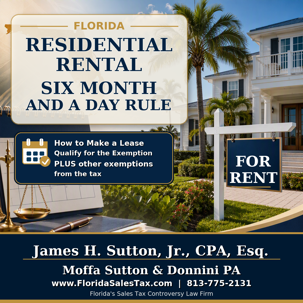
Florida Sales Tax on Residential Rentals: The Six Months and a Day Rule Explained
Why a 183-Day Lease Is Taxable and a 184-Day Lease Is Not — and Why What You Rent Can Matter More Than the Lease Itself
Author: James H. Sutton, Jr., CPA, Esq.
Law Offices of Moffa, Sutton & Donnini, P.A. — Tampa, Fort Lauderdale, Tallahassee
813-775-2131 | JamesSutton@FloridaSalesTax.com | www.FloridaSalesTax.com
Synopsis: Most residential/transient leases for six months or less are subject to sales tax, local surtax, and (in some counties) a local bed tax - with notable exceptions. I have sat across the table from landlords who were stunned to learn that a single missing word in a lease — the word "month-to-month" instead of a stated term — turned three years of rent into a sales tax assessment for at least the first six months. The short answer to the question every Florida residential landlord eventually asks is this: a rental of six months or less is taxable, and a rental for more than six months is not, but "more than six months" means exactly what it says. A lease for precisely six months does not qualify. It has to be six months and at least one day. That single day, and the paperwork proving it, is the difference between an exempt long-term rental and a transient rental subject to Florida's 6% state sales tax plus county surtax and, in many counties, tourist development tax on top of that. This article explains the six-months-and-a-day rule, separate exemptions that apply regardless of individual lease length, the specific lease provisions that will disqualify an otherwise long-term lease, and the audit and criminal exposure landlords face when they get this wrong.
I. Is My Florida Residential Rental Subject to Sales Tax? The Direct Answer
It depends on the length of the lease and the type of building. Under Section 212.03, F.S., Florida imposes a 6% state sales tax — plus county discretionary surtax and, in many counties, tourist development tax — on the rental of living quarters for a term of six months or less. Rent a house, condo, or apartment for longer than six months under a bona fide written lease, and the rental charges are exempt from sales tax entirely. Rent the same property for six months or less, and every dollar of rent is taxable, the same as a hotel room. There is no partial taxation and no proration — the line is binary, and it is drawn at six months, not "about six months" or "close enough."
Separately, and often overlooked, an entire class of rental property is exempt from this tax regardless of individual lease length: buildings intended primarily as a permanent or principal place of residence, such as ordinary apartment complexes. That building-level exemption and the individual six-months-and-a-day lease exemption are two different legal paths to the same result, and landlords who only know one of them tend to either over-collect tax they didn't need to charge or under-collect tax they did. KEEP READING as there are also exemptions for certain RV parks, full time college students, military personnel, hospitals, and nursing homes.
II. The Six Months and a Day Rule: Why One Day Matters
Rule 12A-1.061, F.A.C., implements the exemption at Section 212.03(1), F.S. Transient accommodations leased under a bona fide written lease for periods longer than six months, for continuous residence by the tenant, are exempt from tax. The word "longer" is doing all the work in that sentence. A lease with a stated term of exactly six months does not satisfy the exemption — the Department's own position is that the lease term must exceed six months, which is why practitioners refer to this as the six-months-and-a-day rule. A lease dated to run precisely 182 or 183 days, however common that round number feels to a landlord drafting a form lease, leaves every dollar of rent taxable. If a lease starts on the first day of the month, then the least term must extend through the first day of the seventh month to be exempt according to Rule 12A-1.061.
This is a drafting problem, not a residency problem. The exemption turns on the stated term of the written lease at signing, not on how long the tenant actually ends up living there. A landlord who signs a tenant to a clean twelve-month lease has satisfied the rule from day one, even if the tenant later breaks the lease after four months. Conversely, a landlord who starts a tenant on a six-month lease and simply lets it run month-to-month afterward has a much harder exemption argument — the Department has taken the position that a shorter lease agreement that happens to be extended past six months does not retroactively become an exempt lease, because the bona fide written lease requirement is tested against the term as written.
III. What Disqualifies an Otherwise Long-Term Lease from Being "Bona Fide"
A written lease with a term longer than six months is not automatically exempt — it also has to be a bona fide lease for continuous residence, and the Department has identified specific provisions that will defeat the exemption even when the stated term is long enough. A lease will generally not qualify as bona fide if it: (1) allows the landlord to lease the property back from the tenant; (2) allows the tenant to sublease the property to others for periods of less than six months; (3) does not give the tenant the right to occupy the property for the entire stated lease term; (4) allows the tenant to cancel without penalty absent a genuine change in circumstances such as illness, death, or bankruptcy; or (5) allows the tenant to avoid paying the full amount of rent due under the lease. See Rule 12A-1.061(17).
Each of these provisions is a proxy for the same underlying question: is this arrangement functioning as a genuine long-term residence, or is it a disguised short-term or transient arrangement wearing a long-term lease as a costume? A lease with a cancel-anytime clause or a sublease-for-a-weekend clause looks, in substance, like the flexible short-term arrangement the tax was designed to reach — regardless of what the term on page one says.
IV. The General Building-Level Exemption and the Student/Military Exemption Under Section 212.03(7)(a)
Section 212.03(7)(a), F.S., does two distinct things in the same paragraph, and it is worth separating them. First, it exempts full-time students enrolled in a postsecondary institution and military personnel currently on active duty who reside in any of the facilities described in subsection (1) — hotels, apartment houses, rooming houses, tourist or trailer camps, mobile home parks, RV parks, condominiums, or timeshare resorts — regardless of lease length. This exemption applies irrespective of any other provisions of this section, meaning a full-time student or active-duty service member does not need a six-months-and-a-day lease at all; the Department is empowered to determine acceptable proof of full-time enrollment or active-duty status.
Second, and separately, the same paragraph exempts a category of rental defined by the character of the building itself. The statute exempts rentals to any person who resides in "any building or group of buildings intended primarily for lease or rent to persons as their permanent or principal place of residence." Notably, the statute never uses the word "apartment" here — the exemption is written broadly in terms of the building's primary purpose, not its label, which is why it reaches any building or group of buildings functioning as permanent housing, not merely properties formally called apartment complexes. This is the provision that lets an ordinary residential building lease units on a month-to-month basis to permanent residents without collecting sales tax on any of that rent, even where no individual tenant holds a bona fide written lease exceeding six months. The exemption follows the character of the building, not the paperwork of any one tenancy. This is kind of a dangerous exemption as it lacks parameters. A landlord looking to use this might consider getting a ruling from the state on this exemption.
V. The Separate Mobile Home Park, RV Park, and Trailer Camp Exemption Under Section 212.03(7)(c)
A different, narrower exemption sits in Section 212.03(7)(c), F.S., and it is easy to conflate with the general building-level exemption in (7)(a), but it targets a specific category of property: facilities defined in Section 212.02(10)(f), F.S. — that subsection defines a "trailer camp," "mobile home park," or "recreational vehicle park," not apartment buildings. Rentals at these facilities are exempt when the facility is intended primarily for rental as a principal or permanent place of residence.
The statute builds in a presumption that cuts against parks that also serve transient or seasonal guests. Unless the mobile home park or RV park owner files a verified declaration establishing that more than half of the rental units are occupied by tenants with a continuous residence exceeding three months, the Department will treat the facility as primarily serving transient guests — meaning this exemption is unavailable and the analysis falls back to the individual six-months-and-a-day lease test for every space. This matters for owners of mixed-use RV resorts or mobile home parks that rent some lots to seasonal snowbirds and others to year-round residents; the park-wide exemption is only available if the permanent-resident majority can actually be documented and declared.
VI. The Continuous-Residence Alternative for Guests Without a Written Lease
A related but distinct rule covers accommodations rented without any written lease at all — the classic long-staying hotel or extended-stay guest. Under Rule 12A-1.061, when a person continuously resides at one transient accommodation and pays tax on the rental charges for the first six months, the rental charges for the seventh month and thereafter are exempt for as long as that person continuously resides at the same accommodation. This provision does not require a written lease; it requires actual continuous residence and actual payment of tax for the first six months. It is a narrower, use-based exemption that exists precisely because many extended-stay guests never sign a lease in the first place, and it should not be confused with the bona fide written lease exemption, which can apply from day one if the lease term is drafted correctly.
VII. The Seasonal and Snowbird Trap
Florida's seasonal rental market creates a recurring, predictable compliance problem: owners who rent the same property to a series of different tenants, each for a season of four or five months, and assume that because the arrangement feels like a long-term residential rental — not a hotel — sales tax does not apply. It does. Each individual rental in that series is a transient rental under Section 212.03, F.S., because each lease term is six months or less, and the fact that the property is a single-family home rather than a hotel room changes nothing about the tax analysis. The same trap catches owners who rent to the same snowbird tenant every winter for five months a year: because no single lease exceeds six months and the stays are not continuous within one rental period, neither the bona fide written lease exemption nor the continuous-residence exemption applies, and the rent is taxable season after season.
VIII. Practical Steps for Getting the Six-Months-and-a-Day Rule Right
Draft every lease intended to be exempt with a stated term of at least six months and one day — not a round six months — and confirm the lease contains no leaseback, short-term sublease, early-cancellation-without-cause, or reduced-rent provisions that could defeat bona fide status. Determine whether the property qualifies for the general permanent-residence building exemption under Section 212.03(7)(a), F.S., or, for mobile home and RV parks specifically, the narrower Section 212.03(7)(c) exemption — either of which can moot the individual lease-term analysis entirely if the building or park-wide test is satisfied. Confirm whether any tenants qualify as full-time students or active-duty military, since that exemption applies regardless of lease length. For single-family homes, condos, and any property that mixes short-term and long-term tenants, review each lease independently rather than assuming a track record of long-term tenants protects the whole property. And for owners who have been under-collecting tax on a series of sub-six-month seasonal rentals, Florida's Voluntary Disclosure Program remains the most reliable way to correct multiple years of exposure with a reduced look-back period and abated penalties before an audit finds it first.
IX. Conclusion
The six-months-and-a-day rule is one of the more mechanical tests in Florida sales tax law — it turns on a specific number of days and specific lease language rather than a facts-and-circumstances judgment call — which makes it one of the easier compliance problems to fix and one of the more common ones to get wrong anyway. A landlord who drafts leases with the correct term, avoids the disqualifying provisions, and understands whether the building-level exemption applies to their property rarely has a rental tax problem. A landlord who assumes "long-term enough" is the same as "exempt" usually finds out otherwise at audit. If you own residential rental property in Florida and want your leases and rental structure reviewed before the Department reviews them for you, I would would be glad to help.
Frequently Asked Questions
Is a six-month lease in Florida exempt from sales tax?
No. The exemption under Rule 12A-1.061, F.A.C., requires a lease term longer than six months. A lease for exactly six months does not qualify; the term must be six months and at least one day.
What makes a lease "bona fide" for purposes of the exemption?
A bona fide lease must give the tenant the right to occupy the property for the full stated term without a leaseback to the landlord, a short-term sublease right, penalty-free early cancellation, or a reduced-rent option. A lease containing any of these provisions can lose the exemption even if its stated term exceeds six months.
If a tenant stays past six months on a month-to-month rollover, is the rent exempt from that point forward?
Yes, IF the same accommodation is rented for the entire period, then tax is not due after six months. Change hotel rooms and the six month clock starts over.
Do apartment buildings have to track each tenant's lease term to avoid charging sales tax?
Generally no. Under Section 212.03(7)(a), F.S., any building or group of buildings intended primarily for lease or rent as a permanent or principal place of residence is exempt regardless of individual lease terms. A separate, narrower exemption in Section 212.03(7)(c), F.S. applies specifically to mobile home parks, RV parks, and trailer camps, and requires the owner to file a verified declaration that more than half of the units house tenants continuously residing more than three months.
Do full-time students or military members need a six-month lease to get the exemption?
No. Section 212.03(7)(a), F.S. exempts full-time postsecondary students and active-duty military personnel residing in qualifying facilities regardless of lease length — this exemption applies irrespective of the six-months-and-a-day rule that governs everyone else.
Do institutions that care for the ill, aged, or mentally/physically incapacitated have to charge tax?
No. Florida Rule 12A-1.061(2)(c) specifically exemption institutions that care for the ill, aged, or mentally/physically incapacitated from the tax. Think nursing homes, hospitals, etc.
Do I owe sales tax if I rent my vacation home to a different snowbird each winter for five months at a time?
Yes. Each rental is six months or less, so each one is a taxable transient rental under Section 212.03, F.S. — even though the tenants are long-term compared to a typical short-term rental guest, none of the individual leases exceeds the six-month threshold.
What if my extended-stay guest never signed a written lease at all?
A separate continuous-residence rule can apply: if tax is paid on the rental charges for the first six months of continuous residence at the same accommodation, the charges for the seventh month and thereafter become exempt for as long as that continuous residence continues — without requiring a written lease.
As a landlord, if I only enter into residential leases more than six months, then do I have to even register with the Department of Revenue as a landlord?
No. Rule 12A-1.061(2)(b) provides that a landlord that only enters bona fide written residential leases for more than six months does NOT have to register with the Department of Revenue.
If I am registered as a residential landlord for sales tax with Florida, then do I have to register with the county as well?
Maybe. Some counties have their on “bed tax” “tourist development tax” “hotel tax.” Some of those counties allow the state to administer their tax. Some counties administer the bed tax, which requires landlords to separately register, collect, and remit tax on separate county tax returns.
About the Author
 James H. Sutton, Jr., CPA, Esq. is a State and Local Tax (SALT) attorney and CPA as well as a Shareholder at the Law Offices of Moffa, Sutton, & Donnini, P.A. Mr. Sutton has an almost exclusive focus on Florida sales and use tax controversy. Since 2002, Mr. Sutton has served as an Adjunct Professor of Law at Stetson University College of Law, teaching State and Local Tax, and he also teaches Sales and Use Tax at Boston University School of Law's LLM in Taxation program. If you have any questions, then Mr. Sutton has a FREE INITIAL CONSULTATION policy.
Phone: 813-775-2131 | Email: JamesSutton@FloridaSalesTax.com | View Full Bio
About the Firm
The Law Offices of Moffa, Sutton, & Donnini, P.A. is a Florida law firm practicing almost exclusively in the area of Florida state and local tax (SALT) controversy, with offices in Tampa, Fort Lauderdale, and Tallahassee. The firm's attorneys have over 200 years of combined experience representing businesses in Florida sales and use tax audits, protests, and litigation against the Florida Department of Revenue, and regularly speak and write on Florida sales tax topics for CPAs, attorneys, and business owners across the state.
Additional Resources
Florida Sales Tax on Short-Term and Vacation Rentals: What Airbnb and VRBO Hosts Actually Owe, July 7, 2026, James H. Sutton, Jr., CPA, Esq.
Florida Sales Tax Criminal Investigations: When Sales Tax Experience Matters, June 24, 2026, James H. Sutton, Jr., CPA, Esq.
Florida Sales Tax Voluntary Disclosure: The Best Way to Clean Up a Florida Sales Tax Problem, May 26, 2026, James H. Sutton, Jr., CPA, Esq.
© Copyright 2026. James H Sutton, Jr. All rights reserved.