
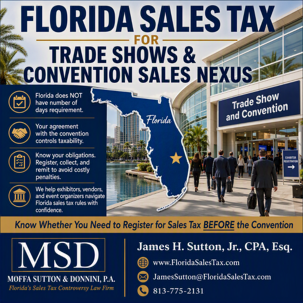
Florida Trade Show and Convention Nexus: Does Exhibiting at a Florida Trade Show Create a Sales Tax Obligation?
Why Your Exhibitor Agreement — Not the Calendar — Determines Whether Three Days on a Miami Convention Floor Creates a Multistate Tax Problem
Author: James H. Sutton, Jr., CPA, Esq.
Law Offices of Moffa, Sutton & Donnini, P.A. — Tampa, Fort Lauderdale, Tallahassee
813-775-2131 | JamesSutton@FloridaSalesTax.com | www.FloridaSalesTax.com
Synopsis: I have represented out-of-state companies who treated a Florida trade show booth as nothing more than a marketing expense — until an audit letter arrived eighteen months later asking why the company never registered to collect Florida sales tax. The short answer to the question in the title is: it depends, and the thing it depends on is not how many days your team spent on the exhibit floor. Florida does not set a bright-line number of trade-show days that triggers nexus. Instead, whether an out-of-state exhibitor must register turns on the written exhibitor agreement, on whether the company also uses independent brokers or sales representatives working Florida on a continuing basis, and on whether the company's total Florida sales already exceed the state's separate $100,000 economic nexus threshold. This article walks through the controlling statute, the two foundational nexus cases every trade-show exhibitor should know — Scripto, Inc. v. Carson and Department of Revenue v. Share International, Inc. — and a practical checklist for exhibiting in Florida without walking into an unregistered-dealer assessment.
I. Does Attending a Florida Trade Show Create Sales Tax Nexus? The Direct Answer
Yes, sometimes — and Florida decides it by contract language, not by counting days. An out-of-state company that displays products or services at a Florida trade show or convention may or may not have to register as a dealer, and the answer comes from the written agreement signed with the show's sponsor or organizer, not from any statutory day-count safe harbor. Layered on top of that contract-driven rule are two older nexus doctrines that predate the trade-show statute and still control a company's broader Florida exposure: whether the company uses Florida-based independent brokers or representatives to solicit business on a continuing basis, and whether an isolated, one-time event like a single trade show can taint every other sale the company makes into Florida. Get the exhibitor agreement wrong, and a straightforward three-day expo becomes a multi-year assessment.
II. The Statute That Actually Controls: Section 212.18(3)(g) and the Exhibitor Agreement Test
Florida law defines an "exhibitor" and sets four distinct registration outcomes. Under Section 212.18(3)(g), Florida Statutes, an exhibitor is any person who enters into an agreement authorizing the display of tangible personal property or services at a convention or a trade show. The statute then does something most nexus statutes do not: it tells you exactly what to look for in the paperwork rather than leaving it to case-by-case audit discretion.
(1) If the exhibitor agreement prohibits the sale of taxable tangible personal property or services, the exhibitor is not required to register as a dealer solely because of the trade show. (2) If the agreement authorizes sales at wholesale only, the exhibitor must obtain a resale certificate from the purchasing dealer but still does not need to register. (3) If the agreement authorizes retail sales of taxable property or services, the exhibitor must register as a dealer and collect tax on those sales. (4) If the exhibitor makes a remote sale within the meaning of the state's economic nexus statute, registration is required on that basis regardless of what the exhibitor agreement says.
The Department's own registration rule, Rule 12A-1.060, F.A.C., tracks this same four-part framework, and it adds an important operational detail: the obligation attaches even if no sale is ever actually made. If the agreement authorizes retail sales, the registration duty exists the moment the agreement is signed. A company that plans a wholesale-only booth but leaves the door open to retail sales "just in case" has, as a matter of contract language alone, created a registration obligation before the booth is even set up.
Practically, this means the single most important document in a Florida trade-show compliance review is not a sales log — it is the exhibitor agreement itself. Pull it before the show, not after the audit notice.
III. Independent Sales Reps and Brokers: The Scripto v. Carson Problem
A recurring pattern among trade-show exhibitors is to attend Florida shows using independent brokers, manufacturer's representatives, or commissioned agents rather than payroll employees, on the theory that an independent contractor relationship keeps the company out of Florida's tax net. The U.S. Supreme Court closed that door sixty-five years ago in Scripto, Inc. v. Carson, 362 U.S. 207 (1960). Scripto, a Georgia corporation with no office, property, or payroll employees in Florida, used ten Florida-based independent brokers who solicited orders on commission and forwarded them to Atlanta for acceptance. The brokers had no authority to bind the company, collect payment, or incur debt on its behalf — the classic hallmarks of a true independent contractor. The Supreme Court held it did not matter. The brokers' continuous, in-state solicitation on Scripto's behalf was enough to create constitutional nexus, and the Court expressly rejected the argument that the independent-contractor label made any difference.
Why this matters for trade-show exhibitors specifically: many companies staff their Florida booths with the same regional independent reps or distributors who solicit Florida business year-round, not just at the show. Scripto teaches that it is the continuity and nature of that solicitation relationship — not the corporate label attached to the individual — that creates nexus. A company whose only Florida contact is genuinely limited to a handful of trade-show days each year is in very different territory than a company that also runs the same brokers on a standing, commission basis between shows.
IV. The Share International Limitation: Why One Trade Show Did Not Taint Every Other Sale
If Scripto is the case that expands nexus, Department of Revenue v. Share International, Inc. (Fla. 1996) is the case that limits it. In Share International, a company representative attended a Florida trade show for several days and collected and remitted Florida sales tax on the sales made at that show — full compliance for the event itself. The Department nonetheless argued that the trade-show presence gave the company nexus for all of its other, unrelated sales shipped into Florida from out of state. Florida's courts disagreed: the isolated, temporary contact created by the trade show, standing alone, was not a sufficient and continuous connection to extend nexus to the company's broader out-of-state sales activity.
The line between Scripto and Share International is continuity, not intent. Ten brokers soliciting Florida business year after year is a standing, continuous relationship with the state. A single representative at a single show, who properly collected tax on the show's own sales and then left, is a temporary, self-contained event. Where a given company's fact pattern falls between those two poles is exactly the kind of question that belongs in a nexus review before — not after — a second, third, or fourth Florida show gets added to the marketing calendar.
It is worth being candid about the limits of Share International as protection: the decision addresses a single isolated show properly handled at the time. It offers little shelter to a company that regularly exhibits at multiple Florida shows each year, or that pairs occasional trade-show attendance with standing independent representatives soliciting business between shows — the fact pattern Scripto controls.
V. No Bright-Line Safe Harbor for Days on the Floor
Some states provide an explicit de minimis threshold — a specific number of trade-show days per year that will not, by itself, create nexus. Florida does not. There is no statute or rule setting a day count below which trade-show attendance is automatically disregarded. The registration analysis under Section 212.18(3)(g) turns on contract language, and the broader constitutional nexus analysis under Scripto and Share International turns on continuity and the nature of the in-state relationship — not on a calendar. A company that assumes "we were only there for two days" is a defense is relying on a safe harbor Florida has never enacted.
VI. Economic Nexus as a Backstop Even Without Meaningful Physical Presence
Even a company with a genuinely limited, isolated trade-show presence in Florida can still owe registration on an entirely separate basis: economic nexus. Florida's economic nexus statute, Section 212.0596, F.S., requires any remote seller making a "substantial number of remote sales" — defined as taxable remote sales into Florida exceeding $100,000 in the prior calendar year — to register, collect, and remit Florida sales tax, effective July 1, 2021. A company that exhibits at a single Florida trade show under a display-only agreement, with no independent Florida brokers and no other physical presence, can still find itself squarely inside Florida's tax net if its total remote sales into the state clear that six-figure threshold. Trade-show nexus analysis and economic nexus analysis are two separate questions, and a clean answer on one does not resolve the other.
VII. Practical Steps Before You Exhibit in Florida
Obtain and read the written exhibitor agreement before the show, not after — it is the single document that determines registration under Section 212.18(3)(g). If the agreement authorizes retail sales, register in advance; if it is wholesale-only, be ready to collect a resale certificate from every purchasing dealer at the show. Inventory whether the company also uses Florida-based independent brokers, sales reps, or distributors on a standing basis between shows — that is a Scripto question, separate from the trade-show statute itself. Track total Florida remote sales against the $100,000 economic nexus threshold regardless of how the trade-show analysis comes out. And if a review turns up several years of unregistered trade-show activity layered on top of standing broker relationships, Florida's Voluntary Disclosure Program can resolve the exposure with a reduced look-back period and abated penalties before the Department finds it first.
VIII. Conclusion
Florida's trade-show nexus rules reward exactly the kind of preparation most exhibitors skip. The controlling statute is contract-driven and knowable in advance; the constitutional case law is sixty-plus years old and consistent; and the one thing that will not save a company is assuming a short visit is automatically safe. Companies that pull the exhibitor agreement before the show, take an honest inventory of their Florida broker and representative relationships, and keep an eye on the separate $100,000 economic nexus threshold rarely have a trade-show nexus problem at all. Those that treat a Florida convention floor as tax-free territory are the ones who hear from the Department eighteen months later. If your company exhibits at Florida trade shows or uses independent Florida representatives and you want your nexus position reviewed before it becomes an audit issue, my office would be glad to help.
Frequently Asked Questions
Does exhibiting at a Florida trade show automatically create sales tax nexus?
Not automatically. Registration turns on the written exhibitor agreement under Section 212.18(3)(g), F.S. — if the agreement authorizes retail sales, registration is required; if it prohibits retail sales or limits the exhibitor to wholesale, it generally is not, based on the trade show alone.
What if our exhibitor agreement prohibits retail sales?
An exhibitor whose agreement prohibits taxable retail sales is not required to register as a dealer solely because of that trade show, under both Section 212.18(3)(g), F.S., and Rule 12A-1.060, F.A.C. A separate registration duty can still exist for other reasons, such as economic nexus or standing Florida representatives.
Does using independent brokers or sales reps in Florida create nexus even without a trade show?
Yes. Under Scripto, Inc. v. Carson, 362 U.S. 207 (1960), continuous solicitation by Florida-based independent brokers or representatives creates nexus regardless of their independent-contractor status. This is a separate and often more durable basis for nexus than trade-show attendance alone.
Did Department of Revenue v. Share International eliminate trade-show nexus in Florida?
No. Share International held that one company representative's isolated attendance at a single Florida trade show — where tax was properly collected and remitted on that show's sales — was not enough, by itself, to extend nexus to the company's unrelated out-of-state sales. It does not protect a company that exhibits at multiple Florida shows regularly or that pairs trade-show attendance with standing Florida broker relationships.
Is there a minimum number of days before a Florida trade show creates nexus?
No. Florida does not provide a day-count safe harbor for temporary trade-show presence. The registration analysis depends on the exhibitor agreement's terms, not on how many days the booth was staffed.
If our exhibitor agreement only allows sales for resale, do we still have any obligations?
Yes — you must obtain a copy of the purchasing dealer's Florida Annual Resale Certificate for each wholesale sale made at the show, even though you are not required to register as a dealer solely for the trade show itself.
Can we owe Florida tax on trade-show sales even if we have no other Florida presence at all?
Yes, through economic nexus. Under Section 212.0596, F.S., any remote seller whose total taxable Florida sales exceeded $100,000 in the prior calendar year must register and collect tax, regardless of the trade-show analysis or any physical presence question.
About the Author
 James H. Sutton, Jr., CPA, Esq. is a State and Local Tax (SALT) attorney and CPA as well as a Shareholder at the Law Offices of Moffa, Sutton, & Donnini, P.A. Mr. Sutton has an almost exclusive focus on Florida sales and use tax controversy. Since 2002, Mr. Sutton has served as an Adjunct Professor of Law at Stetson University College of Law, teaching State and Local Tax, and he also teaches Sales and Use Tax at Boston University School of Law's LLM in Taxation program. If you have any questions, then Mr. Sutton has a FREE INITIAL CONSULTATION policy.
Phone: 813-775-2131 | Email: JamesSutton@FloridaSalesTax.com | View Full Bio
About the Firm
The Law Offices of Moffa, Sutton, & Donnini, P.A. is a Florida law firm practicing almost exclusively in the area of Florida state and local tax (SALT) controversy, with offices in Tampa, Fort Lauderdale, and Tallahassee. The firm's attorneys have over 200 years of combined experience representing businesses in Florida sales and use tax audits, protests, and litigation against the Florida Department of Revenue, and regularly speak and write on Florida sales tax topics for CPAs, attorneys, and business owners across the state.
Additional Resources
Florida Sales Tax Voluntary Disclosure – The Best Way to Clean Up Sales Tax Problems, May 26, 2026, by James H Sutton, Jr., CPA, Esq.
Florida Sales Tax Audits of Convenience Stores: A Guide for Owners and Their CPAs, July 14, 2026, James H. Sutton, Jr., CPA, Esq.
Florida Sales Tax on Construction: (3)(d) Retail Sale Plus Installation, July 13, 2026, James H. Sutton, Jr., CPA, Esq.
Florida Sales Tax: Public Works Contracts Guide: What Construction Companies and Their CPAs Need to Know Including the New University Refund Law, July 11, 2026, James H. Sutton, Jr., CPA, Esq.
Florida Sales Tax on Short-Term and Vacation Rentals: What Airbnb and VRBO Hosts Actually Owe, July 7, 2026, James H. Sutton, Jr., CPA, Esq.
Florida Sales Tax for E-Commerce Sellers, June 2026, James H. Sutton, Jr., CPA, Esq.
Is Software as a Service (SaaS) Taxable in Florida?, July 2026, James H. Sutton, Jr., CPA, Esq.
© Copyright 2026. James H Sutton, Jr. All rights reserved.