
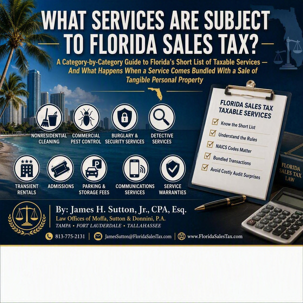
What Services Are Subject to Florida Sales Tax?
A Category-by-Category Guide to Florida's Short List of Taxable Services — And What Happens When a Service Comes Bundled With a Sale of Tangible Personal Property
By: James H. Sutton, Jr., CPA, Esq.
Law Offices of Moffa, Sutton & Donnini, P.A. — Tampa, Fort Lauderdale, Tallahassee
813-775-2131 | JamesSutton@FloridaSalesTax.com | www.FloridaSalesTax.com
In the last 15 years, one of the most common things I hear is that “labor is not taxable” in Florida. While that is true most of the time, there are times when labor/services are taxable. Business owners need to understand when labor/services are taxable for both sales and purchases. Florida's sales tax starts from a tax on tangible personal property and then reaches out, by specific statute, to grab a short and closed list of services — nonresidential cleaning, nonresidential pest control, and a handful of investigative and protective services chief among them — while leaving the vast majority of services, including every licensed profession, untouched. This article walks through each category of taxable service on that list, explains where a rental, an admission charge, or a warranty fits into the picture, and closes with the single issue that generates more audit assessments than all of the enumerated services combined: what happens to the tax when a contractor sells tangible personal property and installs it in the same transaction.
I. The General Rule: Florida Taxes Tangible Personal Property — Not Services
Section 212.05, Florida Statutes, opens by declaring that every person is exercising a taxable privilege who is "engaged in the business of selling tangible personal property at retail," or who "rents or furnishes any of the things or services taxable under this chapter." That second clause is doing quiet but important work: it taxes services only to the extent a service is specifically made taxable somewhere in Chapter 212. Unlike states that impose a broad, gross-receipts-style tax that reaches most services unless specifically exempted, Florida runs in the opposite direction — services are presumed nontaxable unless the Legislature has expressly listed that particular service in the statute.
Why this matters in an audit. We regularly see auditors treat a service as taxable simply because the customer is a business, or because the service touches a commercial building, or because the auditor has seen it taxed before somewhere else. None of that is the legal test. The correct question is always narrower: does this specific service appear on Florida's enumerated list, and does the transaction in front of us actually fit the statutory description? Parts II through V below walk through the four specific taxable services — nonresidential cleaning, commercial pest control, commercial/residential burglary and security services, and detective services. Part VI explains why the precise NAICS code matters even within those four categories, and Parts VII through XI cover the rest of the enumerated list (transient rentals, admissions, parking and storage fees, communications services, and service warranties). Part XII addresses the far more common scenario of a service bundled into a sale of tangible personal property.
II. Nonresidential Cleaning Services
Section 212.05(1)(i)1.b., F.S., imposes the state's 6 percent sales tax on charges for nonresidential cleaning services, cross-referencing NAICS National Number 561720 (janitorial services). Rule 12A-1.0091, F.A.C. fills in the details.
What is being cleaned controls — not who pays. The rule turns on whether the building being cleaned is residential or nonresidential. A detached home, apartment, condominium, or nursing home is residential and exempt, even if a commercial property management company writes the check. An office building, warehouse, restaurant, or retail store is nonresidential and taxable, even if a tax-exempt nonprofit occupies it (the occupant's own exemption certificate would still need to be honored separately). Auditors sometimes reverse this test and assume that because a commercial entity hired the vendor, the service must be taxable — that is not the law.
Aircraft, boats, and vehicles are carved out. The rule does not treat aircraft, boats, motor vehicles, or other transportation equipment as a "nonresidential building," so cleaning those items falls outside this provision entirely (though cleaning of tangible personal property can implicate a different rule, discussed in Part XII below).
Employees are never taxable. Under Rule 12A-1.0161, F.A.C., the tax reaches only services purchased from an outside vendor. A business that simply hires its own janitorial staff as W-2 employees owes no sales tax on their wages, regardless of what kind of building they clean.
III. Commercial Pest Control Services
The same statutory paragraph, section 212.05(1)(i)1.b., F.S., also taxes nonresidential (commonly referred to as commercial) pest control services, cross-referencing NAICS National Number 561710. Rule 12A-1.009, F.A.C. governs the details, and it runs on the same residential-versus-nonresidential building test described in Part II — bird control, exterminating, fumigating, and termite treatment are all taxable when performed at an office, warehouse, restaurant, or other commercial or industrial building, and not taxable when performed at a private residence.
A few narrow carve-outs. The spraying of lawns — residential or nonresidential — is never taxable, and pest control performed for agricultural or forestry purposes is likewise exempt. A residential utility shed sprayed along with the main house is treated as part of the residential service, provided no commercial activity takes place in the shed. As with cleaning, aircraft, boats, and motor vehicles are not "buildings" for purposes of this rule, and in-house employee pest-control work is never taxable.
IV. Commercial/Residential Burglary and Security Services
Section 212.05(1)(i)1.a., F.S., taxes burglar and security services identified under NAICS National Number 561621 (security systems services), which Rule 12A-1.0092, F.A.C. implements. Burglar alarm, fire alarm, and security system monitoring and maintenance — along with bodyguard and personal-protection services — all fall within this category, per the Department of Revenue's own published guidance (GT-800018).
Unlike cleaning and pest control, there is no residential exemption. Cleaning and pest control services are taxable only when performed at a nonresidential building. Burglar and security services carry no equivalent carve-out — a homeowner's residential alarm monitoring contract is just as taxable as a commercial building's. This is the single most common trap for security companies that assume a "residential" job is automatically tax-free the way a residential cleaning job would be.
A 2014 repeal effort went nowhere. CS/SB 500 (2014) would have removed security systems services from this paragraph; the bill was withdrawn from consideration before it ever reached a floor vote, and the tax remains in force today exactly as it has for years.
V. Detective Services
The remaining piece of section 212.05(1)(i)1.a., F.S., reaches detective and investigation services under NAICS National Numbers 561611 (investigation services), 561612 (security guard and patrol services), and 561613 (armored car services) — the balance of the NAICS codes covered by Rule 12A-1.0092, F.A.C.. Detective agency work, skip tracing, missing-person tracing, polygraph and lie-detection services, fingerprinting, and guard and patrol services are all taxable under this category.
Small private investigative agency exemption. Effective July 1, 2023, Section 212.08(7)(qqq), F.S., exempts private investigation services sold by a "small private investigative agency" — one licensed under section 493.6201, F.S., that employs three or fewer full- or part-time employees and, in the prior calendar year, had less than $150,000 in private investigation charges across all commonly owned businesses. The exemption does not apply in an agency's first calendar year of operation, so a newly licensed investigator cannot rely on it out of the gate.
VI. Why the NAICS Code Matters
Everything discussed in Parts II through V turns on a specific NAICS code, not on a plain-English label. That distinction is not a technicality — it is frequently the entire ballgame, because Florida's taxable-services statute reaches only the exact NAICS classification written into the law. If a business's activity is more accurately classified under a narrower, related NAICS code that the Legislature did not include, the service is not taxable, even though a layperson — or an inexperienced auditor — would call it the same thing in conversation.
Carpet cleaning is the clearest example. Section 212.05(1)(i)1.b., F.S., taxes NAICS 561720 (janitorial services), and one might assume commercial carpet cleaning is simply a subset of janitorial work. It is not. The federal classification system gives carpet and upholstery cleaning its own distinct code, NAICS 561740, which is nowhere on Florida's taxable-services list. Because the statute reaches 561720 by number and nothing more, commercial carpet cleaning falls outside the tax entirely — a result the Department itself has confirmed even though it surprises most business owners (and more than a few auditors).
Post-construction cleaning is the second recurring example. Cleaning companies that follow behind a general contractor — removing construction debris, wiping down surfaces, and preparing a building for its final certificate of occupancy — are commonly classified under the more narrow NAICS 238990 (Construction Site Clean-Up services), a construction classification rather than the broader NAICS 561720 nonresidential cleaning. The Department has reached this same conclusion in its own advisements: construction-phase debris removal and post-construction cleanup have repeatedly been treated as nontaxable construction activity rather than taxable nonresidential cleaning, while routine janitorial service that begins after the building is complete and occupied is a different story and does become taxable at that point. The line is timing and purpose — cleanup that is part of finishing the construction job is not the same NAICS activity as ongoing janitorial maintenance of a completed building.
The practical lesson. Before conceding that a cleaning, pest-control, security, or investigative charge is taxable — or before assuming it is not — identify the specific NAICS code that actually describes the activity, and compare that number against the codes written into section 212.05(1)(i), F.S. This is exactly the kind of detail that gets missed in a fast-moving audit, and it can just as easily work in the Department's favor as against it if nobody checks. We make it standard practice to run this comparison on every cleaning, pest-control, or protective-services engagement we review, in both directions — for what a client is charging its own customers, and for what a client is being charged by its vendors.
VII. Transient Rental Accommodations
Section 212.03, F.S., taxes the total rental charge for living, sleeping, or housekeeping accommodations rented for six months or less — hotels, motels, vacation rentals, and similar short-term stays. A rental of the same type of space for a period longer than six months is generally treated as an exempt residential tenancy rather than a taxable transient rental. We have covered the mechanics of that six-month line, and the traps that come with it, in a dedicated article listed in the Additional Resources below. However, a reason for bringing up this topic in a taxable services article is that transient rental landlords often throw in additional fees for things, such as a cleaning fee. While you might jump to the conclusion that a home rented out as an AirBnB would be a residential cleaning and exempt from the sales tax on the service, your logic would be sound, but you still have a wrong conclusion. You are right that a cleaning fee to someone staying in a short term rental home would NOT be subject to sales tax as cleaning service, the fee would be subject to both sales tax AND any local tourist bed taxes as part of the rent paid for occupancy of the room.
VIII. Admissions
Section 212.04, F.S., imposes sales tax on admission charges to places of amusement, sport, or recreation — theme parks, concerts, sporting events, gyms and health clubs, golf and country club membership dues, and similar access-for-a-fee arrangements. "Admission" is defined broadly under Rule 12A-1.005, F.A.C., and reaches initiation fees and membership dues to private clubs in addition to per-visit ticket prices, so a business that assumes admissions tax only applies to a box-office ticket window can be caught off guard during an audit of membership-based revenue.
IX. Parking, Vehicle Storage, Boat Docking, and Aircraft Tie-Down Fees
This category deserves special attention because the law changed underneath it in 2025. For years, the tax on parking or storage spaces for motor vehicles, docking or storage spaces for boats, and tie-down or storage space for aircraft lived in section 212.031, F.S., alongside the state's commercial real property rental tax. House Bill 7031 completely repealed section 212.031, F.S., effective October 1, 2025, ending the 2 percent state tax on commercial real property rentals.
The repeal did not touch parking, docking, or tie-down fees — it just relocated them. The Department of Revenue's guidance on the repeal (TIP 25A01-04) confirms that sales tax and any applicable discretionary sales surtax continue to apply, without interruption, to parking or storage spaces for motor vehicles in parking lots or garages, docking or storage spaces for boats in boat docks or marinas, and tie-down or storage space for aircraft at airports — but now under section 212.03, F.S., the same transient-rentals statute discussed in Part VII, rather than the now-repealed section 212.031. A practitioner who still cites section 212.031, F.S., for these charges in a protest filed after October 1, 2025, is citing dead law, even though the tax result for the client is unchanged.
X. Communications Services: A Different Tax Under a Different Chapter
Charges for telephone service, VoIP, cable and satellite television, and similar communications are not taxed under Chapter 212 at all. They are taxed under the separate Communications Services Tax of Chapter 202, F.S., which layers a state rate and a local rate on top of communications charges using its own definitions, its own exemptions, and its own dealer registration and return process. We include it here only because clients frequently ask "is my phone bill sales tax," and the honest answer is that it is a different tax entirely — one that happens to look and feel like sales tax on an invoice.
XI. Taxable Service Warranties
Section 212.0506, F.S., taxes the sale of a "service warranty" — an extended warranty, maintenance agreement, or similar contract sold in connection with tangible personal property, real property, or certain services, under which the issuer agrees to repair, replace, or maintain the covered item for a stated period. A service warranty sold on tangible personal property is generally taxed the same way the underlying property would be taxed if sold outright, which is why an extended warranty sold at the register with a taxable television or appliance is itself taxable, even though the warranty is, strictly speaking, a promise rather than a piece of property.
XII. When a "Service" Becomes a Taxable Sale of Tangible Personal Property: Installation, Repair, and Contractor Transactions
Every category above involves the Legislature reaching out and taxing a pure service by name. The far more common way a "service" ends up taxed in Florida, however, has nothing to do with the enumerated list at all — it happens because the service is bundled into the sale of tangible personal property, and Florida taxes the entire bundle.
The statutory hook. Section 212.02(16), F.S., defines "sales price" as the total amount paid for tangible personal property, "including any services that are a part of the sale," without any deduction for labor, materials, or other costs. Combined with the general 6 percent tax on retail sales of tangible personal property under section 212.05, F.S., this means that once tangible personal property changes hands in a transaction, the labor to assemble or install it rides along as part of the taxable sales price — separately stating the installation charge on the invoice does not exempt it.
Repairs to tangible personal property. Under Rule 12A-1.006, F.A.C., where a repairer furnishes the parts, the entire charge for adjusting, applying, installing, maintaining, remodeling, or repairing tangible personal property is taxable — parts and labor together. There is a narrow carve-out for separately stated labor on the repair and maintenance of large aircraft exceeding 20,000 pounds maximum certified takeoff weight, but outside that specific exception, a repair shop cannot avoid tax on its labor simply by writing "labor" on a separate invoice line. Never assume a labor-only charge escapes tax on that basis alone; the parts-furnished trigger controls.
The Real Property Line: Rule 12A-1.051, F.A.C.
The analysis changes entirely once the item being installed becomes part of real property rather than remaining tangible personal property. Rule 12A-1.051, F.A.C., governs contracts to improve real property and sorts a contractor's work into categories based on whether the item installed loses its separate identity and becomes a fixture — an accessory to a building or structure that becomes permanently attached to the realty, as described in section 212.06(14)(a), F.S.
Real property improvement contracts. Where a contractor installs an item that becomes a fixture — cabinetry built into the structure, a central air handler, in-ground plumbing — the contractor is generally treated as the ultimate consumer of the materials. The contractor pays sales tax on the cost of the materials when purchased, and does not separately charge the customer sales tax on the installed contract price. This is the framework behind Technical Assistance Advisement 04A-040, where a residential developer's appliance contract split cleanly between built-in appliances that became real property (materials taxed to the contractor, no tax charged to the homeowner on the installed price) and freestanding appliances that remained tangible personal property (full sales price, including delivery and installation, taxed to the homeowner).
Retail sale with installation — the item stays tangible personal property. Where the item retains its character as tangible personal property even after being set in place — because it remains readily removable, or because the contract itself treats the item as severable personal property rather than a permanent improvement — the vendor charges tax on the full sales price, including delivery and installation labor. Technical Assistance Advisement 13A-025 (plantation shutters) and TAA 96A-003 (installed signs) both illustrate this outcome: in each case, the item's contractual and physical characteristics kept it in the tangible-personal-property column, so the full contract price, not just the materials, was taxable.
The "one drop of oil" principle. As we have written elsewhere, when any tangible personal property transfers to the customer as part of an otherwise service-labeled transaction, the entire charge — including any professional or service fee bundled with it — becomes taxable. Separately stating the service fee does not cure this. The rule does not apply to true professional services performed by CPAs, attorneys, or architects, but it does reach transactions like catering, event planning, and any contractor arrangement where the "service" cannot be cleanly separated from tangible personal property that changes hands in the same transaction.
Because this line — fixture versus tangible personal property, real property contract versus retail sale — is drawn case by case and turns on facts like attachment method, contract language, and industry practice, it is one of the most heavily litigated distinctions in Florida sales tax law, and the source of a large share of the contested audit assessments our firm handles. We address the construction-industry version of this issue, including the subcontractor-as-vendor trap on public works jobs, in the Public Works Contracts guide listed below.
XIII. Frequently Asked Questions
Does Florida charge sales tax on professional services like legal, accounting, or medical services?
No. Professional services are not on Florida's enumerated list of taxable services, and no tangible personal property changes hands in a typical professional engagement. The analysis changes only if tangible personal property is sold alongside the service — for example, a dentist selling a take-home teeth-whitening kit.
Is lawn care or landscaping taxable in Florida?
No. Rule 12A-1.009(6), F.A.C., specifically states that spraying lawns — residential or nonresidential — is not taxable pest control, and general lawn mowing and landscaping maintenance are not on the enumerated services list at all.
If I hire a contractor to install a water heater or built-in cabinets in my home, is the installation labor taxed?
It depends on whether the installed item becomes a fixture (real property) or remains tangible personal property under Rule 12A-1.051, F.A.C. If it becomes a fixture, the contractor pays tax on the materials and generally does not separately charge you tax on the installed price. If the item remains tangible personal property, the full price — including installation labor — is taxable. This is exactly the line-drawing exercise described in Part XII above, and it is worth getting a second opinion on before assuming either answer.
Are nonresidential cleaning services taxable even if the customer is a tax-exempt nonprofit?
Yes, unless the nonprofit has its own Florida sales tax exemption certificate and presents it to the vendor. Whether the service itself falls within taxable nonresidential cleaning depends on the nature of the building being cleaned, not on who is paying the bill.
Do I owe sales tax on my home or business alarm monitoring service?
Yes. Security systems services, including alarm monitoring, fall under NAICS 561621 and remain taxable under section 212.05(1)(i)1.a., F.S. A 2014 bill that would have removed this tax was withdrawn before it passed.
Since Florida repealed the commercial rental tax, is parking or boat dock rental now tax-free too?
No. The October 1, 2025 repeal eliminated the tax on commercial real property rentals generally, but the Legislature specifically preserved the tax on parking or storage for motor vehicles, boat docking or storage, and aircraft tie-down or storage space — those charges simply moved to section 212.03, F.S.
About the Author
 James H. Sutton, Jr., CPA, Esq. is a Shareholder at the Law Offices of Moffa, Sutton & Donnini, P.A. and practices almost exclusively in the area of Florida sales and use tax controversy. James has been a licensed Certified Public Accountant since 1994 and a member of The Florida Bar since 1998. For 20 years, Mr. Sutton has served as an Adjunct Professor of Law at Stetson University College of Law, teaching State and Local Tax, and also taught Sales and Use Tax at Boston University School of Law's LLM in Taxation program. If you have any questions, then Mr. Sutton has a FREE INITIAL CONSULTATION policy. He can be reached directly at 813-775-2131 or JamesSutton@FloridaSalesTax.com.
About the Firm
The Law Offices of Moffa, Sutton & Donnini, P.A. practices almost exclusively in the area of Florida state and local tax (SALT) controversy, with offices in Tampa, Fort Lauderdale, and Tallahassee, and over 200 years of combined experience on the team.
Additional Resources
Florida Sales Tax Audit Help — June 20, 2026, by James H. Sutton, Jr., CPA, Esq.
Florida's Public Works Contracts Guide — July 2026, by James H. Sutton, Jr., CPA, Esq.
Florida Sales Tax on Residential Rentals – The Six Month and A Day Rule — August 4, 2026, by James H. Sutton, Jr., CPA, Esq.
Florida Sales Tax Audits of Convenience Stores — July 2026, by James H. Sutton, Jr., CPA, Esq.
Florida Sales Tax Voluntary Disclosure: The Best Way to Clean Up a Florida Sales Tax Problem — May 26, 2026, by James H. Sutton, Jr., CPA, Esq.
Florida Sales Tax Criminal Investigations: When Sales Tax Experience Matters — June 2026, by James H. Sutton, Jr., CPA, Esq.
© Copyright 2026. James H Sutton, Jr. All rights reserved.