
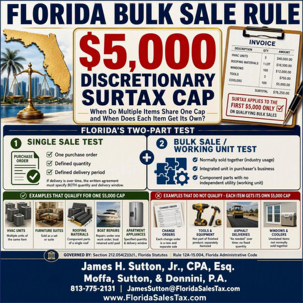
Florida Bulk Sale Rule Guide to the $5,000 Discretionary Surtax Cap
How Florida's Two-Part Test Decides Whether Multiple Items Sold Together Share One $5,000 Cap or Each Get Their Own
By: James H. Sutton, Jr., CPA, Esq.
Law Offices of Moffa, Sutton, & Donnini, P.A.
813-775-2131 | JamesSutton@FloridaSalesTax.com | www.FloridaSalesTax.com
My firm has represented thousands of Florida businesses in more sales tax audits, and the $5,000 discretionary sales surtax limitation on tangible personal property remains one of the most consistently misapplied rules in the entire sales tax code — misapplied by dealers, purchasers, and auditors alike. This article walks through Florida's bulk sale rule from the governing statute through the Department of Revenue's own Technical Assistance Advisements, focusing on the question every multi-item invoice raises: are these separate items, each entitled to its own $5,000 cap, or one bulk sale entitled to only a single cap for the whole transaction?
I. Why the $5,000 Cap Exists — and Why It's Worth Getting Right
Florida's discretionary sales surtax generally piggybacks on the state sales tax: wherever a transaction is taxable and occurs in a county that has adopted a local surtax, the surtax applies on top of the state's 6% rate. But the Legislature built in an important limitation for tangible personal property. Under section 212.054(2)(b)1., Florida Statutes, the surtax applies only to the first $5,000 of the sales amount on any single item of tangible personal property. Sell a piece of equipment for $50,000, and the county surtax applies to only the first $5,000 of that price — the remaining $45,000 is surtax-free.
That limitation creates an obvious question: what happens when a customer buys several items at once? If a contractor buys a truckload of building materials, or a developer buys 250 refrigerators for an apartment complex, is the $5,000 cap applied once to the entire purchase, or separately to every single line item? Get the answer wrong on a large invoice, and the surtax exposure — or the surtax refund — can run into real money, particularly in counties stacking multiple discretionary surtaxes on top of one another.
The answer turns on what the Department of Revenue calls the “bulk sale rule,” codified in Rule 12A-15.004, Florida Administrative Code, and interpreted repeatedly through Technical Assistance Advisements. This article breaks the rule into its two component tests, works through the Department's own examples, and highlights where taxpayers most often get tripped up — particularly around the recurring question of when products are considered “normally sold together.”
II. The Statutory Foundation: Section 212.054, Florida Statutes
Section 212.054(2)(b)1., Florida Statutes, provides the core rule: the sales amount above $5,000 on any item of tangible personal property is not subject to the discretionary sales surtax. The same subsection then carves out the bulk sale exception in the language that everything else in this article interprets:
“[I]f two or more taxable items of tangible personal property are sold to the same purchaser at the same time and, under generally accepted business practice or industry standards or usage, are normally sold in bulk or are items that, when assembled, comprise a working unit or part of a working unit, such items must be considered a single item for purposes of the $5,000 limitation when supported by a charge ticket, sales slip, invoice, or other tangible evidence of a single sale or rental.”
Read carefully, that single sentence contains two separate, independent requirements, both of which must be satisfied before multiple items can be treated as one item for purposes of the cap. The Department of Revenue and the courts have distilled this into what practitioners call the single sale test and the bulk sale/working unit test. Fail either one, and each item on the invoice is subject to its own, separate $5,000 limitation.
III. Rule 12A-15.004, F.A.C.: The Department's Two-Part Test
The Department's governing rule, Rule 12A-15.004, Florida Administrative Code, fleshes out the statute with specific documentation requirements and a long list of worked examples. Subsection (3) of the rule confirms that the $5,000 limitation applies to multiple items only when the sale meets both the single sale requirement of paragraph (a) and the bulk sale/working unit requirement of paragraph (b). Both tests are addressed in turn below.
IV. The Single Sale Test
What it requires. The purchaser must buy all of the items from the dealer in a single, documented transaction. Rule 12A-15.004(3)(a), F.A.C., requires tangible evidence of the sale — an invoice, sales slip, charge ticket, or written purchase order — establishing that the items were sold together. If delivery of all the items will not happen on the same day, the written purchase order or agreement must specify both a specific quantity of tangible personal property and a specific time period within which delivery will occur. Without both of those elements, each delivery (or each invoice) is treated as its own, separate sale.
The refrigerator example. The rule's own illustration is instructive: a developer purchases 250 refrigerators for an apartment complex, with delivery in ten loads of twenty-five refrigerators as buildings are completed, invoicing to follow each delivery, and final delivery required within ten months of signing. Because the agreement specifies both the total quantity and the delivery window, the entire 250-refrigerator purchase is treated as a single sale — even though it will take ten separate deliveries and ten separate invoices to complete. Contrast that with a road contractor who agrees to buy “all the asphalt needed” for a job over six months at a set price per ton, with no fixed quantity specified. Because that agreement never commits to a quantity, every delivery is its own separate sale.
Change orders break the chain. Technical Assistance Advisement 21A-005 illustrates how easily the single sale test can fail in practice. A general contractor argued that its entire concrete purchase for a construction project qualified for the $5,000 cap as one bulk sale. The Department disagreed. The purchase agreement was not signed at the same time as the related subcontract agreements, the documentation did not clearly specify quantity and delivery timing, and — critically — there were three separate change orders issued over the course of the project. The Department held that each change order constitutes a new order and a separate sale in its own right, meaning each change order had to independently satisfy both the single sale test and the bulk sale/working unit test. Because the underlying documentation could not establish one continuous single sale, the entire $5,000 cap claim failed on this threshold test alone — without the Department ever having to reach the bulk sale/working unit question.
V. The Bulk Sale/Working Unit Test — When Are Products “Normally Sold Together”?
Even a well-documented single sale does not automatically qualify for the cap. The items themselves must also meet the bulk sale/working unit test. Rule 12A-15.004(3)(b), F.A.C., recognizes four independent categories of qualifying items, and a transaction needs to satisfy only one of the four:
- Multiple quantities of a single item that the dealer normally sells in multiple quantities, or that the purchaser normally buys in multiple quantities, in the ordinary course of business;
- Items normally sold as a set or a unit, where the utility of each piece for its intended purpose depends on the set being complete;
- Items normally sold in a single sale for use in the purchaser's normal business practice as an integrated unit; or
- Component parts that have no utility unless assembled with each other into a working unit, or part of a working unit.
Category 1 — multiple quantities of a single item. This is the most literal “bulk sale” category. When an HVAC contractor who normally purchases several heating and air conditioning units at the same time buys several units on one invoice from the same dealer, the Department applies the $5,000 cap to the entire invoice — not to each unit separately — because multiple units of the same equipment are exactly what that contractor normally buys in bulk.
Category 2 — sets and suites. Furniture is the Department's own example. When a furniture dealer advertises, sells, and invoices a suite or set of furniture for a single price, without breaking out the individual pieces, the $5,000 cap applies once to the entire suite. But if that same dealer sells the individual pieces and separately itemizes each one on the invoice, the cap applies separately to each piece. The dealer's own invoicing practice — lump sum versus itemized — can determine the tax result.
Category 3 — integrated units used in the purchaser's business. Technical Assistance Advisement 21A-006 offers a detailed illustration of this category outside the construction context. A marine repair yard performed a series of repairs on a customer's boat under a single Service and Storage Contract and Work Order, adding activities over several months, all reflected on one final invoice, with the yard retaining custody and control of the boat until the final bill was paid in full. The Department held that a boat is properly treated as a “working unit” for these purposes, that the repair items were sold as an integrated unit for use in the boat's operation, and — because the repairs all traced back to a single original work order and the yard never released the boat mid-repair — the single sale test was satisfied as well. The result: the $5,000 surtax cap applied to the entire repair invoice, not to each repair line item. (Practitioners should also note the related cap in section 212.05(5), Florida Statutes, limiting the total tax, surtax included, on a single boat repair to $60,000.)
Category 4 — component parts with no independent utility. The Department's classic example here is a roofing job: when a lumber and building supply dealer sells lumber, nails, felt, shingles, and other materials that the purchasing roofing contractor uses to construct a single roof, the surtax cap applies once to the entire single sale, because none of those individual materials has any utility to the purchaser except as part of the finished roof. The rule draws a sharp line, however, for items in the same sale that do not become part of the finished product — hammers, saws, shovels, and other tools used to build the roof are separately itemized and get their own, individual $5,000 caps, because tools are not components of the roof itself.
VI. Items That Cannot Be Aggregated
Rule 12A-15.004(3)(c), F.A.C., is the mirror image of the bulk sale/working unit test: multiple items sold in a single transaction that are not normally sold in bulk, and that will not be assembled into a working unit or integrated unit, cannot be lumped together for purposes of the $5,000 limitation — no matter how the invoice is formatted. Mixing qualifying and non-qualifying items on the same invoice does not taint the qualifying items or rescue the non-qualifying ones; the rule requires looking at each category of item separately. A single invoice can properly apply the surtax cap once to a bulk-qualifying group of items and separately, item-by-item, to everything else on that same invoice. Example, a home builder buying 100 windows and 100 Yeti coolers on the same invoice. Because these two types of items are not normally sold together and are not parts of a working unit, the 100 windows and 100 coolers each have their own $5,000 bulk sale surtax cap.
VII. Practical Compliance Tips
- Get the quantity and delivery window in writing. If delivery will be staggered, the purchase order or agreement must specify both the total quantity to be purchased and the time period for delivery — open-ended “as-needed” agreements will not qualify as a single sale.
- Treat every change order as a fresh transaction. Under TAA 21A-005, a change order is a new sale that must independently satisfy both tests — it does not simply attach to the original purchase order's documentation.
- Document the purchaser's normal buying pattern. For the multiple-quantities category, be prepared to show that the purchaser (or the industry) normally buys that item in bulk quantities, not just that this particular purchase happened to involve several units.
- Watch how invoices are itemized. Selling a suite or set for one lump-sum price supports the cap applying once; itemizing each piece separately on the same invoice can defeat that result even for the identical furniture.
- Separately itemize tools and non-component items. Materials that become part of a finished working unit qualify for aggregation; equipment and tools used to build that unit generally do not and should be broken out on the invoice.
- Maintain custody-and-control evidence for service and repair work on boats. In the marine repair context, the dealer's continuous custody of the property until final payment helped establish that all of the work traced back to a single sale.
VIII. Conclusion
Florida's bulk sale rule rewards careful documentation and punishes loose invoicing. The same set of physical items can be taxed very differently under the discretionary sales surtax depending on how the purchase order is drafted, whether delivery windows and quantities are pinned down in writing, how change orders are handled, and how the final invoice is itemized. Businesses that regularly sell or purchase multiple items in a single transaction — contractors, furniture dealers, HVAC installers, marine repair yards, and equipment distributors chief among them — should build these two tests into their standard contracting and invoicing practices before an audit forces the issue.
Frequently Asked Questions
What is Florida's bulk sale rule for sales tax purposes?
It is the informal name for the exception in section 212.054(2)(b)1., Florida Statutes, and Rule 12A-15.004, F.A.C., that lets multiple items of tangible personal property sold to the same purchaser in a single transaction be treated as one item for purposes of the $5,000 discretionary sales surtax cap — but only if the sale passes both the single sale test and the bulk sale/working unit test.
Does the $5,000 surtax cap apply to services?
No. The $5,000 limitation applies only to sales of tangible personal property. Services, admissions, and commercial or residential real property rentals subject to the discretionary surtax are taxed on their full amount, with no per-transaction cap.
If delivery happens over several months, can the sale still qualify as a single sale?
Yes, but only if the written purchase order or agreement specifies both the total quantity to be purchased and the time period within which delivery will occur. Open-ended agreements to deliver goods “as needed,” with no fixed quantity, will not qualify — each delivery is treated as its own separate sale.
Are furniture sets subject to the $5,000 cap once, or once per piece?
It depends on how the dealer invoices the sale. A suite or set sold and invoiced for one lump-sum price is capped once. The same furniture, if the dealer separately itemizes each piece on the invoice, is capped separately, piece by piece.
Can a change order break up an otherwise qualifying bulk sale?
Yes. The Department of Revenue treats each change order as a new, separate sale that must independently satisfy both the single sale test and the bulk sale/working unit test — it cannot simply ride on the documentation from the original purchase order.
Is there a similar cap for real property construction contracts?
The $5,000 discretionary surtax limitation applies specifically to sales of tangible personal property. Rule 12A-15.004, F.A.C., cross-references Rule 12A-15.008, F.A.C., for how the limitation applies to fabricated items used in the performance of a real property contract, which involves a separate analysis beyond the scope of this article.
About the Author
 James H. Sutton, Jr., CPA, Esq. is a State and Local Tax (SALT) attorney/CPA and practices almost exclusively in the area of Florida sales and use tax controversy. James is a Shareholder at the Law Offices of Moffa, Sutton, & Donnini, P.A. and has been a licensed Certified Public Accountant since 1994 and a member of The Florida Bar since 1998. For 20 years, Mr. Sutton has served as an Adjunct Professor of Law at Stetson University College of Law, teaching State and Local Tax, and also taught Sales and Use Tax at Boston University School of Law's LLM in Taxation program. If you have any questions, then Mr. Sutton has a FREE INITIAL CONSULTATION policy. He can be reached directly at 813-775-2131 or JamesSutton@FloridaSalesTax.com.
About the Firm
The Law Offices of Moffa, Sutton, & Donnini, P.A. is a Florida law firm that practices almost exclusively in the area of Florida state and local tax (SALT) controversy, with offices in Tampa, Fort Lauderdale, and Tallahassee, and over 200 years of combined experience among its attorneys.
Additional Resources
Florida Reemployment Tax Audit Help — September 2026, by James H. Sutton, Jr., CPA, Esq.
Florida County Surtax Rates for 2026: The Complete Chart — August 8, 2026, by James H. Sutton, Jr., CPA, Esq.
Florida Sales Tax: Public Works Contracts Guide — July 2026, by James H. Sutton, Jr., CPA, Esq.
Florida Sales Tax Criminal Investigations: When Sales Tax Experience Matters — June 2026, by James H. Sutton, Jr., CPA, Esq.
Florida Sales Tax Audit Help — June 20, 2026, by James H. Sutton, Jr., CPA, Esq.
Florida Sales Tax Voluntary Disclosure: The Best Way to Clean Up a Florida Sales Tax Problem — May 26, 2026, by James H. Sutton, Jr., CPA, Esq.
2026 FL Transient/Hotel Rent Tax Rates by County — January 2026
FL Sales Tax: $5,000 Surtax Cap on Bulk Sales — July 2018
© Copyright 2026. James H. Sutton, Jr. All rights reserved.