
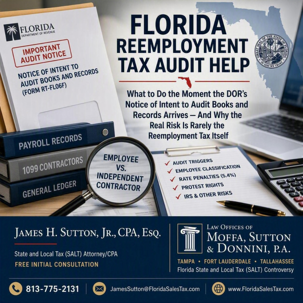
Florida Reemployment Tax Audit Help
What to Do the Moment the DOR's Notice of Intent to Audit Books and Records Arrives — And Why the Real Risk Is Rarely the Reemployment Tax Itself
By: James H. Sutton, Jr., CPA, Esq.
Law Offices of Moffa, Sutton & Donnini, P.A. — Tampa, Fort Lauderdale, Tallahassee
813-775-2131 | JamesSutton@FloridaSalesTax.com | www.FloridaSalesTax.com
Synopsis: Our law firm has represented Florida employers in reemployment tax audits since long before the tax carried that name, and one thing has never changed: business owners consistently underestimate Florida Reemployment Tax (“RT”) audits because the dollar amount on the Notice of Proposed Assessment looks small next to a sales tax bill. That is exactly the wrong lens. An RT audit turns on the single most contested question in Florida employment tax — whether the people who do your work are employees or independent contractors — and the answer can trigger consequences at the IRS, in workers' compensation premium audits, and in wage-and-hour litigation that dwarf the Florida assessment itself. This article walks through how a Florida reemployment tax audit unfolds, the traps that catch even careful business owners, and how to protect your rights from the moment the Department's notice arrives.
I. What Triggers a Florida Reemployment Tax Audit
The Florida Department of Revenue (“FDOR” or “the Department”) audits roughly 1% of active contributing employer accounts every year to verify that wages have been reported correctly. That sounds like long odds until you look at how audit leads are actually generated. The Department cross-references IRS Form 1099 data against your quarterly Employer's Reemployment Tax Report (Form RT-6), flags employers whose payroll drops sharply from one quarter to the next, follows up on new-hire reporting mismatches, and reviews referrals from reemployment assistance (unemployment) benefit claims where a former worker was never reported on your RT-6 at all. Any company with 1099’s is fair game. Construction, home health care, landscaping, staffing, restaurants, and any industry that leans on 1099 contractors are disproportionately represented, because those are exactly the industries where the employee-versus-independent-contractor line gets blurry in practice. As the joke goes in my firm, there is no 1099 contractor that a Florida tax auditor doesn’t think should be a W2 employee.
Liability for the tax itself is broader than most owners assume. Under Chapter 443, Florida Statutes, most commercial employers become liable once they pay at least $1,500 in wages during any single calendar quarter, or employ at least one worker for any part of a day in 20 different weeks in a year. Agricultural employers are liable at $10,000 in quarterly cash wages, and domestic employers (household help) at $1,000 in a quarter. Once you cross that threshold, every subsequent RT-6 is subject to audit, going back as far as the Department's assessment authority reaches.
II. The Audit Timeline: From the Notice of Intent to the Assessment
A Florida RT audit begins with a Notice of Intent to Audit Books and Records (Form RT-FL06F), mailed to the address on file, naming the calendar year or years under audit. The Department conducts two types of RT audits: desk audits, handled by mail or electronically, and field audits, conducted at your place of business. Either way, the auditor is applying generally accepted auditing standards to your payroll records, your 1099 filings, your general ledger, and your bank statements, looking for wages that were paid but never reported — whether because a worker was misclassified, a payment was run through a related entity, or an owner simply never registered the business for RT purposes at all.
One part of the audit you can consider a “safe space” would be 1099’s that are to legal entities. The Department of Revenue Reemployment Tax Auditors will accept legal entities as independent contractors just about every time. So, use that to your advantage in the audit and keep this in mind by encouraging your 1099 contractors to get legal entities.
When the auditor finishes fieldwork, you receive a Notice of Intent to Make Audit Changes (Form RT-FL11F). This form summarizes the proposed adjustments and includes a written statement of your protest and appeal rights — read it carefully, because the clock on your right to respond starts running from this notice, not from some later, more formal-looking document. If the issues are not resolved informally, the Department issues a formal assessment. As with sales tax, agreeing to extend the audit period gives up valuable rights; that decision should never be made without first speaking to someone who handles these audits regularly.
III. The Core Battleground: Employee or Independent Contractor?
Never assume a signed 1099 or an independent contractor agreement settles the question — it does not, by itself, control the outcome. Chapter 443, Florida Statutes, defines employment by reference to the usual common law rules for determining an employer-employee relationship, codified through the classification framework in section 443.1216, Florida Statutes. The Department applies a ten-factor common law test, but one factor dominates the analysis: the extent of control the business retains, or has the right to retain, over the details of how the work gets done — not merely the end result. If your business dictates the schedule, supplies the tools, sets the price charged to the customer, or can terminate the relationship at will without cause, the auditor will very likely conclude the worker is an employee no matter what the contract says.
The other nine factors — whether the worker is engaged in a distinct occupation, whether the work is normally done under a business's direction or by a specialist without supervision, the skill required, who supplies the tools and place of work, the length of the relationship, the method of payment, whether the work is part of the business's regular operations, the parties' own belief about the relationship, and whether the worker operates an independent, separately marketed business — all support or undercut the control factor, but rarely override it. Auditors reclassify workers far more often than business owners expect, and each reclassified worker becomes a wage the Department believes should have been reported and taxed.
IV. Other Issues That Surface During an RT Audit
- Officer and responsible-party liability. Section 443.171, Florida Statutes, gives the Department the authority to inspect books and records and, in the collection context, to pursue the individuals responsible for an employer's compliance — meaning an owner or officer can end up personally exposed for unpaid reemployment tax, not just the corporate entity.
- SUTA dumping and successor-employer transfers. Section 443.131, Florida Statutes, governs how an experience rating transfers when a business is sold or restructured. If a transfer is made with the intent of shifting payroll to a lower-rated entity, the Department can add a penalty rate to both employers' accounts for three years, and an intentional violation can be prosecuted as a felony.
- Multi-entity and PEO wage misallocation. “Payrolling” — one employer reporting another's payroll for convenience — is not permitted. Each legal entity must report only its own employees, and audits of businesses that share staff across related entities or that recently changed professional employer organizations frequently surface double-reported or entirely unreported wages.
- Wage base and rate errors. Reemployment tax applies only to the first $7,000 of each employee's wages in a calendar year. Auditors sometimes tax wages above the cap on reclassified workers, or apply the wrong experience rate to the audit period — both are worth checking independently rather than accepting the auditor's math.
V. The Trap Most Business Owners Never See Coming: The 5.4% Rate
Never assume a modest RT assessment is the worst-case outcome of the audit — it is not. By law, an employer's tax rate can be pushed to the maximum 5.4% of the first $7,000 of wages per employee if the employer fails to provide all requested work records during an audit. The Department makes that decision unilaterally: a rate notice goes out, and the higher rate takes effect the following quarter, applied to your entire payroll going forward, not just to the specific wages in dispute. If you only have a few employees, then the top tax rate is not terribly consequential, but the report of a misclassification to the IRS could have a lot more financial consequences over the rate change. For a company with a modest to large number of employees, the increase in tax rate can begin a material number, and it is likely avoidable with organized records and a coordinated response from the outset.
VI. Protesting the Audit: Section 443.141
If you disagree with the auditor's findings, you have the right to protest, and the protest process is an administrative proceeding governed by section 443.141, Florida Statutes, and the Department's applicable rules. A timely, well-prepared protest can meaningfully reduce a proposed assessment — particularly where the auditor's worker-classification analysis failed to fully credit the independent nature of your contractor relationships, or where the estimate of unreported wages is not supported by your actual payroll records. Missing the protest deadline forfeits these rights entirely, which is why the deadline deserves the same urgency as a court filing deadline.
If you protest liability or the assigned tax rate, Florida law still requires you to file your quarterly reports and pay tax at the assigned rate while the protest is pending. If the protest is ultimately decided in your favor, the Department issues an adjustment or refund for the amounts overpaid — but continuing to file and pay during the dispute is not optional.
VII. Why the IRS Cares About Your Florida RT Audit
The amount actually due on a Florida RT assessment can be surprisingly small — sometimes zero, if a reclassified worker's other reported wages already exceeded the $7,000 cap for the year. Do not mistake a small check for a small problem. Florida and the IRS share employment tax audit information, and a state-level worker reclassification is exactly the kind of finding that can trigger a federal employment tax exam, with federal income tax withholding, Social Security, and Medicare exposure attached to every reclassified worker for every open year — consequences that regularly exceed the Florida assessment by a wide margin. In fact, the IRS actually pays the Florida Department of Revenue to conduct Reemployment Tax Audits and report the results to the IRS. So, treat the state audit as the opening chapter of a much longer story, not the whole book.
VIII. Should You Just Shut Down the Business and Start Over?
Business owners facing a large reemployment tax exposure sometimes ask whether closing the company and starting fresh under a new entity makes the problem disappear. It does not. Florida law allows the Department to pursue successor employers and responsible individuals directly, and a pattern of closing one entity to open a substantially similar one performing the same work with the same workers is precisely the fact pattern the SUTA dumping and successor-liability provisions of Chapter 443 were written to catch. Corporate veil piercing, transferee liability, and the practical difficulty of ever obtaining financing, bonding, or licensing again under a tainted history make this option far riskier than it appears at first glance. Even if you just wanted to permanently close down the business, you will not avoid potential exposure to 200% at the personal level as an owner of the business. A properly negotiated resolution of the existing exposure is almost always the better path.
IX. Why You Need Experienced Counsel, Not Just a Bookkeeper, at the Table
A reemployment tax audit is, at its core, a legal proceeding wearing an accounting disguise. The central dispute — whether a given worker is an employee or an independent contractor — is a legal analysis under Chapter 443, Florida Statutes, and decades of Florida administrative and judicial decisions interpreting it, not a bookkeeping question with a single correct answer on a spreadsheet. If you have a good CPA with RT audit experience, then your CPA represent you through the audit if they are comfortable with the process. My law firm handles dozens of RT audits every year and would be glad to assist. If you know you have a problem with 1099’s that should be W2’s, then you should consider this a legal battle from the day you get the audit notice.
X. How Plan Ahead for Reemployment Tax Issues
It is always a good idea to have executed subcontractor agreements in place that takes into account the criteria to be considered for a subcontractor versus employee. A little extra time taking in drafting those agreements can save a world of problems in an audit. Additionally, as a business owner, you should consider requiring your subcontractors to operate out of a legal entity. Among all the other smart reasons for always having a legal entity in place when doing business, it can be a great shield in a federal or state employment tax audit for a company hiring subcontractors.
Frequently Asked Questions
Q: I only have a handful of 1099 contractors. Can the Department really audit me?
Yes. Audit selection has nothing to do with the size of your payroll and everything to do with the data the Department already has — 1099 filings, prior RT-6 reports, and unemployment claims filed by workers you never reported. Small employers with heavy 1099 use are, if anything, more likely to be selected.
Q: The auditor says I owe almost nothing. Can I just pay it and move on?
You can, but consider the downstream exposure first. A worker reclassification finding is exactly the kind of record that can prompt an IRS employment tax exam or a workers' compensation premium audit, where the numbers are rarely small.
Q: What happens if I can't locate all the records the auditor requested?
Incomplete records are the single biggest driver of the maximum 5.4% rate penalty, which applies to your entire future payroll, not just the disputed wages. If records are missing, say so early and work with counsel on a reconstruction strategy rather than letting the audit close on an incomplete file.
Q: Can I still protest after the Notice of Intent to Make Audit Changes is issued?
Yes, but the protest window is strictly enforced under section 443.141, Florida Statutes. Missing it forfeits your right to challenge the findings administratively, so the deadline on the RT-FL11F should be treated as immovable.
Q: Does a reemployment tax audit ever result in a refund instead of an assessment?
It happens. Many audited employers owe nothing additional, and some audits identify overpayments — for example, tax paid on wages that were misreported to the wrong entity or reported above the $7,000 wage base.
About the Author
 James H. Sutton, Jr., CPA, Esq. is a State and Local Tax (SALT) attorney/CPA and practices almost exclusively in the area of Florida state and local tax controversy. James is a Shareholder at the Law Offices of Moffa, Sutton & Donnini, P.A. and has been a licensed Certified Public Accountant since 1994 and a member of The Florida Bar since 1998. For 20 years, Mr. Sutton has served as an Adjunct Professor of Law at Stetson University College of Law, teaching State and Local Tax, and also taught Sales and Use Tax at Boston University School of Law's LLM in Taxation program. If you have any questions, then Mr. Sutton has a FREE INITIAL CONSULTATION policy. He can be reached directly at 813-775-2131 or JamesSutton@FloridaSalesTax.com.
About the Firm
The Law Offices of Moffa, Sutton & Donnini, P.A. is a Florida law firm that practices almost exclusively in the area of Florida state and local tax (SALT) controversy, with over 200 years of combined experience among its attorneys. The firm represents businesses and individuals in Florida sales and use tax, reemployment tax, and corporate income tax audits, protests, criminal investigations, and litigation before the Florida Department of Revenue, and has offices in Tampa, Fort Lauderdale, and Tallahassee.
Additional Resources
Florida Reemployment Tax Audits: What Every Business Owner Needs to Know Before the Auditor Arrives — May 8, 2026, by James H. Sutton, Jr., CPA, Esq.
Florida Reemployment Tax Audits in the Home Health Care Industry — June 2026, by James H. Sutton, Jr., CPA, Esq.
Florida Sales Tax Voluntary Disclosure: The Best Way to Clean Up a Florida Sales Tax Problem — May 26, 2026, by James H. Sutton, Jr., CPA, Esq.
Florida Sales Tax Audit Help — June 20, 2026, by James H. Sutton, Jr., CPA, Esq.
Florida Sales Tax Criminal Investigations: When Sales Tax Experience Matters — June 2026, by James H. Sutton, Jr., CPA, Esq.
FL Dept. of Revenue – Reemployment Tax Rate Notice — December 15, 2024, by James H. Sutton, Jr., CPA, Esq.
What to Expect from a Florida Reemployment Tax Audit — November 29, 2023, by Matthew Parker, Esq.
© Copyright 2026. James H. Sutton, Jr. All rights reserved.