
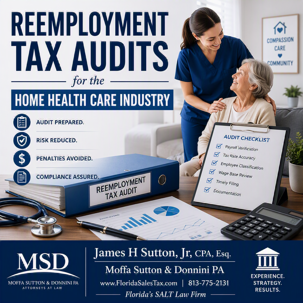
Florida Reemployment Tax Audits in the Home Health Care Industry
James H. Sutton, Jr., CPA, Esq.
Law Offices of Moffa, Sutton & Donnini, P.A. — Tampa, Fort Lauderdale, Tallahassee
Synopsis: Florida reemployment tax is a payroll-based state tax that falls entirely on employers, and the home health care industry faces exposure to worker misclassification audits. When a caregiver files for reemployment benefits and the agency has not been including that worker on its quarterly wage reports, the Department opens an investigation that can reach back years and expose the agency to back taxes, interest, and penalties across its entire workforce. This has happened enough times in the industry that the Department has started an industry-wide audit campaign. The most dangerous part is that the Department reports its reemployment tax audit findings to the IRS, which could lead to a much more expensive IRS audit. This article explains the governing law, the ten-factor common law test that determines whether a caregiver is an employee or a contractor, how the Department conducts reemployment tax audits in this industry, and the practical defense strategies available to home health care operators and their advisors when an audit letter arrives.
The article is written by James H Sutton, Jr, CPA, Esq., a State and Local Tax (SALT) attorney and CPA that focuses exclusively on Florida state tax matters.
I. Introduction: Why Home Health Care Is a Target
Florida's home health care industry is one of the most labor-intensive and fastest-growing sectors in the state. With a large and aging population, tens of thousands of home health agencies, nurse registries, staffing companies, and private duty operators send nurses, therapists, aides, and companions into patients' homes every day. To manage the volatility of scheduling, patient census, and reimbursement rates, many of these businesses classify their workers — or large segments of their workforce — as independent contractors and issue 1099-NEC forms rather than W-2s.
The appeal is obvious. Classifying workers as independent contractors eliminates the employer's obligation to withhold and remit federal income tax, match and pay FICA, carry workers' compensation coverage on those individuals, and — critically — pay Florida reemployment tax. But Florida's Department of Revenue, which administers the reemployment tax under Chapter 443, Florida Statutes, has made worker misclassification in the home health care industry a consistent audit priority. When a certified nursing assistant, home health aide, or companion files a claim for reemployment benefits after losing a care assignment, the Department's fraud detection systems flag the discrepancy between the benefit claim and the absence of the worker from the employer's quarterly wage reports. What begins as a single unemployment claim can quickly become a full-scope audit of the agency's entire independent contractor workforce — going back three to five years. This has happened so often that the Florida Department of Revenue is now doing an industry-wide reemployment tax audit campaign.
The financial stakes are significant. Reemployment tax is assessed on a per-worker, per-dollar-of-wages basis. An agency with twenty workers that have been treated as contractors, each earning $30,000 per year over a three-year lookback period, is looking at a potential base assessment of $1.8 million in gross wages subject to reclassification — before the Department calculates the tax, penalties, and interest owed. For smaller agencies operating on thin margins, that kind of assessment is existential.
This article provides a practical roadmap for home health care operators and their CPAs and accountants. We will go through the basic mechanics and rates of Florida reemployment tax then walk through the ten-factor common law test the Department uses to determine worker classification, with analysis of how each factor plays out in the home health care context. We will explain how reemployment tax audits are triggered, conducted, and how the Department calculates assessments then address the defenses available during an audit, protest, and appeal. Finally, we will cover the relationship between reemployment tax exposure and parallel risks — workers' compensation, federal employment tax, and criminal liability.
II. Florida Reemployment Tax: The Basics
A. What It Is
Florida reemployment tax is the state's version of unemployment insurance, formerly called the Florida Unemployment Compensation Tax. The name changed with a 2012 legislative overhaul that also restructured the benefit system, but the tax mechanics are substantially the same. Under Section 443.131, Florida Statutes, employers pay a quarterly payroll tax on wages paid to covered employees, and those funds flow into the Unemployment Compensation Trust Fund, which pays temporary benefits to workers who lose their jobs through no fault of their own.
Reemployment tax is entirely an employer obligation. Workers do not pay any portion of it, and employers are prohibited from deducting it from employee wages. This is different from FICA, where both employer and employee share the burden.
B. Who Is Required to Register
Under Section 443.1216, Florida Statutes, most commercial employers become liable for reemployment tax once they either:
- Pay at least $1,500 in total wages during any single calendar quarter, or
- Employ at least one worker for any part of a day in 20 or more different weeks during a calendar year.
For a home health agency with even one part-time aide, therapist, or nurse, either threshold is typically reached in the first quarter of operations. Liability does not depend on size, corporate form, or business model — it depends on whether the agency has employees.
C. Current Tax Rates
New employers pay a standard rate of 2.7% on the first $7,000 of wages paid to each covered employee per calendar year. After the employer accumulates a sufficient employment history, the Department assigns an experience-based rate that can range from 0.1% to 5.4%. Agencies that have filed unemployment claims against them — as routinely happens when caregivers lose assignments — tend to see their experience rates rise over time, which compounds the cost of misclassification.
The $7,000 taxable wage base means that once an employee earns $7,000 in a calendar year, no additional reemployment tax is owed on wages paid to that individual for the rest of that year. For high-earning nurses and therapists, this cap is typically reached early in the year. For aides and companions working part-time at lower hourly rates, the $7,000 base may not be reached at all — meaning every dollar of their wages is subject to tax.
D. Quarterly Filing Requirements
Covered employers must file Form RT-6 (Employer's Quarterly Report) and remit any tax due by the last day of the month following the close of each calendar quarter: April 30, July 31, October 31, and January 31. The quarterly report lists each employee by name, Social Security number, and total wages paid during the quarter. Independent contractors — workers properly classified as such — are not included on the RT-6. Issuing a 1099-NEC rather than a W-2 is not, by itself, evidence of proper contractor status; it is simply a reporting choice that the Department will scrutinize.
III. The Ten-Factor Test: Applying It to Home Health Care Workers
A. The Governing Framework
Chapter 443, Florida Statutes, provides that "employment" includes service performed by individuals under the usual common law rules applicable in determining an employer-employee relationship. The Florida Department of Revenue has identified ten factors derived from common law that govern the classification determination. Of these, the degree of control the agency exercises over the worker is the most important single factor — but the analysis does not stop there, and no single factor is automatically determinative.
The ten factors, and how they typically play out in home health care, are as follows.
B. Factor 1: Degree of Control Over the Work (Most Important)
The central question is whether the agency controls not just the result — a patient receiving care — but the method by which the worker achieves that result. An agency that assigns a specific patient, determines the days and hours of service, provides a care plan or duty sheet, requires the worker to follow its documented protocols, and retains the right to redirect how care is delivered is exercising the kind of control that makes the worker an employee. An agency that simply connects a patient with a licensed nurse or therapist who then decides independently how to assess and treat the patient, sets her own schedule, and follows her own professional clinical judgment is closer to the independent contractor end of the spectrum.
In practice, most home health agencies fall in the middle — but the Department's auditors look closely at care plans, duty sheets, supervisor visit records, incident reports, and scheduling practices to determine how much operational control the agency actually exercised. Agencies that set shift times, require workers to call in when they arrive and depart, conduct supervisory visits, and issue corrective action memos to caregivers will have difficulty arguing they did not control the work.
C. Factor 2: Whether the Worker Is Engaged in a Distinct Occupation or Business
A licensed registered nurse who maintains an independent practice, has her own business entity, carries her own professional liability insurance, bills patients or payers directly for some of her work, and markets her services to multiple agencies and clients is more plausibly a contractor than a home health aide whose only work relationship is with a single agency. This factor tends to favor employee status for lower-credentialed workers — aides, companions, and sitters — and is more contested for licensed professionals.
While the existence of a separate LLC or business entity does not automatically establish a distinct occupation, in my experience, the fact that the subcontractor is a legal entity can be the determining factor to the Department in the taxpayer’s favor.
D. Factor 3: Supervision and Locality
Is work of this kind in the local market typically performed under employer direction, or by specialists working independently? Skilled professional services — nursing, physical therapy, occupational therapy, speech therapy — that require independent clinical judgment and are routinely performed by licensed professionals working without direct supervision tend to support contractor status under this factor. Companion services and non-medical homemaker services, which involve less independent judgment and are more commonly provided under agency direction, tend to support employee status.
E. Factor 4: Skill Required
Higher skill requirements support contractor status. Licensed and credentialed workers — registered nurses, physical therapists, occupational therapists, speech-language pathologists — who possess specialized knowledge and exercise independent professional judgment generally fare better under this factor than home health aides or companions whose training requirements are more limited. That said, the factor does not operate in isolation. A highly credentialed worker who is nonetheless subject to extensive agency control may still be classified as an employee under the overall analysis.
F. Factor 5: Who Supplies the Instrumentalities and Tools
Independent contractors are generally expected to provide their own equipment, supplies, and tools. In a medical or clinical context, this typically means professional supplies, licensing credentials, and professional liability (malpractice) insurance. An agency that provides the medical supplies, personal protective equipment, care records, charting software, and clinical forms used in the delivery of care is supplying the instrumentalities of the work — a factor pointing toward employee status. An agency that requires workers to carry their own malpractice insurance and use their own nursing bags or therapy kits is in a better position on this factor.
G. Factor 6: Length of Employment
A worker who has been placed with the same patient continuously for eighteen months, with the agency scheduling all shifts and managing all billing, looks much more like an employee than a contractor brought in for a defined episodic engagement. Long-term, ongoing care relationships are the norm in home health care, particularly in non-skilled personal care and companion service settings. This factor frequently works against agencies that rely on 1099 classification for their core workforce rather than truly transient or project-specific engagements.
H. Factor 7: Method of Payment
Employees are typically paid by the hour, shift, or week. Independent contractors are typically paid by the job or project. Hourly pay is nearly universal in home health care, regardless of whether the worker is classified as an employee or a contractor. The Department's auditors are aware of this industry reality, but they will note it as a factor pointing toward employment when combined with other indicia of control. Agencies that pay daily, weekly, or per-visit flat rates — rather than a pure hourly wage — have marginally more defensible positions on this factor.
I. Factor 8: Whether the Work Is Part of the Agency's Regular Business
If the services performed by the worker are an integral and essential part of what the agency does for its clients, the worker is more likely to be an employee. This factor is, for most home health agencies, nearly impossible to win. A home health agency's core business is providing care to patients through nurses, aides, and therapists. The services of those caregivers are not ancillary or occasional — they are the service the agency sells. When the business will succeed or fail based on how well those workers perform, the Department reasons that the agency will want to control their performance, which creates the employment relationship.
J. Factor 9: Whether the Parties Believe They Are Creating an Employment Relationship
The parties' own written agreement and their stated understanding of the relationship is relevant, but it is not dispositive. A contract that labels a worker an "independent contractor" and describes the relationship in contractor terms will be given weight if the actual working practices are consistent with contractor status. If the agreement says "independent contractor" but the agency's conduct looks like employment — setting schedules, issuing performance reviews, requiring attendance at agency training sessions, directing the method of care — the agreement will be disregarded. Agencies that have well-drafted independent contractor agreements but fail to operate consistently with those terms receive little benefit from the paperwork.
K. Factor 10: Whether the Principal Is in Business
This factor — whether the entity engaging the worker is operating a business rather than merely a household employer — is virtually always met in the home health context and rarely changes the outcome of the analysis.
IV. How Reemployment Tax Audits Are Triggered and Conducted
A. How Audits Begin
Historically, reemployment tax audits of home health agencies usually began with a single unemployment claim. When a caregiver files for reemployment benefits after a care assignment ends and the agency has not been reporting that worker on its quarterly RT-6, the Department's systems flag the discrepancy. The Department then opens a worker classification investigation and sends both the employer and the worker a copy of Form RTS-6061, the Independent Contractor Analysis.
Form RTS-6061 is a multi-part questionnaire that collects information about the working relationship from both sides. Both the agency and the worker must answer questions about scheduling, supervision, tools and equipment, payment method, ability to work for competitors, and the economic terms of the engagement. The answers the worker provides — which the agency cannot control — often reveal details inconsistent with independent contractor status, particularly when workers describe being told when and how to work, being required to attend agency training, and having no other clients.
In the last year, the Department of Revenue has seen enough “successful” audits in the home health care industry that the Department started a reemployment tax audit campaign on the whole industry. That means even if none of your workers file unemployment claims, your company still has a target on it.
B. Scope of the Audit
Once the Department opens a reemployment tax audit, it typically expands well beyond the single worker who filed the unemployment claim. The auditor will review all workers the agency has classified as independent contractors, often for a three-to-five year lookback period. If the Department determines that workers in the same job class as the claimant should have been classified as employees, it will assess tax on the total wages paid to all workers in that class over the entire lookback period.
The records an auditor typically requests include: all Forms 1099-NEC and 1096 filed, all independent contractor agreements, payroll records and general ledgers, schedule and dispatch records, care plans and duty sheets, workers' compensation coverage records, federal Forms 940 and 941, and any prior classification determinations from other agencies. Many auditors will ask for the Federal Income Tax Returns for the audit period to review the expenses listed on the return to find other people that should have been given 1099’s. Each of those expenses become a potential target in the audit.
C. How the Assessment Is Calculated
Once the Department determines that a group of workers should have been classified as employees, it calculates the tax owed by applying the employer's applicable reemployment tax rate to the first $7,000 of wages paid to each worker in each calendar year of the lookback period. Interest under Section 213.235, Florida Statutes, accrues at a rate of up to 1% per month from the original due date of each quarterly report. Penalties apply for failure to file and failure to pay.
For an agency with a sizable contractor workforce, even a single year of reclassification can produce a six-figure assessment. A multi-year lookback covering twenty or thirty workers regularly produces assessments that threaten the viability of smaller operations.
V. Defending a Florida Reemployment Tax Audit
A. Starting with the Independent Contractor Agreement
The first line of defense in any reemployment tax audit is the independent contractor agreement — but only if it is drafted to reflect a genuine contractor relationship and the agency has actually operated consistently with its terms. An agreement that gives the agency discretion over scheduling, requires the worker to comply with the agency's care protocols, prohibits the worker from working for competitors during the engagement, or requires the worker to attend mandatory training undermines the contractor classification on its face. Agreements should be reviewed before an audit begins.
B. Building the Factual Record on Each Factor
Because the ten-factor analysis is highly fact-specific, a strong defense requires a detailed factual record. For each worker or worker class at issue, the agency should be able to document: that the worker was free to accept or decline assignments; that the worker set her own clinical protocols within the bounds of her license and professional standards; that the worker carried her own professional liability insurance; that the worker worked for other agencies or clients during the same period; that the agency did not direct the method of care delivery; and that the worker was paid on a per-visit or per-engagement basis rather than a fixed hourly wage.
For licensed professionals — nurses, therapists, social workers — the fact that the worker exercises independent professional judgment regulated by a separate licensing board (Board of Nursing, Board of Physical Therapy, etc.) is a meaningful argument. The agency's role in specifying the clinical parameters of care, to the extent it does so, is constrained by what those professional licensing authorities permit and require.
C. The RTS-6061 Analysis
When the Department sends Form RTS-6061 to both the employer and the worker, the employer has an opportunity to respond in detail to each question. This response is important — it becomes part of the record. Do not simply check boxes without supporting documentation. If the agency's answer to a question diverges from the worker's answer, the Department will note the discrepancy and generally credit the worker's account. Engage legal counsel before completing Form RTS-6061, particularly if an adverse classification determination appears likely to cascade across a large contractor workforce. Remember – your answers really affect the audit and you need to make sure that you get experienced advice before answering.
D. The Informal Protest
If the Department issues a preliminary determination reclassifying workers and assessing tax, the you have the right to file an informal protest with the Department of Revenue. The informal protest is often underused by employers who receive it and simply pay, not understanding that it is the gateway to the formal appellate process. Perhaps the dollars were not that large in the reemployment tax, failing to recognize the much larger tax exposure if the IRS does a follow up audit for the same independent contractors/employees.
E. Lookback Period and Statute of Limitations
For reemployment tax purposes, the Department's lookback is generally limited to assessments within three years of the date the quarterly reports were due, absent fraud or willful misclassification. However, when workers were never included on the agency's quarterly reports at all — the most common scenario in a misclassification audit — the Department takes the position that the statute of limitations has not begun to run because the employer never filed a return disclosing the wages. This argument expands the Department's exposure window considerably and should be challenged vigorously where the agency can demonstrate that it filed timely returns for the reported portion of its workforce.
F. Negotiating a Settlement
In appropriate cases, particularly where the evidence on worker classification is mixed, the Department will consider a negotiated settlement that caps the lookback period, excludes certain worker classes, or applies a reduced rate to the wages at issue. Settlement discussions are most productive after the audit, during the informal protest process, when the Department has a full picture of the factual record and the parties have identified which classifications are genuinely contested. An experienced SALT attorney can often achieve a materially better outcome through negotiation than through continued litigation, particularly when the agency has ongoing operations and needs to preserve its experience rating.
VI. Connected Risks: Workers' Compensation, Federal Taxes, and Criminal Exposure
A. Workers' Compensation
Florida's workers' compensation system is administered separately from reemployment tax, but the two enforcement systems share data. A workers' compensation audit that reclassifies home health caregivers as employees will produce its own assessment — and a potential stop-work order that halts the agency's operations until compliance is demonstrated. The penalties under the workers' compensation misclassification rules are severe: $2,500 per misclassified worker for the first two workers at a site, and $5,000 per worker thereafter. For a mid-size agency with thirty misclassified caregivers, the penalty exposure alone can reach six figures before any back premium is calculated.
B. Federal Employment Taxes
A Florida reemployment tax reclassification does not automatically trigger a federal employment tax assessment, but the Department of Revenue does share reemployment tax audit results with the IRS. In fact, the IRS pays the Florida Department of Revenue hundreds of thousands of dollars each year to specifically conduct reemployment tax audits and provide the IRS with the results. An business that faces a state reemployment tax reclassification audit is well advised to conduct a parallel review of its federal employment tax position. If the agency has a valid basis — under Section 530 of the Revenue Act of 1978 — for having treated the workers as contractors (such as a long-standing industry practice, a prior IRS determination, or a good-faith reliance on professional advice), that defense should be documented and preserved for any subsequent federal audit.
C. Criminal Liability
Intentional misclassification of an employee as an independent contractor is a third-degree felony under Section 443.071, Florida Statutes. The statute does not require proof that the employer pocketed the withheld taxes — the knowing misclassification itself is the offense. Most reemployment tax audits resolve as civil tax disputes, without criminal referral. But agencies that have received prior guidance from the Department, or that changed their classification practices after a prior audit, are at greater risk of a criminal referral if a subsequent audit reveals continued misclassification. Keep documentation of good-faith reliance on professional advice and contemporaneous business reasons for classification decisions.
VII. What Should Home Health Care Operators Do Now?
Every home health agency, nurse registry, and private duty operator in Florida that uses independent contractors should conduct an internal classification review before a reemployment tax audit begins. That review should include the following steps:
First, pull all independent contractor agreements and compare the written terms to actual practice. If the agreements grant the agency scheduling authority, require compliance with agency protocols, prohibit competitive engagements, or make the workers economically dependent on the agency, the agreements need to be revised — and the working practices need to change. Our business division can help with updating the agreements.
Second, assess each worker class separately. The classification analysis does not work the same way for a licensed RN contractor as it does for a home health aide or companion. Job classes with stronger contractor characteristics — licensed professionals with independent practices, workers who serve multiple agencies, workers who carry their own insurance — should be documented and segregated from classes with stronger employee characteristics.
Third, audit the 1099 issuance practices. Issuing a 1099 to someone does not make them a contractor, and the Department's auditors know it. The number of 1099s issued relative to W-2 employees, the consistency of classification across similarly situated workers, and the dollar amounts involved are all signals the Department uses to select audit targets. Are there any payments to individuals that you didn’t issue a 1099?
Fourth, consult with experienced tax counsel before completing Form RTS-6061 or responding to a Department inquiry. The answers provided during the classification investigation become part of the permanent record and can significantly expand or limit the agency's exposure.
If the review reveals that a misclassification problem exists, voluntary disclosure or prospective reclassification of the affected workers — before a benefit claim triggers an audit — may substantially reduce the agency's exposure. An experienced SALT attorney can advise on the best path forward depending on the scope of the problem and the agency's ability to absorb a reclassification adjustment.
Frequently Asked Questions
Does issuing a 1099 form to a caregiver make them an independent contractor for Florida reemployment tax purposes?
No. The issuance of a 1099-NEC is a federal reporting choice, not a determination of tax status. Florida's Department of Revenue applies the ten-factor common law test independently of how the employer reports the worker for federal purposes. An employer can issue a 1099 and still owe Florida reemployment tax on that worker's wages if the working relationship satisfies the common law test for employment.
If a nurse or therapist has her own LLC, does that protect an agency from a reemployment tax reclassification?
Not automatically. The Department will look through the corporate form to the economic reality of the working relationship. A caregiver who forms an LLC but works exclusively for one agency, follows that agency's care protocols, and has no other clients is not operating an independent business in any meaningful sense. All of this being said, in my experience, the existence of a business entity is single most persuasive piece of evidence in favor of independent contractor status.
How far back can the Florida Department of Revenue go in a reemployment tax audit?
The standard lookback is three years from the date the quarterly report was due. However, when the employer never filed a return reporting the workers at issue, the Department frequently takes the position that the limitations period has not run. Employers should not assume a three-year cap will protect them if they have been issuing 1099s to a workforce that was never reported on the RT-6.
Can a home health agency face both a Florida reemployment tax assessment and a federal employment tax assessment for the same workers?
Yes. Florida reemployment tax and federal FUTA and FICA are separate obligations administered by separate agencies, but you can count on the fact that the Florida Department of Revenue will give your reemployment tax audit results to the IRS. An agency that faces a reemployment tax reclassification audit should evaluate its federal position at the same time and determine whether it has a valid defense. Fighting and winning an appeal to the Florida audit result may keep the IRS from starting their own audit.
Is worker misclassification in home health care a civil or criminal matter?
It is primarily civil — most audits result in a tax assessment, penalties, and interest, not a criminal referral. However, intentional misclassification is a third-degree felony under Section 443.071, Florida Statutes. Agencies that have received prior guidance from the Department or that changed their classification practices after a prior adverse determination are at greater risk of criminal exposure in a subsequent audit.
What is the first thing a home health agency should do when it receives an RTS-6061 form from the Department of Revenue?
Contact a Florida SALT attorney or CPA with reemployment tax experience before completing or returning the form. The answers provided on Form RTS-6061 become part of the Department's classification record. Completing the form without understanding how each answer maps to the ten-factor test can inadvertently concede the employment relationship and expand the scope of the resulting audit. The author of this article, James H Sutton, Jr, CPA, Esq. is just such a SALT attorney and offers free initial consultations.
What does the Department look for when it audits a home health agency's 1099 contractor practices?
Auditors typically examine: whether the agency set shifts and schedules; whether workers could decline assignments without consequence; whether the agency provided tools, supplies, or equipment; whether workers were required to attend agency training; whether workers carried their own professional liability insurance; whether workers provided services to other clients or agencies; the length of each engagement; and whether the written independent contractor agreements accurately reflected the parties' actual practices.
About the Author
 James H. Sutton, Jr., CPA, Esq. is a State and Local Tax (SALT) attorney and CPA as well as a shareholder at the Law Offices of Moffa, Sutton & Donnini, P.A. He has been a licensed Certified Public Accountant since 1994 and a member of The Florida Bar since 1998. Since 2002, Mr. Sutton has served as an Adjunct Professor of Law at Stetson University College of Law, teaching State and Local Tax, and also teaches Sales and Use Tax at Boston University School of Law's LLM in Taxation program. Mr Sutton is a frequent lecturer for professional groups throughout Florida. If you have questions about a Florida reemployment tax audit or worker classification issue, take advantage of his FREE INITIAL CONSULTATION by contacting James directly.
Phone: 813-775-2131 Email: JamesSutton@FloridaSalesTax.com Bio: https://www.floridasalestax.com/staff-profiles/james-h-sutton-jr-cpa-esq-/
About the Firm
The Law Offices of Moffa, Sutton & Donnini, P.A. is a Florida law firm concentrating almost exclusively in Florida state and local tax controversy, with offices in Fort Lauderdale, Tampa, and Tallahassee. The firm represents businesses, owners, and their advisors in Florida Department of Revenue audits, protests, appeals, and litigation across all Florida tax types. The official website for the State and Local Tax Division of the law firm is www.FloridaSalesTax.com.
Additional Resources
- Florida Reemployment Tax Audits: What Every Business Owner Needs to Know Before the Auditor Arrives – May 8, 2026, by James H Sutton, Jr, CPA, Esq.
- "Do I Have to Charge Florida Sales Tax on a Wholesale Sale?" — June 7, 2026 — James H. Sutton, Jr., CPA, Esq.
- "Can I Trust AI for Florida Sales Tax Advice?" — June 6, 2026 — James H. Sutton, Jr., CPA, Esq.
- Florida Sales Tax Criminal Investigations: When Sales Tax Experience Matters – June 24, 2026, by James H Sutton, Jr, CPA, Esq.
- "Florida Sales Tax – Inadvertent Registration: What It Is and How It Can Save Your Business" — June 5, 2026 — James Sutton, CPA, Esq.
- "Florida Sales Tax Voluntary Disclosure: The Best Way to Clean Up a Florida Sales Tax Problem" — May 26, 2026 — James H. Sutton, Jr., CPA, Esq.
© Copyright 2026. James H. Sutton, Jr. All rights reserved.