
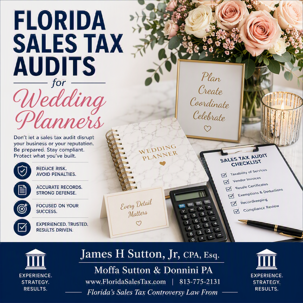
Are Wedding Planning Fees Subject to Florida Sales Tax?
James H. Sutton, Jr., CPA, Esq.
Law Offices of Moffa, Sutton & Donnini, P.A. — Tampa, Fort Lauderdale, Tallahassee
Answer — likely yes. Florida sales tax is one of the most misunderstood aspects of running a wedding planning business in Florida — and one of the most dangerous. The core problem is deceptively simple: Florida generally does not tax pure services, but the moment a wedding planner provides even a single item of tangible personal property as part of her services — a floral arrangement, a linen, a centerpiece — the “one drop of oil” rule can make the entire transaction taxable, including the planning fee. This article explains where the taxable lines are drawn and how to avoid the most common audit traps.
This article is written by James H. Sutton, Jr., CPA, Esq., a State and Local Tax (SALT) attorney and CPA with an almost exclusive focus on Florida sales and use tax controversy.
I. The Starting Point — And the Trap
Florida does not generally impose sales tax on services. A fee charged purely for planning, coordinating, consulting, and managing a wedding is not subject to Florida sales tax. That part is correct — and it is also where most wedding planners stop reading.
The trap is the one drop of oil rule. Under Florida sales tax law, if a service provider transfers any tangible personal property to a customer as part of a transaction, the entire transaction — including the service fee — becomes taxable. This is not a bundling technicality. It is a foundational principle of Florida sales tax: the transfer of even a single item of tangible personal property alongside a service turns the whole package into a taxable sale. Separately stating the service fee on the invoice does not change the result.
The professional service exemption that shields CPAs, attorneys, and architects from this rule — allowing them to hand a client a tax return or a legal brief without triggering tax on their fee — does not extend to wedding planners, event coordinators, or caterers. Those businesses are not recognized as professional services under Florida law. That means a wedding planner who provides flowers, décor, linens, centerpieces, or any other tangible item as part of her services is not in the clear just because she breaks out a separate “planning fee” line on the invoice.
The practical implication: virtually every full-service wedding planner in Florida has sales tax exposure, because virtually no full-service wedding planner operates in a world of pure services.
II. Flowers and Floral Arrangements: Always Taxable
Flowers and floral arrangements are tangible personal property, and their sale is always subject to Florida sales tax under Rule 12A-1.047, Florida Administrative Code. This is true regardless of the artistic labor involved in arranging them. A planner who purchases wholesale flowers, arranges them, and transfers them to the client must collect and remit sales tax on the full retail price — including any design or arrangement fee that is not genuinely and separately distinct from the product sale.
If the planner purchases flowers using a valid Florida resale certificate (Form DR-13), she does not pay tax at wholesale — but she owes tax when those flowers are sold at retail to the client. If she pays tax at wholesale and does not charge the client, she has paid tax at the wrong step and may still face an assessment in a sales tax audit.
Separately stated and optional delivery charges are not taxable. Mandatory or bundled delivery charges are part of the taxable sales price.
III. Décor and Rentals
Wedding planners often maintain their own inventory of décor — candelabras, charger plates, linens, arbors, arches, lighting, drapery — that they deploy at events and retrieve afterward. Florida taxes the rental of tangible personal property, and the Department of Revenue treats client use of these items as a taxable rental.
The argument that items are not a rental — that the planner retains possession and control throughout the event as part of an integrated styling service — can be made in some circumstances. The Department’s analysis focuses on who retains possession and control during the engagement. A planner who arrives early, deploys items, manages them throughout the reception, and strikes them at the end without ever relinquishing control is in a better position than one who drops items off and picks them up the next day. But most items at a wedding — chairs, tables, table settings, centerpieces — are used by guests, not managed by the planner. Those are taxable rentals, making the whole fee taxable.
A practical note: I generally advise clients that trying to save sales tax on décor and rentals usually does not save the wedding planner a penny. The client pays the sales tax, not the planner. Aggressively structuring contracts to avoid tax creates audit risk with no financial benefit to the planner. When we are defending a past audit, however, that is exactly when we argue positions aggressively — because then there is real money to save you.
IV. Catering
Catering is among the most reliably taxable components of a Florida wedding. Under Section 212.08, Florida Statutes, and Rule 12A-1.011, Florida Administrative Code, sales by caterers of food and beverages prepared and served for immediate consumption are taxable. The grocery exemption does not apply to catered meals.
The key question is how the catering is structured:
If the client hires the caterer directly and invoices go to the client directly, the caterer collects and remits the tax. The planner has no sales tax obligation on the catering.
If the wedding planner contracts with the caterer as the buyer and then bills the client for catering — whether at cost or marked up — the planner has made a taxable retail sale of food. The planner should provide a resale certificate to the caterer to avoid paying tax twice, then collect and remit tax on the full amount billed to the client.
Mandatory service charges billed by caterers or venues where the fee goes to the business are part of the taxable sales price. Optional gratuities paid separately and directly to service staff are not taxable. Alcohol sold at a catered wedding is separately taxable.
V. All-Inclusive Packages: The Most Dangerous Billing Structure
The most common audit trigger for wedding planners is an all-inclusive package — a single flat fee covering planning, coordination, florals, décor, catering passthrough, and everything else. This billing structure is clean and client-friendly, and it is a sales tax disaster.
Florida has no rule that transforms a mixed service-and-product sale into a nontaxable transaction. When taxable items — floral arrangements, rentals, catering — are bundled into a single package fee with nontaxable services, the one drop of oil rule applies: the Department can take the position that the entire package is taxable. The fact that most of the value is in the nontaxable services does not help. One drop of a taxable item pulls the entire transaction into taxability.
The practical recommendation is to structure invoices with separately stated line items for:
• Planning, coordination, and consulting fees (not taxable as pure services — but only if no tangible property is transferred in the same transaction)
• Floral and décor sales (taxable)
• Equipment or property rental charges (taxable)
• Catering passthroughs billed through the planner (taxable)
• Delivery charges (not taxable when separately stated and genuinely optional)
VI. Buying for Resale vs. Consuming for Your Own Use
A wedding planner who buys items to resell to clients — flowers, stationery, favors, décor — should use a Florida resale certificate (Form DR-13) to purchase those items tax-exempt from suppliers. The planner then collects and remits sales tax when those items are sold at retail to the client.
A planner who buys items for her own business use — office supplies, sample décor for portfolio shoots, items she personally consumes — owes use tax on those purchases if sales tax was not paid at the time of purchase, including purchases from out-of-state vendors. Misuse of a resale certificate — claiming resale treatment on items that are actually consumed by the business — is itself a basis for a tax assessment and penalty.
Frequently Asked Questions
Do Florida wedding planners have to charge sales tax on their planning fees?
Possibly yes, due to the one drop of oil rule. A pure planning fee for services only — with no transfer of tangible personal property — is not taxable. But if the planner provides any tangible items (flowers, décor, favors, linens) as part of the same engagement, the entire transaction including the planning fee may become taxable. Unlike CPAs or attorneys, wedding planners are not recognized as professional services exempt from this rule.
What is the “one drop of oil” rule and how does it apply to wedding planners?
The one drop of oil rule is a principle of Florida sales tax law: if a service provider transfers any tangible personal property to a customer as part of a transaction, the entire transaction — including the service fee — becomes taxable. Separately stating sevice charges does not cure the problem. Wedding planners, event coordinators, and caterers are subject to this rule, meaning a single taxable item bundled with an otherwise nontaxable service can make the whole package taxable.
Are floral arrangements taxable in Florida?
Yes. Flowers and floral arrangements are tangible personal property, and their sale is taxable under Rule 12A-1.047, Florida Administrative Code, regardless of how much creative labor went into arranging them.
Is the rental of wedding décor like linens, chargers, and candelabras taxable?
Yes, when the client uses the items during the event. Florida taxes the rental of tangible personal property. If the planner bundles those items into a flat planning fee without separate charge, the one drop of oil rule makes the entire fee taxable.
Is catering at a Florida wedding taxable?
Yes. Food and beverages prepared and served for immediate consumption at events are taxable. If a wedding planner contracts with the caterer and bills catering through to the client on her own invoice, the planner is making the taxable retail sale — not the caterer.
Does a wedding venue have to charge sales tax on its venue fee?
No — not anymore. The Florida sales tax on commercial real property rentals was repealed effective October 1, 2025. Venue rental fees are no longer subject to Florida sales tax. However, separately charged parking or vehicle storage remains taxable under Section 212.03(6), Florida Statutes.
What is the risk of charging an all-inclusive package fee without separating taxable components?
It is all taxable. Under the one drop of oil rule, a bundled package containing any taxable items — florals, rentals, catering passthroughs — can be assessed as entirely taxable by the Department of Revenue. The lookback period is typically three years for registered dealers; for planners who have never registered, it can extend to the beginning of operations. Assessments include tax, up to 50% penalty, and interest at 11% per month year.
What should a wedding planner do if she receives a Florida sales tax audit notice?
Contact a Florida sales tax attorney or CPA immediately — before responding to the auditor, submitting any records, or signing any waivers. The initial responses submitted during an audit significantly shape its scope and outcome. Better yet, take advantage of my FREE INITIAL CONSULTATION policy.
Additional Resources
FL Sales Tax: Pre-Prepared Meals & Catering — April 2, 2026, Michele Larrinaga, Esq.
Florida Sales Tax Audit Help — June 20, 2026, James H. Sutton, Jr., CPA, Esq.
“Do I Have to Charge Florida Sales Tax on a Wholesale Sale?” — June 7, 2026, James H. Sutton, Jr., CPA, Esq.
“Can I Trust AI for Florida Sales Tax Advice?” — June 6, 2026, James H. Sutton, Jr., CPA, Esq.
“Florida Sales Tax – Inadvertent Registration” — June 5, 2026, James Sutton, CPA, Esq.
“Florida Sales Tax Voluntary Disclosure” — May 26, 2026, James H. Sutton, Jr., CPA, Esq.
About the Author
 James H. Sutton, Jr., CPA, Esq. is a State and Local Tax (SALT) attorney and CPA and shareholder at the Law Offices of Moffa, Sutton & Donnini, P.A. He has been a licensed Certified Public Accountant since 1994 and a member of The Florida Bar since 1998. Since 2002, Mr. Sutton has served as an Adjunct Professor of Law at Stetson University College of Law, teaching State and Local Tax, and also teaches Sales and Use Tax at Boston University School of Law’s LLM in Taxation program. Mr. Sutton is a frequent lecturer on Florida sales tax and has represented many wedding planners, event planners, and caterers for Florida sales tax problems. If you have questions about Florida sales tax for your wedding planning business, take advantage of his FREE INITIAL CONSULTATION by contacting James directly.
Phone: 813-775-2131 Email: JamesSutton@FloridaSalesTax.com Bio: https://www.floridasalestax.com/staff-profiles/james-h-sutton-jr-cpa-esq-/
About the Firm
The Law Offices of Moffa, Sutton & Donnini, P.A. is Florida’s premier State and Local Tax (SALT) law firm with a very heavy concentration in Florida sales and use tax controversy, with offices in Fort Lauderdale, Tampa, and Tallahassee. The firm also has a business division that handles transactional and litigation matters. The official website for the state and local tax team is www.FloridaSalesTax.com.
© Copyright 2026. James H. Sutton, Jr. All rights reserved.