
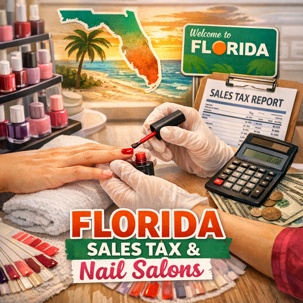
Florida is home to more than 111,000 nail salon businesses — third in the nation behind only California and New York — making the Sunshine State one of the most active nail care markets in the country. With that density comes scrutiny. The Florida Department of Revenue (DOR) regularly audits beauty industry businesses, and nail salons present a unique combination of tax issues that can blindside even the most diligent owner. From the use tax on supplies consumed during services, to the explosive controversy surrounding booth and chair rentals, the sales tax landscape for Florida nail salons is more complicated than most operators realize. If Florida sales tax on chair rentals is the reason you are reading this article – then you have come to the right place!
This article walks through every major Florida sales tax issue affecting nail salons today, with particular attention to the chair rental debate — currently one of the hottest and most legally contested issues in the Florida beauty industry.
The Good News: Nail Services Are Not Taxable
Let's start with what most nail salon owners already know: the core services provided by a nail salon are not subject to Florida sales tax.
Under Florida Administrative Code Rule 12A-1.010, barber and beauty shops are explicitly not required to collect sales tax on the services they provide. This covers manicures, pedicures, gel applications, nail extensions, acrylic sets, and similar treatments. Florida generally taxes the sale of tangible personal property, not services — and nail care falls squarely in the service category.
Nail salons fall under NAICS Code 812113, which covers establishments primarily engaged in providing nail care services such as manicures, pedicures, and nail extensions. None of those service categories appear in Florida's short list of taxable services under Section 212.02, Florida Statutes. So the service itself? You're safe.
But that's where the "good news" largely ends.
Issue #1: Product Sales — Taxable at the Register
While services are exempt, any product sold to a customer at retail is taxable — and the line between "used during a service" and "sold to a customer" is one the DOR watches closely.
Rule 12A-1.010 specifically provides that beauty shops are required to collect sales tax on cosmetics, hair products, nail kits, polishes, ornamental nails, and other items of tangible personal property sold separately. If a client walks out with a bottle of nail polish, a nail kit, press-on nails, or cuticle oil, the salon must collect and remit Florida's 6% sales tax — plus any applicable county discretionary surtax, which can add another 0.5% to 2.5% depending on the county.
Salon owners who carry retail products need to register as a Sales Tax Dealer with the Florida Department of Revenue and collect tax on every qualifying sale. This is a basic compliance requirement, but it is also one of the areas auditors check immediately when they walk in the door.
Issue #2: Use Tax on Supplies Consumed During Services
Here is where many nail salon operators get caught off guard. If you purchase supplies to use on your clients — gels, acrylics, nail files, polishes applied during a service, disinfectants, and similar materials — those are considered consumed in the course of providing services. That means you, the business owner, are treated as the end consumer of those products, and you owe use tax on them.
Per Rule 12A-1.010, the owner or operator of a barber or beauty shop is required to pay use tax on any products or other items that are used or consumed in providing services. Use tax is calculated at the same rate as sales tax: 6% state plus any applicable local surtax.
There are two ways to handle this:
- Pay sales tax at purchase. Buy your supplies at retail, pay the sales tax upfront, and you are done. This is the simplest approach for small operations.
- Use a Resale Certificate and self-report use tax. If your salon sells a significant volume of products to clients, you may want to purchase all inventory tax-free using your Florida Annual Resale Certificate, then charge sales tax when items are sold to clients. However, for any inventory you consume during services rather than sell, you must calculate and self-report use tax each month based on the cost of those items.
The DOR specifically looks at this during audits. If you are buying large quantities of supplies with a resale certificate but your retail sales figures don't match up with expected inventory consumption, you may face an assessment for underreported use tax. Keeping meticulous inventory records is not optional — it is essential.
Issue #3: Chair and Booth Rentals — The Biggest and Most Contested Issue
This is where things get complicated, and frankly, where the most money is at stake for nail salon owners across Florida. The taxation of booth and chair rentals is the single most active and legally contentious sales tax issue in the Florida beauty industry right now.
What Is a Booth/Chair Rental Arrangement?
In many Florida nail salons, the owner does not employ nail technicians directly. Instead, individual technicians pay the salon owner a weekly or monthly fee under a commission agreement. The customers come to and hire the nail salon for services, then the salon assigns a nail tech to the customer. Under the commission agreement, the salon will pay the technician a percentage of what the customer pays the nail salon. The salon owner provides the customers, space, utilities, and sometimes shared equipment. The nail tech provides services to the nail salon’s customers.
This arrangement is extraordinarily common. It reduces the salon owner's payroll burden, gives technicians flexibility, and keeps overhead predictable. But, in the last few years, it has also created a significant sales tax issue under Florida law.
Booth Rentals Were Taxable, according to FL Dept of Revenue
Under Section 212.031, Florida Statutes, Florida imposes sales tax on the lease or license to use commercial real property. When a salon owner charges a nail technician for the right to occupy a specific space in the salon, the DOR has long treated that arrangement as a license to use real property — which was taxable. The typical nail salon could be facing $100,000+ sales tax assessment on this issue
It’s important to note that Florida repealed the sales tax on commercial rent effective October 1, 2025. So, going forward, this is not an issue for nail salons. However, taxes are NEVER that simple. Because a typical Florida sales tax audit goes back 3 years, a nail salon getting an audit notice as of May 2026 will still have 2 ½ years of their audit period where booth rental is still an issue.
Rule 12A-1.070 of the Florida Administrative Code governed licenses to use real property. Under these rules, the total amount charged for the arrangement is subject to Florida's commercial real property rental tax. The tax base includes not just the base weekly or monthly chair fee, but also any additional amounts charged for utilities, shared supplies, or other fees that are part of the rental arrangement.
What this means practically: if a nail technician pays $200 per week to rent a station, the salon owner is supposed to collect sales tax on that $200 — and remit it to the state.
The TIP 24A01-16R Controversy
This is where the issue has become particularly fraught. In late 2024, the Florida Department of Revenue issued TIP 24A01-16R (Taxpayer Information Publication 24A01-16, Revised), a guidance document addressing sales tax rules for hair salons, nail salons, barber shops, and other beauty businesses.
Tax attorneys who practice in this area have been vocal in their criticism. The change reflected in TIP 24A01-16R is not supported by the underlying administrative rules or Florida statutes. In fact, it is arguably contrary to them. A TIP is not law — it represents the Department's opinion on taxability, but it has no force of law in and of itself. Nonetheless, the DOR uses its own published guidance as the basis for audit assessments, which puts salon owners in a difficult position.
If the DOR's revised position holds, booth and chair rental arrangements in nail salons face much larger tax exposure than many owners previously understood.
What Counts as the Taxable "License Fee"?
Salon owners who have been collecting rent from independent contractors but not charging or remitting sales tax on those amounts may be sitting on years of unpaid tax liability — plus interest and penalties.
HOW TO FIGHT THE ASSESSMET ON BOTH RENTAL?
Just because the Florida Department of Revenue interprets the real property rental law in a way to say your commission agreement is really a real property rental does NOT mean that they are correct in their interpretation of the law. In fact, there is a pretty strong position to say that the DOR never had the authority to interpret the law that way. This is because under your commission agreement there is no money flowing from the “renting” nail technician to the “landlord” nail salon. The Florida sales tax statutes and promulgated rules interpreting the rental statute all discuss a sales tax imposed on rental payments coming from the renter to the landlord. There is no promulgated rule that interprets the rental statute to say payments coming from the landlord to the tenant, such as a commission agreement, can be considered taxable rent. The DOR would have to promulgate a whole new rule interpreting the statute for the FL DOR to have that legal authority. Simply issuing a TIP claiming commission agreements are taxable does not work under Florida law. So, this is our cornerstone for fighting back and our law firm has had a lot of success settling cases for pennies on the dollar. There is no guarantee that we will get the same results, of course. But we have not had a single nail salon case settled since 2025 that did not settle very favorably for the nail salon owner. We’ve had CPAs refer their whole nail salon clientele to us so we can fight back. If you are a nail salon owner facing scrutiny from a Florida sales tax audit over your booth agreements, then it is worth a call to our attorneys to discuss how to fight back.
Issue #4: Independent Contractor vs. Employee Classification
Closely connected to the booth rental issue is the reemployment tax question: are your nail technicians really independent contractors?
The DOR pays attention to how a salon structures its relationships with technicians. If the salon owner controls scheduling, dictates pricing, requires a uniform or specific products, or otherwise exercises significant control over how a technician performs their work, those technicians may be reclassified as employees — not independent contractors. That reclassification has payroll tax consequences under Florida's reemployment tax system, and it can also affect how booth payments are characterized for sales tax purposes. The distinction matters because an employee is not considered a renter for Florida sales tax purposes. But an independent contractor could be considered a renter.
This is a particularly troubling tax problem for the Florida nail salon industry because, as I’m sure you know, the nail technicians in Florida all but refuse to be employees. I’ve heard story after story about nail salons trying to force employment contracts on nail techs only to find all their nail techs find work elsewhere. With over 100,000 nail salons in Florida, finding another position is not that difficult. That means, you need to pay particular attention to how you draft commission agreements with your nail technicians. Requiring them to have their own licenses is important. If they have their own legal entity, then it becomes very difficult for the FL DOR to claim the independent contractor is an employee. Having knowledge of the law and planning ahead with good contracts can be the difference between a easy, boring reemployment tax audit or a very scary, expensive one.
Issue #5: New eFile System for Remittances
For salon owners who do collect and remit sales tax — whether on retail product sales, booth rentals, or both — there is an important administrative update to be aware of: Florida migrated to a new electronic filing and payment system in December 2025. The old eFile & Pay portal has been replaced, and saved credentials from the prior system do not carry over. Any salon owner who has not yet registered with the new system should do so immediately to avoid missed filing deadlines. Returns are due on the first of the month following the reporting period, with an automatic extension to the 20th for returns filed and paid electronically.
What to Do If You Are Concerned About Exposure
If any of the issues described above apply to your salon — whether that is unreported use tax on supplies, uncollected sales tax on booth rentals, or questions about employee vs. contractor classification — the Florida Department of Revenue does offer a Voluntary Disclosure Program. Under this program, taxpayers who come forward proactively to report and pay previously unpaid tax liabilities typically have penalties waived. It is one of the most effective ways to resolve accumulated exposure before an auditor appears at your door.
The DOR's audit selection process is data-driven. Salons with mismatched sales figures, high supply purchases relative to reported taxable sales, or booth rental income that never appears on a tax return are the kinds of anomalies that trigger audit selection.
If you are already under a sales tax audit, then NOW is the time to learn as much as you can on how to fight back. Call one of our attorneys today to learn how you can fight back!!!
 About the Author: James Sutton is a Florida licensed CPA and attorney as well as a shareholder in Moffa, Sutton, & Donnini, PA. Mr. Sutton is charge of the Tampa office of the firm and practices almost exclusively in the area of Florida Sales & Use Tax Controversy. Mr. Sutton handles audits, protest, litigation, criminal cases, revocations, collections, and consulting engagements all in the area of sales tax. Mr. Sutton is an active member in the FICPA and Florida Bar Tax Section. Mr. Sutton was also the State and Local Tax Chairman for the AAA-CPA and past president of the Florida AAA-CPA. For 2022 to 2024, Mr Sutton was the Chairman for the State Tax Committee for the FICPA. Otherwise, you can learn more about Mr. Sutton in his firm bio HERE and you call him directly at 813-775-2131.
About the Firm: Moffa, Sutton, & Donnini, PA is a Florida-based state tax law firm that has been around since 1991 focused almost exclusively on Florida state tax controversy. Our attorneys and CPAs have represented Florida businesses — including nail salons, barber shops, tattoo parlors, and hair salons — against the Florida Department of Revenue in audits, protests, and litigation. Contact us for a free initial consultation.
AUTHORITY
TIP 2401-16R – Rentals, Leases, & Licenses to Use Real Property: Sales Tax Implications for Barbershops, Beauty Salons, & Nail Salons
ADDITIONAL RESOURCES
FLORIDA SALES TAX – NAIL SALON RENT TAX, published August 16, 2025, by James Sutton, CPA, Esq.
FLORIDA SALES TAX – REPEAL OF COMMERCIAL RENT TAX, published July 1, 2025, by James Sutton, CPA, Esq.
HELP! – FLORIDA SALES TAX AUDIT, published January 26, 2026, by James Sutton, CPA, Esq.
FLORIDA SALES TAX PROTEST LAWYER, published January 14, 2026, by James Sutton, CPA, Esq.
FL DOR SALES TAX CRIMINAL INVESTIGATIONS – WHAT YOU NEED TO KNOW, published July 1, 2023, by Matthew Parker, Esq.
DON’T HIRE AN IRS ATTORNEY FOR SALES TAX PROBLEMS, published July 17, 2024, by James Sutton, CPA, Esq.
© 2026 James H Sutton, Jr. All Rights Reserved