
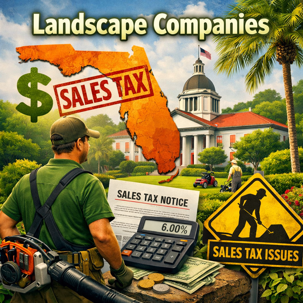
If you run a landscaping business in Florida, you already know the physical demands of the work. What may surprise you — and what surprises a staggering number of landscaping business owners every year — is how complicated Florida sales and use tax can be for your industry. The rules are counterintuitive, the distinctions are subtle, and the Florida Department of Revenue (DOR) has learned exactly where landscapers tend to make mistakes. When an auditor walks through your door, those mistakes become assessments with interest and penalties attached.
This article is written for you — the business owner — not for lawyers or accountants. It is meant to give you a plain-English explanation of how Florida sales tax applies to the most common situations your landscaping business faces every day: installation contracts, materials sales, maintenance services, irrigation work, tree removal, and government jobs. Please note - the wording of your agreements can completely change the taxability of your business. If you finish reading this and realize you have been doing something wrong, please do not wait for the DOR to find it first. There are options available to fix a problem proactively, and the cost of fixing it yourself is almost always far less than the cost of defending an audit.
1. The Single Most Important Concept: Real Property Improvement vs. Sale of Tangible Personal Property
Almost everything in Florida sales tax law for landscapers flows from one fundamental question: Are you improving real property, or are you selling tangible personal property? The answer determines who pays the tax, when the tax is due, and how much is owed.
When you enter into a contract to install landscaping — whether that is laying sod, planting trees, building a retaining wall, installing pavers, or putting in an irrigation system plumbed into the property — that is generally classified as a real property improvement contract. Under Florida law, a real property improvement contract is one where the work becomes a permanent part of the property, expected to stay with the property when it is sold. Think of grass, permanent plantings, hardscaping, plumbed fountains, and permanent irrigation.
For real property improvement contracts, the tax works like this:
- You, the landscaper, are treated as the consumer of all materials you purchase to do the job.
- You must pay Florida sales tax to your suppliers on everything you buy: plants, sod, mulch, pavers, pipe, valves, irrigation heads, and other materials.
- You do NOT charge your customer sales tax on your invoice. Your invoice to the customer is free of sales tax.
- You should NOT give your supplier your Florida Annual Resale Certificate (Form DR-13) for these purchases.
The flip side: when you sell materials to a customer who is doing their own installation — a DIY customer who buys plants or materials from your nursery operation or your yard — that is a retail sale of tangible personal property. In that case, you must charge the customer Florida sales tax on the full retail price of the items sold, and you CAN use your resale certificate when you purchased those items from your own supplier because you are reselling them.
The authority controlling this distinction is Florida Administrative Code Rule 12A-1.048, the specific rule for ornamental nursery stock and landscaping, and Florida Administrative Code Rule 12A-1.051, the general rule governing contractors and real property improvement contracts. Every landscaping business owner should be familiar with both.
2. The Three Types of Contracts — And Why Each One Is Taxed Differently
Florida law recognizes several types of contracts that a landscaper might use. Getting the contract structure right is not just a formality — it directly controls your tax obligations.
2a. Lump-Sum Contracts
A lump-sum contract is one where you charge the customer a single price for the entire job — materials and labor combined — without separately stating what the materials cost and what the labor costs. This is the most common type of landscaping contract, and for real property improvement work, it is treated as a classic real property improvement contract: you pay tax on your materials, and you do not charge your customer tax.
The risk with lump-sum contracts is that landscapers sometimes forget to pay sales tax on their materials purchases. If you gave your supplier your resale certificate and avoided paying tax at purchase, but then used those materials in a lump-sum installation contract rather than reselling them, you owe Florida use tax directly to the DOR on the cost of those materials. Use tax is the mirror of sales tax — if you did not pay sales tax when you should have, use tax steps in to fill the gap. Interest and penalties will apply if an auditor finds the unpaid use tax before you self-report (ie. Voluntary Disclosure).
2b. Itemized ("Retail Sale Plus Installation") Contracts
An itemized contract is one where you separately state, on your invoice, the price of the materials and the price of the labor. Under Florida law, when you use this type of contract for a real property improvement job, the materials portion is taxable but the labor for installation is not. You should collect Florida sales tax from your customer on the itemized price of the materials only. For these contracts, you CAN use your resale certificate when purchasing the materials because you are technically reselling them to the customer.
This is a specific rule addressed in Rule 12A-1.048(2)(d), which makes clear that when a landscaper agrees by contract to sell specifically described and itemized materials at an agreed or retail price, and to complete the work for a separate labor charge, the landscaper is deemed to be selling tangible personal property and must collect tax on the materials price. Getting this wrong — particularly by not charging tax on itemized materials sales — is a frequent audit finding. THIS IS WHY YOUR CONTRACTS MATTER! Our law firm can help with the contracts by contacting someone in the Business Division of our law firm.
2c. Mixed Contracts
Many real-world landscaping jobs are neither purely real property improvements nor purely materials sales. They are mixed — part installation, part retail sale. For example, a job that involves both installing permanent hardscaping and selling the customer portable containers or uninstalled decorative items is a mixed contract.
Under Rule 12A-1.051(8), the taxability of a mixed contract is determined by its predominant nature unless the contract clearly allocates the price between the real property portion and the tangible personal property portion. If the predominant nature is real property improvement, the entire contract is taxed as a real property contract. If the predominant nature is a sale of tangible personal property, the entire contract may be taxable. The safest approach is to clearly allocate the price between the two components in the contract itself and tax accordingly.
3. Maintenance Services: Lawn Care, Fertilization, and Pest Control
Ongoing maintenance services — weekly lawn mowing, edging, trimming, and cleanup — are services, not sales of tangible personal property. A pure lawn maintenance contract does not involve the transfer of tangible personal property to the customer, so the service itself is not subject to Florida sales tax. However, the materials you use to perform the maintenance — gasoline, blades, fertilizers, herbicides, pesticides — ARE taxable when you purchase them because you are the consumer of those items, not your customer.
The complication arises when your maintenance services include the application of fertilizers, herbicides, or pesticides. The cost of these chemicals, when applied to the customer's property as part of a service, is taxable to you at the time of purchase from your supplier. You should NOT use your resale certificate to purchase fertilizers or pesticides that you apply during a maintenance service, because you are the consumer, not a reseller.
If your landscaping company also holds a pest control license and applies pesticides, be aware that this is a heavily regulated and heavily audited area. The DOR pays attention to landscapers who cross into pest control services, and the purchase and use of pesticide products is a common item examined in audits of landscaping businesses. Furthermore, commercial pest control services are subject to Florida sales tax as a service!
4. Plants, Sod, Trees, and Ornamental Nursery Stock — The Details Matter
Florida's specific rule for ornamental nursery stock, Rule 12A-1.048, defines ornamental nursery stock to include all plants, shrubs, and trees customarily sold by nurseries for landscaping purposes, regardless of their state of growth or maturity. Sod and ferns are specifically listed as examples. The sale of ornamental nursery stock is subject to tax — but who pays that tax and when depends on what you are doing with it.
Here is a breakdown of the key scenarios:
- You purchase nursery stock and install it under a lump-sum real property contract: You pay tax when you buy the stock. You do not charge your customer tax.
- You sell nursery stock to a customer who will plant it themselves: This is a retail sale. You charge your customer sales tax on the full selling price, and you may have purchased the stock tax-free using your resale certificate.
- You grow your own nursery stock and use it in a real property contract: “A landscaper who produces his or her own ornamental nursery stock or who obtains stock that was acquired without cost, such as by digging up wild plants in the woods, is not liable for the tax on such stock which he or she uses in fulfilling” lump sum, cost plus, fixed fee, or guaranteed price contracts. Rule 12A-1.048(2)(c).
- Topsoil, peat moss, sand used for rooting, compost, and manure: These are exempt as agricultural products ONLY when sold by the producer. If you buy them from a supplier (not the producer), they are taxable. Fill dirt is always taxable — it is not an agricultural product.
These distinctions cause significant audit adjustments. Many landscapers purchase topsoil or peat moss from a local supplier without paying tax, assuming it is an agricultural exemption. It is not exempt when purchased from someone other than the producer, and the landscaper owes use tax on those purchases.
5. Irrigation Systems and Hardscaping
Irrigation systems present some of the most nuanced Florida sales tax questions in the landscaping industry. The taxability depends on how the system is installed and whether it becomes a permanent part of the real property.
An irrigation system that is plumbed into the property's water supply, buried underground, and connected to the property in a way that removing it would damage the real property is generally a real property improvement. You pay tax on all the components — pipe, valves, heads, timers, controllers — when you purchase them. You do not charge your customer tax on the installation contract.
However, if you sell a portable irrigation system or sell irrigation components to a customer who handles the installation, the analysis changes to a retail sale and you must collect tax on the full selling price.
Hardscaping — pavers, retaining walls, patios, walkways, and permanent structures like pergolas and gazebos — follows the same general rule. These are real property improvements when permanently installed. You pay tax on your materials. The customer does not pay tax on your invoice. However, a portable fire pit or a freestanding decorative item that can be relocated without tools is tangible personal property — a completely different analysis.
The Technical Assistance Advisement process — through which the DOR provides written guidance on specific factual situations — has addressed several landscaping and contractor questions over the years. You can find relevant TAAs on www.floridasalestax.com, where they are indexed and searchable by topic. Reviewing TAAs on contractor and real property issues can be very helpful in understanding how the DOR applies these rules to real-world situations.
6. Tree Removal, Stump Grinding, and Debris Hauling
Tree removal, stump grinding, and debris hauling are services that do not involve the transfer of tangible personal property to the customer. As a result, these are generally not subject to Florida sales tax as far as what you charge the customer. However, the equipment, fuel, and supplies you use in performing these services are taxable when you purchase them from your vendors.
The issue that sometimes arises is when a landscaper bundles tree removal with planting new trees as part of a single contract. In that scenario, the taxability of the entire contract depends on the contract structure — lump-sum real property improvement, itemized sale plus service, or mixed contract — which brings you back to the analysis in Section 2 above.
If you charge separately for hauling away debris and you are paid by the load or by the trip, be aware that the hauling charge may be subject to sales tax in certain circumstances depending on how it is characterized on the invoice. Keeping the debris removal charge clearly tied to the landscaping service contract — rather than treating it as a standalone freight charge or waist container “rental” — is important for documentary purposes.
7. Government and Public Works Contracts
If your landscaping business does work for a city, county, school board, or other governmental entity, the rules change again. Government entities in Florida are generally exempt from sales tax on direct purchases. However, when a contractor — including a landscaping contractor — purchases materials to use in a government job, the contractor is still the consumer of those materials and owes sales tax on the purchase. The government's exemption does not flow through to the contractor's material purchases.
There is a limited exception when the governmental entity issues a Direct Purchase Order (DPO) directly to your supplier and takes title to the materials directly. In that specific structure, the government can use its exemption certificate to purchase the materials tax-free. But this requires careful documentation and coordination between you, your supplier, and the governmental entity. The rules governing public works contracts are found in Florida Administrative Code Rule 12A-1.094, and landscaping contractors are expressly listed as contractors subject to this rule.
Landscaping companies that work on government projects and fail to pay tax on their material purchases — assuming the government exemption protects them — are a recurring source of audit assessments. Do not make this mistake.
8. The Resale Certificate: Use It Right or Pay the Price
Your Florida Annual Resale Certificate (Form DR-13) is a powerful tool — but only when used correctly. Misuse of a resale certificate can result in a 200% penalty of the tax owed, in addition to the tax itself, and in egregious cases can trigger a criminal referral.
As a landscaping business, you should use your resale certificate only when purchasing materials that you will directly resell to a customer at retail — meaning the customer pays you for those items at a sales-taxable price. If you are purchasing materials to install under a lump-sum real property improvement contract, you should pay tax at the time of purchase rather than using your resale certificate.
The practical consequence of misusing your resale certificate is that you avoid paying sales tax at the time of purchase, but then you do not charge your customer tax either (because it is a real property contract). The result is that tax on those materials has been paid to no one — and the DOR will assess you for use tax on the full cost of all materials for which you improperly used the resale certificate.
The rules governing exemption certificates and resale are in Florida Administrative Code Rule 12A-1.038. If you have been misusing your resale certificate, this is one of the first things a DOR auditor will find — and it is one of the most common findings in landscaping audits.
9. What Happens in a Florida DOR Audit of a Landscaping Business
When the Florida DOR selects a landscaping business for a sales and use tax audit, the auditor typically follows a predictable path. The auditor will request your purchase invoices, sales invoices, tax returns, bank statements, resale certificates received and issued, and any contracts you have with customers. The audit period is typically the prior three years.
The auditor will then look for two things: (1) materials purchased using a resale certificate that should have had tax paid on them, and (2) jobs where tax was not charged to the customer but should have been. The auditor may also perform a markup analysis — applying your average margin to your total cost of goods to estimate whether your reported taxable sales are plausible.
Common audit adjustments in landscaping audits include:
- Use tax assessed on materials purchased with a resale certificate that were used in real property contracts.
- Sales tax assessed on materials sold to customers at retail without tax being charged.
- Use tax on fertilizers, pesticides, and chemicals purchased without tax.
- Tax assessed on topsoil, peat moss, or other materials purchased without tax under a mistaken agricultural exemption claim.
- Failure to pay tax on equipment and supplies purchased for use in performing maintenance services.
Interest accrues on any unpaid tax from the date it was due, and penalties can add 10% to 50% of the tax owed. For a landscaping business that has been operating for several years without properly managing its sales tax obligations, the exposure can be substantial.
10. Quick Reference: Which Tax Rule Applies to My Job?
Situation | Who Pays Tax to Vendor? | Charge Customer Tax? |
Lump-sum install (real property) | Landscaper pays tax on materials | No |
Sell materials only – customer installs | Use resale certificate | Yes – full retail price |
Itemized contract (materials + labor) | Use resale certificate on materials | Tax on materials only, not labor |
Maintenance / lawn service | Pay tax on supplies consumed | No (pure service) |
Maintenance w/ pesticides applied | Pay tax on pesticides at cost | No |
Government / public works contract | Depends on contract structure | No – follow Rule 12A-1.094 |
Conclusion: Do Not Wait for the Auditor
Florida's sales and use tax rules for landscaping businesses are genuinely complicated. The distinction between a real property improvement contract and a retail sale of materials drives the entire analysis, and that distinction is not always obvious — especially when you are busy running a business, managing crews, and bidding jobs. The DOR has audited enough landscaping businesses to know exactly where to look and what to find.
If you have read this article and realized that your business may have been handling sales tax incorrectly — whether by misusing your resale certificate, by failing to pay tax on maintenance supplies, or by applying the wrong rules to government contracts — please do not ignore the issue. Florida's Voluntary Disclosure Program allows taxpayers to come forward, pay what is owed, and in most cases avoid the harshest penalties. A qualified Florida sales tax attorney can evaluate your situation, calculate the exposure, and guide you through the voluntary disclosure process or a proactive self-audit before the DOR finds the problem first.
If you have already received a Notice of Intent to Audit Books and Records (Form DR-840) from the Florida DOR, contact a Florida sales tax attorney immediately. The steps taken — and the information provided — in the first weeks of an audit can make an enormous difference in the outcome.
 About the Author: James Sutton is a Florida licensed CPA and attorney as well as a shareholder in Moffa, Sutton, & Donnini, PA. Mr. Sutton is charge of the Tampa office of the firm and practices almost exclusively in the area of Florida Sales & Use Tax Controversy. Mr. Sutton handles audits, protest, litigation, criminal cases, revocations, collections, and consulting engagements all in the area of sales tax. Mr. Sutton is an active member in the FICPA and Florida Bar Tax Section. Mr. Sutton was also the State and Local Tax Chairman for the AAA-CPA and past president of the Florida AAA-CPA. For 2022 to 2024, Mr Sutton was the Chairman for the State Tax Committee for the FICPA. Otherwise, you can learn more about Mr. Sutton in his firm bio HERE and you call him directly at 813-775-2131.
About the Firm: Moffa, Sutton, & Donnini, PA is a Florida-based state tax law firm focused almost exclusively on Florida state tax controversy. Our attorneys and CPAs have represented Florida businesses — including used car dealers, independent auto groups, and buy-here pay-here operations — against the Florida Department of Revenue in audits, protests, and litigation. Contact us for a free initial consultation.
AUTHORITY
All links below go directly to the relevant statutes, rules, or resources on www.floridasalestax.com.
Florida Statutes
[1] Section 212.05, F.S. — Imposition of Sales Tax
[2] Section 212.06, F.S. — Dealer Collection Obligations and Use Tax
[3] Section 212.08(5), F.S. — Agricultural Exemptions
[4] Section 212.12, F.S. — Penalties, Interest, and Best Information Method
[5] Section 212.13, F.S. — Resale Exemption Authority
[6] Section 213.29, F.S. — Responsible Person Penalty (Personal Liability)
Florida Administrative Code Rules
[7] Rule 12A-1.038, F.A.C. — Exemption Certificates and Resale Certificates
[8] Rule 12A-1.048, F.A.C. — Ornamental Nursery Stock and Landscaping Contracts
[9] Rule 12A-1.051, F.A.C. — Contractors and Real Property Improvement Contracts
[10] Rule 12A-1.051(8), F.A.C. — Mixed Contracts
[11] Rule 12A-1.094, F.A.C. — Public Works / Government Contracts
[12] Florida Sales Tax Rules — Full Index
[13] Florida Sales Tax Statutes — Full Index
Technical Assistance Advisements (TAAs)
[14] TAAs — Contractor and Real Property Topics (www.floridasalestax.com)
ADDITIONAL RESOURCES
FLORIDA SALES TAX AUDIT HELP, published January 8, 2025, by James Sutton, CPA, Esq.
FLORIDA SALES AND USE TAX – LANDSCAPER’S GUIDE, published October 12, 2023, by David Brennan, Esq.
FLORIDA SALES TAX – IS LABOR TAXABLE, published October 4, 2025, by James Sutton, CPA, Esq.
© 2026 James H Sutton, Jr. All Rights Reserved.