
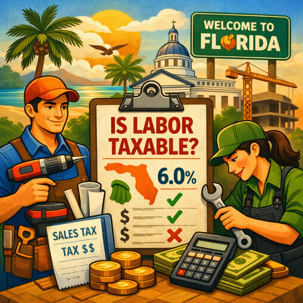
One of the most stubborn myths in Florida business is that labor is never subject to sales tax. I hear it constantly — from contractors, repair shop owners, cleaning company operators, and countless other business owners who have been running their businesses for years under a dangerously incorrect assumption. The reality is that labor is subject to Florida sales and use tax far more often than most people realize, and the Florida Department of Revenue (DOR) has become extremely good at finding exactly the businesses that are getting it wrong.
This article is written for you — the business owner — not for accountants or attorneys. I want to give you a plain-English explanation of when and why labor becomes taxable in Florida, walk through three industries where this issue creates serious audit exposure, and give you enough context to understand whether your business might have a problem worth addressing before the DOR addresses it for you.
The Foundation: Florida Taxes More Than Just "Stuff"
Most people understand intuitively that when you buy a product — a desk, a piece of equipment, a bag of materials — Florida sales tax applies to that sale. What most people do not understand is that Florida law extends taxability well beyond the sale of tangible personal property into three distinct categories where labor becomes taxable.
First, certain services are specifically enumerated in the Florida statutes as taxable. Section 212.05, Florida Statutes, subjects a defined list of services to sales tax regardless of whether any product changes hands. This list includes non-residential cleaning services, pest control services, detective and security services, and others. If your business provides one of these services, you are required to collect sales tax from every commercial customer and remit it to the state. Many businesses in these industries either do not know this or wrongly apply the residential exemption to commercial customers, creating years of uncollected and unremitted tax sitting as a liability on their books.
Second — and this is where the real trap lies for most businesses — Florida taxes the entire charge for a transaction whenever tangible personal property is transferred to the customer as part of a service. This is the famous "one drop of oil" rule. If a mechanic performs $10,000 worth of labor on a customer's vehicle but adds even a single drop of oil during the repair, Florida treats the entire $10,000 transaction as a taxable sale of tangible personal property. The labor does not become a separate, non-taxable component simply because you put it on a separate line of the invoice. The DOR's position is that when a customer receives anything tangible, the entire transaction — labor and materials alike — is subject to Florida sales tax. If you stop and think about it, the DOR had to take this position otherwise everyone would charge $1 for the part and the rest of the purchase price of anything would be allocated to labor to avoid sales tax. This rule applies to auto mechanics, car washes, and interior decorators alike.
Third, Florida imposes use tax on fabrication labor in specific circumstances. Under Rule 12A-1.043, Florida Administrative Code, when a business manufactures or fabricates an item for its own use in a real property improvement contract, the in shop labor component of that fabrication cost is included in the taxable "fabricated cost" on which use tax is owed. This catches manufacturers, cabinet companies, countertop companies, custom fabricators, and similar businesses completely off guard when they face an audit.
Understanding which of these three theories applies to your business — and whether you are properly collecting and remitting (or paying) the associated tax — is the difference between a clean audit and a six-figure assessment.
Why Separate Invoicing Is Not Enough
The single biggest misconception I encounter is the belief that separately stating labor and materials on an invoice will protect a business from tax on the labor portion. In the context of the one drop of oil rule, this is simply not true.
While Florida sales tax is generally analyzed based on the form of the transaction, the DOR and the courts view this type of transaction not based on separate invoices rather on the overriding contract to provide both materials and labor. If a single transaction involves both a service and the transfer of any tangible personal property to the customer, Florida law treats the entire transaction as a taxable sale. A business cannot convert a taxable transaction into a non-taxable one by creative invoicing. The DOR has seen every variation of this strategy, and their auditors are specifically trained to challenge invoice structures that attempt to segregate labor from materials in a transaction where both are plainly present. While separate invoicing can be effective in certain specific situations under Florida law — such as real property improvement contracts structured as "retail sale plus installation" contracts — those exceptions apply in narrow, well-defined circumstances that must be properly structured from the outset. You would need two separate contracts (one for materials and one for labor) that are signed at different times and not co-dependent on each other to have a good shot of avoiding tax on the labor.
Three Industries Where This Problem Is Most Severe
1. Auto Repair Shops and Mechanical Service Businesses
Auto repair shops are one of the most frequently audited industries in Florida, and for good reason. The one drop of oil rule was named for a scenario that happens every single day in every repair shop in the state. A shop performs a $500 brake job. The parts cost $150. The labor is $350. The shop charges tax on the $150 in parts but not on the $350 in labor — a practice many shop owners have followed for years because "labor isn't taxable." When an auditor arrives, the auditor's position is simple: since tangible personal property (the brake parts, the grease, the shop supplies) was transferred to the customer in the same transaction, the entire $500 charge is taxable.
Over a three-year audit period, the uncollected sales tax on labor charges for a busy repair shop can easily reach six figures. The DOR will assess the business for every dollar of sales tax that should have been collected from customers, plus interest that has been running from the date each return was due, plus a penalty of 25% to 50% of the tax. If the shop was collecting some tax but not all of it, those collections may or may not offset the assessment — it depends on whether the invoices can be matched to the taxable transactions.
Repair businesses must charge Florida sales tax on the full invoice price — labor and materials together — any time any tangible personal property is transferred to the customer. The only exception is a transaction where nothing tangible changed hands, and the invoice must clearly document that fact to survive audit scrutiny.
2. Non-Residential Cleaning Companies and Pest Control Services
Under Section 212.05(1)(i), Florida Statutes, non-residential cleaning services are specifically subject to Florida sales tax. This means that a commercial cleaning company is required to collect sales tax on the full charge for cleaning commercial facilities — office buildings, retail stores, restaurants, warehouses, and similar properties. Pest control services to commercial properties are also taxable services under the statute. The entire service charge — which in both cases is predominantly labor — is taxable.
The recurring problem I see in this industry is that cleaning and pest control companies either (a) charge tax on both residential and commercial customers when residential services are actually exempt, creating an overpayment situation, or (b) — far more commonly — fail to charge tax on any of their customers, both residential and commercial, because the owner believes that "service" businesses are not subject to sales tax in Florida. The second error exposes the business to an assessment for all uncollected tax from every commercial customer over the audit period.
Pest control companies face an additional layer of complexity. The chemicals they apply — pesticides, herbicides, rodenticides — are tangible personal property. The purchase of those chemicals to a commercial property as part of a pest control service is a taxable because the company is using the product in the performance of a service. This means there is no ambiguity, a pest control company must charge customers sales tax on the pest control services AND pay sales tax on the purchase of the chemicals.
3. Construction Contractors and Custom Fabricators
The construction industry produces some of the most complex — and most financially significant — labor taxability issues in Florida sales tax law. The general rule in construction is that labor to install tangible personal property into real property as a real property improvement is not taxable; the contractor pays tax on materials and does not charge the customer. However, several specific categories of construction labor break sharply from this general rule.
Most significantly, fabrication labor is taxable. Under Rule 12A-1.043, when a contractor manufactures or fabricates an item in its shop for later installation into a customer's property, use tax is owed on the fabricated cost of that item — and the fabricated cost includes the direct labor used to make it. Cabinet companies, countertop fabricators, custom window and door manufacturers, ornamental iron shops, and similar businesses that both fabricate and install their products are subject to this rule. Many of these businesses have paid tax on materials for years but have never paid use tax on shop fabrication labor, completely unaware that the obligation exists. When an auditor calculates the use tax on years of fabrication labor, the assessment can be staggering.
What To Do If Your Business Has a Problem
If you have read this far and recognized your business in any of these examples, please do not ignore it. The Florida DOR's audit program is active and well-funded. When an auditor selects your business, the lookback period is typically three years, and the assessment will include interest from the date each tax return was due. Penalties can add another 25% to 50% on top.
If you spotted a problem and you have NOT received an audit notice, the good news is that Florida's Voluntary Disclosure Program offers businesses the opportunity to come forward, pay what is owed, and in most cases substantially reduce or eliminate penalties. Coming in voluntarily — before the DOR finds your business — almost always produces a far better outcome than defending an audit. A qualified Florida sales tax attorney can evaluate your situation, estimate the exposure, and guide you through the voluntary disclosure process or help you restructure going forward to minimize future risk.
If you have already received a Notice of Intent to Audit Books and Records (Form DR-840), contact a Florida sales tax attorney immediately. The steps taken in the first weeks of an audit — including what is said to the auditor and what records are provided — can make an enormous difference in the ultimate outcome.
 About the Author: James Sutton is a Florida licensed CPA and attorney, as well as a shareholder in Moffa, Sutton, & Donnini, PA. Mr. Sutton is in charge of the Tampa office of the firm and practices almost exclusively in the area of Florida Sales & Use Tax Controversy. Mr. Sutton handles audits, protests, litigation, criminal cases, revocations, collections, and consulting engagements, all in the area of sales tax. Mr. Sutton is an active member of the FICPA and the Florida Bar Tax Section. Mr. Sutton was the State and Local Tax Chairman for the AAA-CPA, past president of the Florida AAA-CPA, and served as Chairman of the State Tax Committee for the FICPA from 2022 to 2024. You can learn more about Mr. Sutton in his firm bio HERE or reach him directly at 813-775-2131.
About the Firm: The Law Offices of Moffa, Sutton, & Donnini, P.A. is a Florida-based state and local tax law firm that has been fighting the Florida Department of Revenue since 1991. Our attorneys and CPAs practice almost exclusively in the area of Florida tax controversy, representing businesses of every size and industry in audits, protests, litigation, collections, revocation hearings, voluntary disclosures, and criminal investigations. Unlike out-of-state "tax resolution" firms, we are Florida-based professionals with deep knowledge of Florida sales and use tax law — with offices in Fort Lauderdale, Tampa, and Tallahassee. If your business is facing a Florida sales tax issue, contact us for a free initial consultation or call us at 888-444-9568.
Additional Resources
- FLORIDA SALES TAX – IS LABOR TAXABLE? Published: October 4, 2025 | Author: James Sutton, CPA, Esq.
- IS LABOR SUBJECT TO SALES TAX IN FLORIDA? Published: July 2019 | Author: James Sutton, CPA, Esq.
- FLORIDA SALES AND USE TAX FOR TAXABLE SERVICES Published: December 1, 2023 | Author: David Brennan, Esq.
- FL SALES TAX PLAYBOOK: CAR REPAIR SHOPS Published: August 2024 | Author: David Brennan, Esq.
- FLORIDA SALES TAX HANDBOOK: CONSTRUCTION CONTRACTORS Published: October 2019 | Author: James Sutton, CPA, Esq.
- WHAT SERVICES ARE SUBJECT TO SALES TAX IN FLORIDA? Published: May 1, 2012 | Author: James Sutton, CPA, Esq.
- ARE SERVICES TAXABLE IN FLORIDA? Published: September 2, 2020 | Author: Paula Savchenko, Esq.
- FLORIDA SALES TAX: WHAT EVERY LANDSCAPE BUSINESS NEEDS TO KNOW Published: May 7, 2026 | Author: James Sutton, CPA, Esq.
© 2026 James H. Sutton, Jr. All Rights Reserved.
The information in this article is for general informational purposes only and does not constitute legal advice. Nothing in this article creates an attorney-client relationship. For advice specific to your situation, please consult a qualified Florida sales tax attorney.