
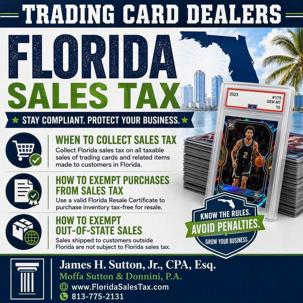
Florida Sales Tax: Trading Card Buyers and Sellers: The Complete Guide
Retail Sales, the Resale Exemption, Out-of-State Shipments, Nexus at Card Shows, and Inadvertent Registration — Everything a Card Dealer or Breaker Needs to Know
By: James H. Sutton, Jr., CPA, Esq.
Law Offices of Moffa, Sutton & Donnini, P.A. — Tampa, Fort Lauderdale, Tallahassee
813-775-2131 | JamesSutton@FloridaSalesTax.com | www.FloridaSalesTax.com
Synopsis: I’ve received an unusually high number of calls recently from Florida based trading card sellers that received a Florida sales tax audit notice. The industry expanded over the last several years, which created an entire new population of dealers, breakers, and card show vendors who have no idea Florida sales tax law even applies to them. It does on your sales, but most likely doesn’t on your purchases. Whether you run a card shop, break sealed boxes live online, or simply buy and sell cards regularly enough to be “in the business” of it, Florida treats you as a dealer with real collection, documentation, and registration obligations. This article walks through when you must charge tax on a retail sale, how to properly document a resale exemption when selling to another dealer, what it actually takes to make an out-of-state shipment tax-exempt, when card show and convention travel creates tax obligations in other states, and the relief available if you have been buying inventory for resale without being properly registered.
I. Are You “In the Business” of Buying and Selling Trading Cards?
The starting point for every card seller is a simple question: are you a hobbyist making an occasional sale, or are you a dealer? Florida law taxes the retail sale of tangible personal property, and trading cards — sports cards, Pokémon, Magic: The Gathering, and every other collectible card — are tangible personal property like any other retail good and subject to Florida sales tax.
An occasional seller who lists off a personal collection every few years is generally covered by the occasional or isolated sale exemption under Rule 12A-1.037, F.A.C. But once a person or business is regularly buying and reselling cards for profit — flipping breaks, buying collections to part out, running a booth at card shows, or operating an online storefront — that regular, repeated activity makes them a dealer under Chapter 212, Florida Statutes, with an obligation to register with the Department of Revenue, collect tax on taxable retail sales, and properly document any exempt sales. In fact, for a Florida based business, the magic number is 3. If you do 3 or more sales of trading cards in a calendar year, then you are considered a retailer on that 3rd sale and become responsible for whether sales tax is collected and remitted to the state on that and every subsequent sale.
II. Retail Sales to Florida Customers
If you are a registered dealer selling a card to the end user — the collector who is buying it to keep, not to resell — that sale is a taxable retail sale. This is true whether the sale happens at a table at a card show, out of a physical shop, or through an online storefront where the card is delivered to a Florida address. Florida sales tax applies to the full sales price, and if you are selling as part of a live break, the tax applies to the amount the customer actually paid for their spot, slot, or hit — not some notional “book value” of the card itself.
III. Selling to Another Dealer: The Resale Exemption
Dealer-to-dealer sales are common in the card industry — a shop selling a bulk lot to another shop, a breaker buying sealed cases from a distributor, or one vendor buying another vendor's leftover inventory at the end of a show. These sales can be exempt from Florida sales tax under the sale for resale exemption, governed by Rule 12A-1.039, F.A.C., but only when the exemption is properly documented.
The buyer must be an active, registered Florida dealer. A buyer who simply says “I'm buying this to resell” is not enough. The buyer must actually hold a current Florida Certificate of Registration and provide the seller with a valid Annual Resale Certificate. A buyer who is not registered cannot make a valid tax-exempt purchase for resale, regardless of their actual intent.
For a one-off sale, the selling dealer should obtain and retain a copy of the buyer's resale certificate at the time of sale. For vendors who regularly sell to the same dealer — for example, a distributor who supplies the same card shop every month — Florida allows the selling dealer to rely on a resale certificate on file without re-verifying it annually, as long as sales to that buyer occur at least once every twelve months. Either way, if the Department of Revenue later determines the buyer was not actually a valid registered dealer at the time of the sale, the burden falls on the selling dealer to show the exemption was properly documented, or the seller becomes liable for the uncollected tax.
IV. Making an Out-of-State Sale Actually Exempt: The Shipping Records That Matter
A huge share of the card business happens online, with cards shipped to buyers all over the country. Florida law allows these out-of-state sales to be exempt from Florida sales tax, but the exemption depends entirely on how the card physically leaves Florida — not simply on the buyer's out-of-state address.
The exemption requires the seller to ship the card out of Florida — not simply sell to an out-of-state buyer. Under Rule 12A-1.0015, F.A.C., a sale of tangible personal property is exempt from Florida sales tax when the seller delivers the property to a common carrier for shipment outside Florida, mails it via United States mail to a destination outside Florida, or delivers it to a licensed forwarding agent for export. This applies whether you ship via USPS, UPS, FedEx, or any other common carrier, and it is exactly how most card sales made through eBay, Whatnot, and similar platforms are structured.
A sale delivered to the buyer in Florida is taxable, even if the buyer says the card is headed out of state. If a customer at a Florida card show buys a card in person and takes it with them, that sale is taxable at the point of delivery, regardless of where that customer lives or where they say the card is going next. The exemption only protects sales the seller physically ships out of the state — not sales where an out-of-state buyer simply picks up the item in Florida.
Because of this, the single most important habit for an online card seller is documentation: keep the shipping label, the tracking number, and proof of the out-of-state delivery address for every exempt sale. That paper trail is what supports the exemption if the Department of Revenue ever asks.
V. Do You Have Nexus in Other States? Card Shows, Conventions, and Selling Online
Card dealers who travel to shows and conventions outside Florida, or who sell online to customers nationwide, need to think beyond Florida's own tax rules and consider whether they have created a tax collection obligation in another state entirely.
Physical Presence Nexus
Setting up a table at an out-of-state card show or convention is a physical presence in that state, even if it only lasts a weekend, and many states treat that kind of temporary trade show and convention activity as sufficient physical presence to create a sales tax collection obligation for sales made at that event. Florida's own case law on this point is actually somewhat favorable to traveling vendors: in Department of Revenue v. Share International, Inc. (Fla. 1996), the Florida Supreme Court held that an out-of-state company whose representative attended a Florida trade show for a few days each year, and properly collected and remitted Florida tax on sales made at that show, did not create broader nexus obligating the company to collect tax on all of its other sales into Florida. The lesson cuts both ways for a traveling card vendor: showing up at an out-of-state show and properly collecting that state's tax on sales made there is generally the safer course, but the protection Share International offers is narrow, is specific to Florida's own facts, and is not something every other state's courts have adopted. Do not assume a single favorable Florida case protects a Florida-based vendor traveling to card shows in other states — each state's own nexus rules control there. As a general rule – if you go to a tradeshow in a state only once in 12 months and you don’t actually sell anything in that state (maybe approve and fulfill order when you get back to Florida), then you most likely do not have nexus in that state.
Economic Nexus
Online card sellers who ship into other states can also trigger a tax collection obligation purely based on sales volume, separate from any physical travel. Florida's own economic nexus threshold, for comparison, is $100,000 in taxable remote sales delivered into Florida during the prior calendar year, with no separate transaction-count requirement. Most other states have adopted a similar dollar-based or transaction-based threshold since the U.S. Supreme Court's Wayfair decision, though the specific dollar amounts and rules vary state by state. The lowest dollar threshold for economic nexus is $100, 000 and most state’s have adopted this threshold. California, on the other hand, has a $500,000 threshold.
Sales made through a registered marketplace facilitator — eBay, Whatnot, and similar platforms that collect and remit tax on the seller's behalf — generally do not count toward the seller's own economic nexus threshold in most states, since the marketplace itself is treated as the collecting dealer on those sales. Cards sold directly, outside of a marketplace platform (for example, through a personal website, Venmo, or direct message sale), do count toward the seller's own threshold. HOWEVER, and this is a big however, if that marketplace facilitator is holding inventory for you, then you have physical presence nexus in every state where you have inventory.
VI. Already Buying for Resale Without Being Registered? There's Relief for That
It is common for a card business to grow organically — someone starts buying wholesale lots and boxes for resale before ever formally registering as a Florida dealer and they end up paying sales tax on all their purchases and not charging tax on any of their sales. If that describes your situation, Florida law provides a path to fix it with meaningfully reduced exposure. It is commonly called “Retroactive Registration” but the statutes refer to it as “Inadvertent Registration.”
Under section 212.07(9), Florida Statutes, a purchaser who bought inventory tax-free in a good-faith belief that the purchase qualified for the resale exemption, but who was not yet registered as a Florida dealer at the time, can apply for inadvertent registration relief. If the purchaser was otherwise qualified to register and does so before the Department opens any audit or inquiry, the mandatory penalty is capped at the lesser of $1,000 or 10% of the tax that would have been due — in place of the full tax, interest, and standard penalty that would otherwise apply. Even if the Department has already begun looking into the matter, relief may still be available at a higher capped penalty of the lesser of $5,000 or 20%, as long as the purchaser registers within seven days of being notified in writing.
This relief is only available before the Department catches the problem on its own, so the sooner a growing card business gets properly registered, the better the outcome if past unregistered purchases come into question. It is very advisable to do any inadvertent registration through a Voluntary Disclosure process to minimize other penalties and cut off the look back period to 3 years. There is a link to a good article on Voluntary Disclosures at the bottom of this article.
VII. Frequently Asked Questions
Do I have to charge Florida sales tax when I sell trading cards?
Yes, if you are a registered dealer selling to the end collector and the card is delivered to the buyer in Florida. Occasional, isolated sales by a hobbyist generally do not require registration, but regularly buying and reselling cards for profit makes you a dealer (3 sales in a year makes you a dealer).
Can I buy cards tax-free from another dealer if I'm going to resell them?
Yes, but only if you are an active, registered Florida dealer and you provide the selling dealer with a valid Annual Resale Certificate at the time of purchase. Simply stating an intent to resell is not sufficient documentation.
If I ship a card to an out-of-state buyer, is that sale exempt from Florida sales tax?
Generally yes, as long as you as the seller physically ships the card out of Florida via a common carrier, USPS, or a licensed forwarding agent, and you keep documentation such as the shipping label and tracking information (tied to sales invoice). A sale where the out-of-state buyer picks the card up in person in Florida is still taxable.
Does attending an out-of-state card show create a tax obligation in that state?
It can. Many states treat even temporary trade show or convention presence as physical presence sufficient to require sales tax registration and collection for sales made at that event. Florida's own courts have taken a narrower view of how far that presence extends to a vendor's other sales, but that Florida-specific ruling does not necessarily apply once you are selling at a show in a different state. Typically, one show a year in a state is not enough to create nexus and tax collection obligations.
Do sales through eBay or Whatnot count toward my economic nexus threshold in other states?
Generally no. Sales made through a registered marketplace facilitator are typically excluded from the seller's own economic nexus calculation, since the marketplace is treated as the collecting dealer on those sales. Direct sales made outside a marketplace do count.
What if I've been buying inventory for resale without ever registering as a Florida dealer?
Section 212.07(9), Florida Statutes, provides inadvertent registration relief that caps the penalty at the lesser of $1,000 or 10% of the tax due if you register before the Department opens any inquiry. This relief is time-sensitive and is not available once the Department has already caught the issue on its own.
About the Author
 James H. Sutton, Jr., CPA, Esq. is a State and Local Tax (SALT) attorney/CPA and practices almost exclusively in the area of Florida sales and use tax controversy. James is a Shareholder at the Law Offices of Moffa, Sutton & Donnini, P.A. and has been a licensed Certified Public Accountant since 1994 and a member of The Florida Bar since 1998. For 20 years, Mr. Sutton has served as an Adjunct Professor of Law at Stetson University College of Law, teaching State and Local Tax, and also taught Sales and Use Tax at Boston University School of Law's LLM in Taxation program. If you have any questions, then Mr. Sutton has a FREE INITIAL CONSULTATION policy. He can be reached directly at 813-775-2131 or JamesSutton@FloridaSalesTax.com.
About the Firm
The Law Offices of Moffa, Sutton & Donnini, P.A. is a Florida law firm that practices almost exclusively in the area of Florida state and local tax (SALT) controversy, with offices in Tampa, Fort Lauderdale, and Tallahassee. Collectively, the firm's attorneys bring over 200 years of combined experience handling Florida sales tax audits, protests, and litigation. Learn more at www.FloridaSalesTax.com.
Additional Resources
- Florida Sales Tax Audit Help — June 20, 2026, by James H. Sutton, Jr., CPA, Esq.
- Florida Sales Tax Criminal Investigations: When Sales Tax Experience Matters — June 2026, by James H. Sutton, Jr., CPA, Esq.
- Do I Have to Charge Florida Sales Tax When I Sell at Wholesale? — June 7, 2026, by James H. Sutton, Jr., CPA, Esq.
- Florida Sales Tax – Inadvertent Registration: What It Is and How It Can Save Your Business — June 5, 2026, by James H Sutton, Jr. CPA, Esq.
- Florida Sales Tax Sales for Resale Exemption — December 1, 2023, by David Brennan, Esq.
- Florida Sales Tax Voluntary Disclosure: The Best Way to Clean Up a Florida Sales Tax Problem — May 26, 2026, by James H. Sutton, Jr., CPA, Esq.
© Copyright 2026. James H Sutton, Jr. All rights reserved.