
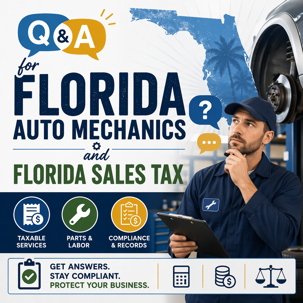
The Florida Department of Revenue has been targeting the auto mechanic industry for a couple of years now. My name is James Sutton. I’m a CPA and Attorney that does almost nothing but Florida sales tax controversy. I’ve represented well over 100 auto repair shops over the last few years and the problems are fairly consistent across the board. Below are the typical questions we get with answers – all focused on your industry. If you have further questions or need help navigating your sales tax audit, then please take advantage of my free initial consultation (contact information at the end of the article).
Q: Does an auto repair shop have to charge Florida sales tax on labor?
Yes, in almost every case. Florida law treats the labor charge on a repair job as taxable whenever any tangible personal property is transferred to the customer as part of the transaction. If your technician installs a part, adds a fluid, or applies any material to the customer's vehicle — even incidentally — the entire invoice, including labor, is subject to Florida sales tax. The only exception is a purely hands-on service where nothing tangible whatsoever transfers to the customer, which is extremely rare in auto repair.
Q: What is the "one drop of oil" rule in Florida sales tax?
The "one drop of oil" rule is the FL DOR's position that if even the smallest amount of tangible personal property is placed on a customer's vehicle during a repair — even a single drop of oil — the entire transaction becomes taxable as the sale of tangible personal property. This means a shop cannot carve out its labor charges as non-taxable simply because the customer supplied all the major parts. As long as the shop contributes any material to the job, the full charge is subject to sales tax.
Q: What happens if an auto repair shop has been charging sales tax on parts but not on labor?
The FL DOR will assess tax on the full amount of every invoice where labor was charged without tax, for the entire audit period — typically three years, but up to five in fraud cases. The assessment will include the unpaid tax itself, interest currently accruing at approximately 11% per year from the original due date, and a minimum 10% penalty (but up to 200% penalty). Because the sales were made years ago, the shop generally cannot go back and collect the tax from customers, meaning the entire assessment comes out of the business's pocket.
Q: How does the Florida Department of Revenue find auto repair shops that are not charging sales tax correctly?
The FL DOR compares IRS Form 1099-K data — which shows total credit and debit card receipts reported by payment processors — against the shop's Florida sales tax returns. If a significant gap exists between total revenue and reported taxable sales, the shop is flagged for potential audit. The department also receives referrals from former employees, competitors, and other state agencies, and conducts industry-wide audits when a pattern of non-compliance is identified in the auto repair sector.
Q: Can the FL DOR hold the shop owner personally liable for unpaid sales tax?
Yes. Under Florida's responsible party provisions (Sec. 213.29, F.S.), the FL DOR can pursue individuals who had control over the collection and remittance of sales tax — including owners, officers, and managers — for the business's unpaid tax liability. This can apply even after the business has closed or lacks sufficient assets to pay the assessment. Personal liability does not require intentional fraud; having the authority and failing to ensure proper tax collection is generally sufficient. The penalty is 200% of the tax not remitted by the business to be imposed on each and every responsible person. This is why you can’t simply walk away from a business’s sales tax problems.
Q: What is Florida's Voluntary Disclosure Program and can an auto repair shop use it?
Florida's Voluntary Disclosure Program allows businesses that have unreported or underreported sales tax to come forward proactively, before an audit begins, and resolve their liability. In exchange for self-disclosure, the program typically offers a reduced look-back period and the possibility of penalty waiver. For an auto repair shop that has not been charging tax on labor and wants to clean up the problem before the FL DOR discovers it, voluntary disclosure is often significantly less costly than waiting for an audit. The program is not available once an audit has already been initiated.
Q: Can I go to jail for Florida sales tax?
Yes: Florida has some rather serious criminal statutes focused on sales tax fraud, aka “intentional theft of state funds.” As little as $301 of collected but not remitted sales tax can get you up to 5 years in jail. Over $20,000 and you are looking at 15 years in jail. More than $100,000 of collected but not remitted sales tax can get you a whooping 30 years in jail. Failure to file 6 consecutive sales tax returns can also get you 5 years in jail. Florida has an entire, statewide criminal investigation unit and they arrest over 1,000 people a year for sales tax fraud. The investigators usually show up at your business with no warning. So, this something to take very seriously. I don’t recommend talking to the investigator. It does not take many questions to get you to admit to every element of the crime of sales tax fraud.
ABOUT THE AUTHOR
 James H. Sutton, Jr., CPA, Esq. is a shareholder at the Law Offices of Moffa, Sutton & Donnini, P.A., one of Florida's preeminent state and local tax law firms, with offices in Fort Lauderdale, Tampa, and Tallahassee. Mr. Sutton holds dual credentials as a Certified Public Accountant and a Florida-licensed attorney, and his practice is devoted exclusively to Florida sales and use tax controversy — representing businesses from the initial audit notice through protest, litigation, and criminal defense before the Florida Department of Revenue. He has taught Florida sales and use tax to CPAs, attorneys, enrolled agents, and law school students, and has authored hundreds of articles on the FloridaSalesTax.com blog addressing complex tax issues across virtually every Florida industry. Mr. Sutton has represented auto mechanics in sales tax audits and has an in-depth understanding of the unique compliance challenges this industry faces. He can be reached at 813-775-2131 JamesSutton@FloridaSalesTax.com or through the contact form at www.FloridaSalesTax.com.
ADDITIONAL RESOURCES
FL AUTO MECHANIC – HIRE A SALES TAX ATTORNEY, published May 26, 2026, by James H Sutton, Jr, CPA, Esq.
FL SALES TAX PLAYBOOK: CAR REPAIR SHOPS, published August 2024, by David Brennan, Jr, Esq.
FL AUTO MECHANIC – LABOR IS TAXABLE, published May 23, 2026, by James H Sutton, Jr., CPA, Esq.
FL SALES TAX – AUTO MECHANICS: WHAT YOU DON’T KNOW WILL HURT YOU, published April 21, 2026, by James H Sutton, Jr., CPA, Esq.
FLORIDA SALES TAX VOLUNTARY DISCLOSURE: THE BEST WAY TO CLEAN UP A FLORIDA SALES TAX PROBLEM, published May 26, 2026, by James H Sutton, Jr., CPA, Esq.
© 2026 Copyright. James H Sutton, Jr. All rights reserved.