
TAA 24A-022 Impact-Resistance Doors, Garage Doors, and Windows
REQUESTED ADVISEMENT
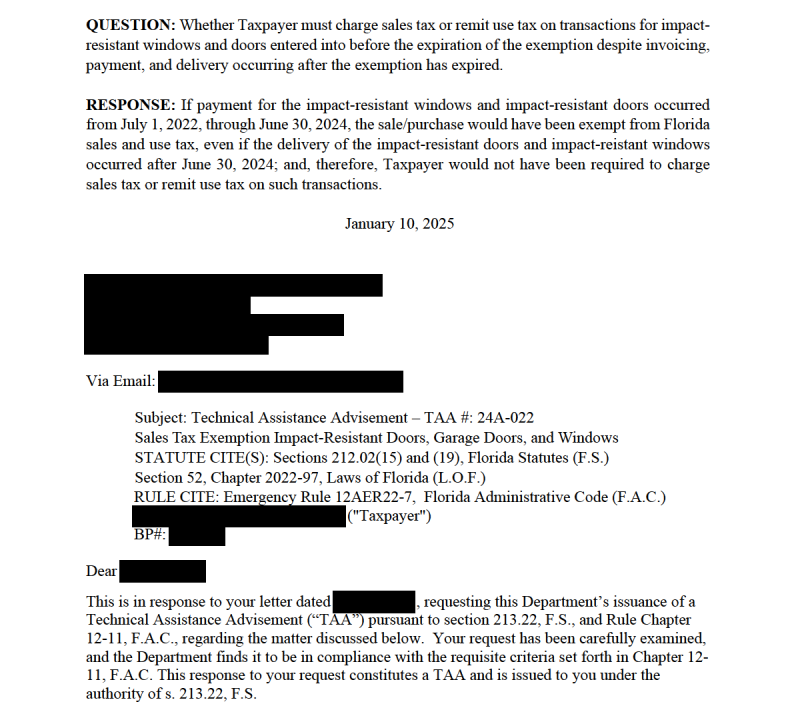
Whether Taxpayer must charge sales tax or remit use tax on transactions for impact-resistant windows and impact-resistant doors entered into before the expiration of the exemption despite invoicing, payment, and delivery occurring after the exemption has expired.
FACTS
Taxpayer is engaged in the business of purchasing and selling windows as well as doors. Some of the windows and doors Taxpayer purchases and sells are impact-resistant. Taxpayer will sell the impact-resistant windows and doors solely as a sale of tangible personal property (i.e., no installation services). In other instances, Taxpayer will sell the impact-resistant windows and doors via a real property improvement contract in which Taxpayer provides the labor and materials to permanently attach said items to the realty.
When Taxpayer purchases the impact-resistant windows solely for the purpose of reselling the tangible personal property, Taxpayer will present its Florida Annual Resale Certificate to the vendor and then collect Florida sales tax from its customer, barring an exemption from sales tax being applicable. For real property improvement contracts, Taxpayer will pay sales tax to its vendor on the acquisition of the materials, unless an exemption applies, and not charge its customer any sales tax.
Currently, Taxpayer does not charge its customers sales tax on sales of impact-resistant windows and doors when sold solely as tangible personal property. Moreover, Taxpayer does not pay sales tax or remit use tax on the acquisition of impact-resistant windows and doors when used to complete a real property improvement contract by Taxpayer. Both occur due to a temporary sales and use tax exemption for impact-resistant windows and doors set to expire after June 30, 2024.
TAXPAYER POSITION
Generally, sales of tangible personal property are subject to sales tax. Section 212.05, Florida Statutes (“F.S.”). The use, consumption, distribution, and storage for use or consumption in Florida of tangible personal property is subject to use tax. Section 212.06(1)(a), F.S.
Contractors are the ultimate consumers of materials and supplies used to perform real property improvement contracts. Rule 12A-1.051(4), Florida Administrative Code (“F.A.C.”). As such, contractors must pay tax on their cost of the materials and supplies. Id. However, the tax levied under chapter 212, Florida Statutes, may not be collected from July 1, 2022, through June 30, 2024, on the retail sale of impact-resistant windows, doors, and garage doors. 2022-97 FLA. LAWS § 52.
The aforementioned exemption includes orders made and accepted during the exemption period based on a binding contract despite title, possession, control, and delivery occurring after the exemption period expires and delivery delay is beyond the control of the purchaser. TECHNICAL ASSISTANCE ADVISEMENT #22A-015 (Aug. 17, 2022).
Here, and as it relates to Taxpayer’s sales of impact-resistant windows and doors solely as tangible personal property, Taxpayer must receive orders from its customers on or before June 30, 2024. To qualify as being exempt, the customer may not have requested any delay. Regardless of when invoicing, payment, and shipment occur, the sale of the impact-resistant windows and doors will be exempt from sales and use tax.
Concerning Taxpayer’s purchases of impact-resistant windows and doors pursuant to a real property improvement contract, Taxpayer must have placed the order to its vendor on or before June 30, 2024. To qualify as being exempt, Taxpayer may not have requested any delay. Regardless of when invoicing, payment, and shipment occur, the sale of the impact-resistant windows and doors to Taxpayer for real property improvement contracts will be exempt from sales and use tax.
LAW AND DISCUSSION
Unless a specific exemption applies, s. 212.05, Florida Statutes (“F.S.”), provides that it is the legislative intent that the sale1 of tangible personal property2 in this state is subject to tax. The tax is due and payable at the rate of 6 percent, plus any applicable surtaxes imposed under s. 212.055, F.S., on the total consideration for each item or article of tangible personal property when sold at retail.3
A sale is defined as the transfer of title or possession of property for consideration. In Florida, tax is due and collectible upon each retail sale, unless an exemption applies.4 The tax is collectible from all dealers5 upon each retail sale, is collected from the purchaser,6 and applies “as of the moment of sale.”7 The taxes collected by a dealer from a purchaser become state funds at the moment of collection.8 Accordingly, it is clear that the imposition of tax is triggered by payment received by the dealer from the purchaser. It is axiomatic that the time of payment (i.e., purchase) is also when any applicable exemption applies.
The Sales Tax Exemption Period on Impact-Resistant Doors, Garage Doors, and Windows was established through the lawmaking authority of the Florida Legislature. The exemption period for the retail sale of impact-resistant doors, garage doors and windows was provided in section 52 of Chapter 2022-97, Laws of Florida 9 (”L.O.F.”). The exemption provided under s. 52 of Chapter 2022-97 L.O.F. and Emergency Rule 12AER22-7(1)(b), F.A.C., pertains to the retail sale of an “impact-resistant window,” “impact-resistant door,” and “impact-resistant garage door” which means, “a window, door, or garage door labeled as impact resistant or has an impactresistance rating.”
For the purposes of this exemption, it is not required that delivery took place during the holiday period for the transaction to qualify for the exemption. All that is required is that the retail sale took place during the exemption period, July 1, 2022, through June 30, 2024. Therefore, if payment to the dealer for the impact-resistant windows and impact-resistant doors occurred from July 1, 2022, through June 30, 2024, the sale/purchase would be exempt from Florida sales and use tax.
It may be possible that Taxpayer’s operations include “remote sales” as defined in Emergency Rule 12AER22-7, F.A.C. For the purposes of this exemption, a “remote sale” means a retail sale of tangible personal property ordered by mail, telephone, the Internet, or other means of communication from a person who receives the order outside of this state and transports the property or causes the property to be transported from any jurisdiction, including this state, to a location in this state. For purposes of the emergency rule, tangible personal property delivered to a location within this state is presumed to be used, consumed, distributed, or stored to be used or consumed in this state. See Emergency Rule 12AER22-7(1)(c), F.A.C.
Under Emergency Rule 12AER22-7(7), F.A.C., regarding remote sales, provides:
(a) Eligible items purchased through a marketplace provider or from a remote seller are exempt when the order is accepted by the marketplace provider or remote seller during the sales tax exemption period for immediate shipment, even if delivery is made after the sales tax exemption period.
(b) An order is accepted by the company when action has been taken to fill the order for immediate shipment. Actions to fill an order include assigning an “order number” to a telephone order, confirming an Internet order by an email to the customer, or placing a date received on an order received by mail.
(c) An order is considered to be for immediate shipment when delayed shipment is not requested by the customer. An order is for immediate shipment even if the shipment may be delayed because of a backlog of orders or stock is currently unavailable or on back order.
Thus, for a remote sale to be made exempt, a purchaser’s order must also be accepted during the exemption period for immediate shipment (or without a requested delay to outside the exemption period), even if delivery is made outside the exemption period.
CONCLUSION
If payment for the impact-resident windows and impact-resistant doors occurred from July 1, 2022, through June 30, 2024, the sale/purchase would have been exempt from Florida sales and use tax, even if the delivery of the impact-resistant doors and impact-resistant windows occurred after June 30, 2024, and therefore, Taxpayer would not have been required to charge sales tax or remit use tax on such transactions.
This response constitutes a TAA under s. 213.22, F.S., which is binding on the Department only under the facts and circumstances described in the request for this advice, as specified in s. 213.22, F.S. Our response is predicated on those facts and the specific situation summarized above. You are advised that subsequent statutory or administrative rule changes, or judicial interpretations of the statutes or rules, upon which this advice is based, may subject similar future transactions to a different treatment than expressed in this response.
You are further advised that this response, your request and related backup documents are public records under Chapter 119, F.S., and are subject to disclosure to the public under the conditions of s. 213.22, F.S. Confidential information must be deleted before public disclosure. In an effort to protect confidentiality, we request you provide the undersigned with an edited copy of your request for TAA, the backup material and this response, deleting names, addresses and any other details which might lead to identification of the Taxpayer. Your response should be received by the Department within ten (10) days of the date of this letter.
Leigh L. Ceci, MAcc
Tax Law Specialist
Office of Technical Assistance
1) Section 212.02(15), F.S., defines the term, “sale,” as any transfer of title or possession, or both of tangible personal property for a consideration.
2) Section 212.02(19), F.S., defines the term, “tangible personal property,” as personal property which may be seen, weighed, measured, or touched or is in any manner perceptible to the senses.
3) Section 212.02(14)(a), F.S., defines the term, “sale at retail,” as a sale to a consumer or to any person for any purpose other than for resale in the form of taxable tangible personal property.
4) Section 212.21(2), F.S., provides the legislative intent to “tax each and every sale, admission, use, storage, consumption, or rental levied and set forth in this chapter, except as to such sale, admission, use, storage, consumption, or rental as shall be specifically exempted therefrom by this chapter subject to the conditions appertaining to such exemption. . . .”
5) Section 212.06(2), F.S., defines the term “dealer” expansively and in great detail. For the purpose of this advisement, it is noted that s. 212.06(2)(c), F.S., describes the term to include “every person, as used in this chapter, who sells at retail or who offers for sale at retail, . . .”
6 Section 212.07(1)(a), provides that “[t]he privilege tax herein levied measured by retail sales shall be collected by the dealers from the purchaser or consumer.”
7) Section 212.06(1)(a), F.S., provides that “[t]he aforesaid tax at the rate of 6 percent of the retail sales price as of the moment of sale, 6 percent of the cost price as of the moment of purchase, or 6 percent of the cost price as of the moment of commingling with the general mass of property in this state, as the case may be, shall be collectible from all dealers as herein defined on the sale at retail, the use, the consumption, the distribution, and the storage for use or consumption in this state of tangible personal property or services taxable under this chapter. The full amount of the tax on a credit sale, installment sale, or sale made on any kind of deferred payment plan shall be due at the moment of the transaction in the same manner as on a cash sale.”
8) Section 212.15(1), F.S., provides that “[t]he taxes imposed by this chapter shall, except as provided in s. 212.06(5)(a)2.e., become state funds at the moment of collection . . . .”


